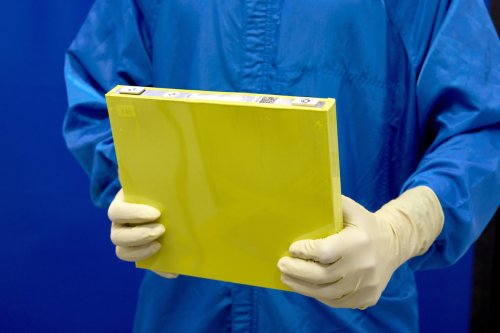
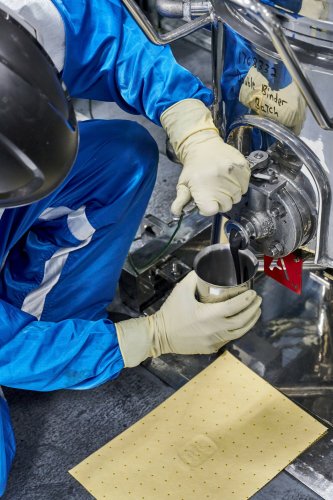
BYD Executive Vice President Stella Li being interviewed by carwow.es. Credit: Carwow.es Understand China EV’s Market Real-time notifications when critical EV data is released All important data in one place 2,000,000+ data points Become a member BYD plans to have a vehicle using its solid-state battery technology next year, Executive Vice President Stella Li said in an interview with Carwow.es in Valencia, Spain. The statement sets a near-term demonstration target but does not establish a retail launch or mass-production timeline. “Any battery technology, I guarantee you will find in one corner of BYD R&D; we are studying that,” Li said. “So, talking about solid-state battery, BYD is in the leading position; we’re in the leading position for the commercial line, and for the technology. So to prove that, even next year we will have one model that will be the first model with this technology there.” Li emphasised that BYD’s battery division is studying not only cell chemistry, but also “manufacturing capability and the equipment design.” However, she did not provide a production date, vehicle name, battery specifications or performance figures, leaving the announcement at the technology-demonstration stage. Sulfide chemistry still faces engineering hurdles FinDreams is pursuing an inorganic sulfide solid-electrolyte route based on materials including lithium phosphorus sulfur chlorine (LPSC). The company has also reported 20 Ah and 60 Ah solid-state cell prototypes targeting energy density approaching 400 Wh/kg, but cell-level figures do not establish equivalent pack performance. Sulfides offer high ionic conductivity, but moving from laboratory cells to automotive packs introduces additional engineering challenges. Solid-solid interfaces can lose contact as electrodes expand and contract, creating impedance and capacity-retention problems. Some sulfide architectures therefore require sustained mechanical stack pressure, adding requirements for pack structure and compression control. A battery installed in a running vehicle must withstand vibration, temperature changes and repeated charge-discharge cycles while maintaining its mechanical and thermal operating conditions. A vehicle demonstration therefore tests system integration as well as cell technology. Manufacturing presents another hurdle. Conventional wet electrode processing uses solvents that can react with sulfide electrolytes, pushing development toward dry electrode processes based on PTFE fibrillation. FinDreams has been working with domestic equipment suppliers on this approach at pilot facilities, but scaling it to high-volume production remains a separate challenge. Moisture exposure is another concern because sulfide electrolytes can generate hydrogen sulfide (H₂S) during hydrolysis. Moisture control and sealed cell and pack environments are therefore important during manufacturing and vehicle operation. Recent China National Intellectual Property Administration filings also show work on composite cathode structures and interfaces between sulfide and halide solid electrolytes, as CarNewsChina previously reported. BYD enters a wider solid-state race Toyota is targeting a 2027–2028 market launch for BEVs using all-solid-state batteries through its partnership with Idemitsu Kosan, while Samsung SDI is targeting all-solid-state battery mass production in 2027. The timelines do not establish which company is ahead. The key challenge is moving from pilot-scale development and vehicle testing to reliable, scalable production. The Roadmap Extends Beyond Next Year FinDreams Battery Chief Technology Officer Sun Huajun has outlined small-batch trials involving roughly 1,000 vehicles around 2027, with large-scale commercial production targeted around 2030. Early applications are expected to focus on higher-end platforms, including Yangwang and flagship Denza vehicles, where the additional cost of early solid-state technology is easier to absorb. Specialised sulfide precursors currently cost dozens of times as much as conventional liquid-electrolyte materials, pressuring cell economics and manufacturing scale-up. BYD is also developing its solid-state technology within China’s All-Solid-State Battery Collaborative Innovation Platform (CASIP), a government-backed industry and research initiative linked to an estimated 830 million USD state R&D program. BYD Chief Scientist Lian Yubo has said liquid lithium-ion batteries and all-solid-state systems could coexist for 15 to 20 years, pointing to a longer transition rather than an immediate replacement of conventional batteries. Next year’s vehicle will test whether BYD’s sulfide technology can perform outside the lab. Mass production remains a much later step on the company’s roadmap. Most important news in your inbox. Recaps · scheduled All you need, in one email. Instant alerts · real-time Ping me when an article goes live. 0 of 27 topics selected Bundle into one email per day — instead of one email per article No spam · Unsubscribe with one click · Change settings anytime


































![Watt's up, doc? Huddig hybrid loader gets a big battery boost [video]](https://cdn.topcarnews.net/thumb/id/aHR0cHM6Ly9pMC53cC5jb20vZWxlY3Ry-ZWsuY28vd3AtY29udGVudC91cGxvYWRz-L3NpdGVzLzMvMjAyNi8xMC9odWRkaWct-aHlicmlkX21haW4uanBnP3c9MTUwMCZh-bXA7cXVhbGl0eT04MiZhbXA7c3RyaXA9-YWxsJmFtcDtzc2w9MQ/ea51c544798341190a5eed718aab1ee3.jpg?t=20261004&post_id=67784)