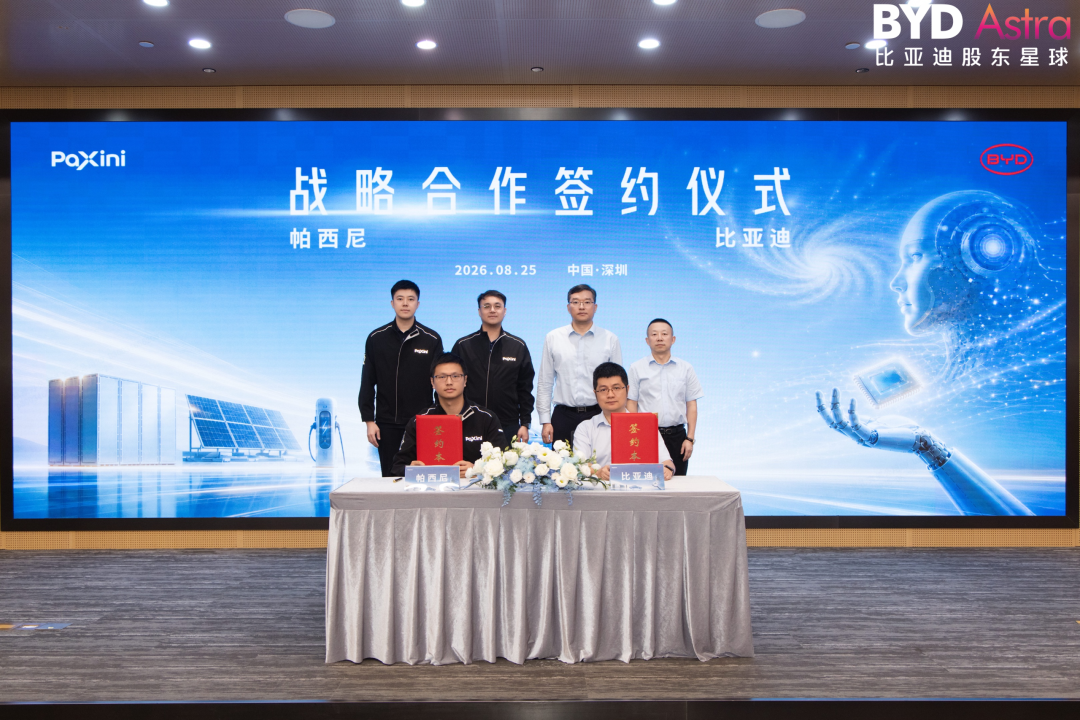



















Gasgoo Munich- BYD has signed a strategic partnership agreement with PaXini Tech, a company specializing in tactile perception and humanoid robotics. By leveraging their respective strengths, the two parties will collaborate deeply on data collection and robotics to drive tangible breakthroughs in industrial manufacturing scenarios.Specifically, BYD will draw on its deep automotive manufacturing expertise—including complex vehicle and component production processes, vast factory environments, and supply chain resources—to provide a realistic industrial testing ground for robotics. At the same time, the automaker will feed massive amounts of real-world operational data back into large model training, continuously iterating on generalization and decision-making capabilities to lay a solid foundation for large-scale robot deployment.For its part, PaXini will rely on its proprietary experience in tactile sensors, multi-dimensional perception, and full-modal embodied data collection to equip robots with "nerve endings."Image Source: BYDThis partnership goes deeper than a typical collaboration. As early as April 2025, BYD invested in PaXini, becoming its second-largest shareholder with a 7.95% stake. The shift from "shareholder" to "strategic partner" signals a further deepening of the relationship between the two.Founded in 2021, PaXini's founding team traces its roots to Sugano Laboratory at Waseda University in Japan—the birthplace of the world's first humanoid robot. Over the past few years, PaXini has leveraged its deep accumulation of force-tactile sensing technology to break through critical bottlenecks in China's high-end sensor sector. The company has achieved a leap from reliance on imports to global leadership, successfully developing a series of world-class tactile products.To date, PaXini has established a complete technological loop spanning "perception hardware, dexterous hands, data collection, embodied large models, and robot bodies."According to data previously released by the company, PaXini's consumption of self-developed tactile chips approached 1 million units over the past year, demonstrating strong validation on both supply and demand sides. Meanwhile, its massive repository of full-modal data has been adopted by several leading embodied intelligence foundation model companies and major internet tech giants.