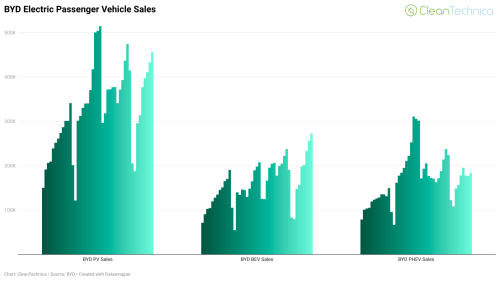
CN122200729A describes a baseline-image comparison method for vehicle underside monitoring. Credit: CNC Understand China EV’s Market Real-time notifications when critical EV data is released All important data in one place 2,000,000+ data points Become a member BYD has published a new patent covering underbody living-organism detection, revealing how the automaker is extending computer-vision technologies beyond driving assistance and battery systems into vehicle safety monitoring. The patent was published by China’s National Intellectual Property Administration on June 12 under application CN122200729A, reported IThome. Baseline Imaging Forms The Core Detection Method The patented system captures an image of the vehicle’s underside when the vehicle is powered down and stores it as a reference image. Subsequent real-time images are compared against that baseline. Instead of continuously analysing the entire underbody area, the system first identifies regions that differ from the stored reference image. Those different regions become target images for further analysis. The architecture reduces unnecessary processing by keeping static components, such as suspension parts, battery enclosures, aerodynamic panels, and structural members, unchanged between scans. Computational resources can therefore focus only on newly detected objects or movement beneath the vehicle. After isolating the changed region, the system extracts feature-detection information, determines whether a living organism is present, and evaluates its status. Computer Vision Targets A Difficult Detection Environment Detecting living organisms beneath vehicles poses challenges distinct from those of conventional occupant-monitoring systems. Underbody environments contain shadows, changing lighting conditions, road debris, dirt accumulation, and varying ground surfaces. Traditional motion-detection systems often struggle to distinguish between harmless environmental changes and genuine biological movement. BYD’s baseline-comparison approach effectively creates a customised reference map for each parked vehicle. Rather than relying solely on object classification, the system first identifies environmental changes and then applies recognition algorithms to determine whether those changes correspond to an animal, person, or other living target. This two-stage architecture improves detection specificity while reducing false positives generated by static objects. Part Of A Broader Vehicle Monitoring Strategy The patent is not an isolated development. BYD recently disclosed another invention for detecting forgotten occupants inside a vehicle using radar channel impulse response data, frequency-domain features, and angle-of-arrival analysis. Together, the two systems address opposite sides of the vehicle. One monitors occupants left inside the cabin, while the new patent focuses on living organisms located beneath the vehicle. The strategy suggests that BYD is building a broader sensing ecosystem that combines computer vision, radar processing, and intelligent monitoring. A similar diversification is evident elsewhere in the company’s technology roadmap. In May, BYD published a sulfide solid-state battery patent targeting next-generation energy storage, while June brought the launch of its first German 1,500 kW flash-charging station as part of a planned 3,000-site European network. Why The Timing Matters The publication adds to a growing list of BYD patents focused on sensing, monitoring, and vehicle intelligence. In addition to the underbody detection system, the company recently disclosed a method for detecting forgotten occupants inside a vehicle using radar-based signal analysis. Together with recent filings covering solid-state batteries and charging technologies, the patent illustrates the breadth of BYD’s current research activity. However, publication of a patent application does not indicate production deployment. No vehicle application, launch timeline, or commercialisation plan was disclosed in the document. Sales Context China EV DataTracker data shows BYD’s sales remain spread across a broad range of models. The Sealion 06 led the lineup in May with 18,856 deliveries, reflecting the scale at which new software and safety technologies could be deployed across the brand’s portfolio.