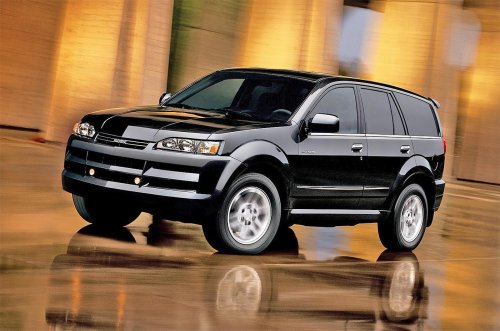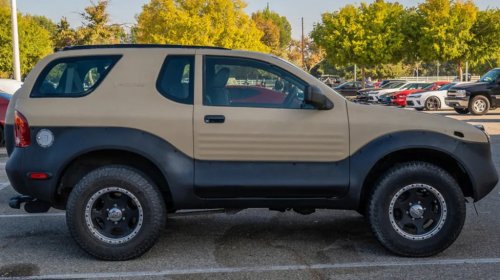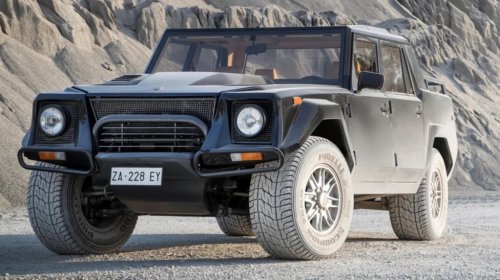
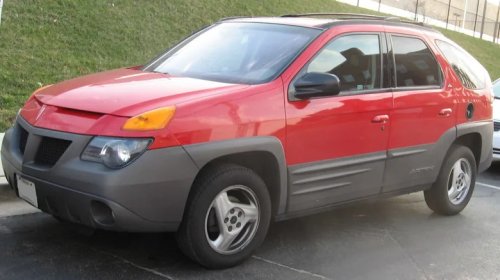
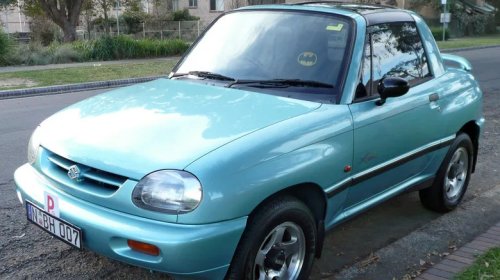
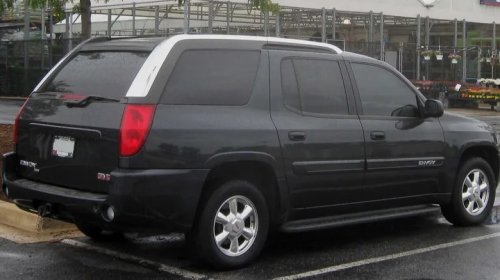
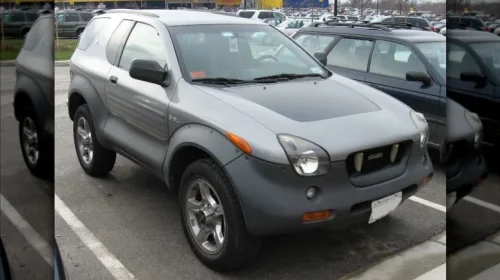
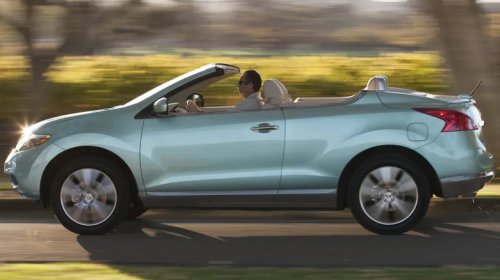
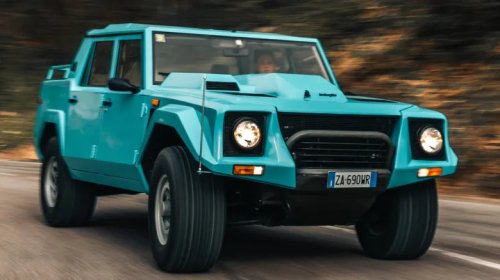
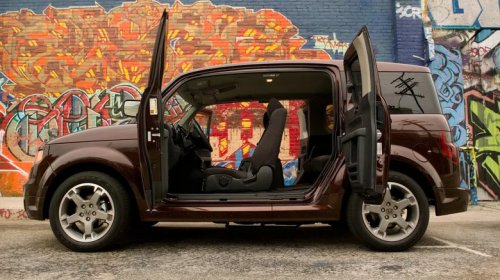
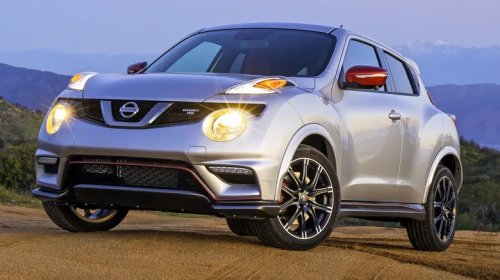



















LamborghiniUnsurprisingly the list of best-selling vehicles is currently dominated by SUVs. As someone who drives a nice sensible Civic, I constantly lose my car in shopping center parking lots full of blobby crossovers, since even a RAV4 can eclipse my little ride. So it's hard to remember that as late as the first decade of the 2000s, cars like sedans made up more than half of sales, with SUVs relegated mainly to the more northerly reaches of the Snow Belt. Yet now the most popular vehicle type in 48 states is the SUV.Perhaps the segment was so new from the '80s through the Oughts, and even a bit beyond, that manufacturers weren't yet completely sure what an SUV should be. I'm just speculating here, but this could be why they were willing to take chances on some fairly radical designs. Today, SUVs have converged mainly on rounded-off family trucklets — tall station wagons, really, which is ironic since the marketing for the earliest truck-based SUVs presented them as alternatives to station wagons for people who didn't want to drive Carol Brady's car.It's almost as if convergent evolution in the marketplace selected for bland crossovers. But in days gone by, you could find SUV convertibles, a military-grade Italian supercar SUV, and other designs so awkward that they were almost bound to become cult classics. Here are eight of the most unconventional SUVs, along with a wish that this kind of creativity would return to showrooms.AdvertisementAdvertisementRead more: These Are The Cars That Scream 'I Peaked In High School'Pontiac AztekIFCAR/Wikimedia CommonsYou knew the Aztek would be on this list, and I knew you knew the Aztek would be on this list. I figured if I didn't put it at the top, half of you would have hit Ctrl+F "Aztek" to jump right to it, so let's get it over with here. Arguably the ugliest American vehicle ever built, at least its appearance in "Breaking Bad" also gave it the cachet of being the personal ride of New Mexico's biggest fictional meth dealer. Yet if it weren't for its two-bagger appearance, it would have been a decent SUV.For a vehicle built between 2001 and 2005, it offered surprisingly modern styling. No, seriously. This refers not to the strange double grille or the awkward squared-off lower body cladding that clashes with the angular styling of the front end, but to its overall shape. That profile is basically what most SUVs wear today. It even made our readers' list of the most influential car designs of all time for inspiring the "crossover coupe" trend. Plus, under the skin, it was downright appealing.Though it was an SUV, Pontiac based the Aztek on a minivan platform, giving it a very spacious interior. In fact, it offered a generous 93.5 cubic feet of cargo space. Plus, the cabin was loaded with useful features like a center console with a built-in cooler, a sliding cargo tray, and family-friendly options like a DVD player. A tent accessory converted the Aztek into a camper, and optional all-wheel drive meant it could get to your favorite camping spot.Suzuki X90OSX/Wikimedia CommonsSuzuki called the X-90, introduced in 1995, "the world's first two-seater SUV coupe." It's a reasonably safe bet that no one was racing to beat them to market with that concept. No one quite knew what to make of it at the time, and most of us still don't. Multiple sources today compare it to a cross between a Miata and an SUV. For example, Driving Line calls it "the Mazda Miata of 1990s 4x4s."AdvertisementAdvertisementI always thought it looked vaguely like the weekend ride of the Great Gazoo from "The Flintstones." Great minds think alike, because at the X-90's U.S. debut in 1996, Car and Driver referred to it as a "comic-book car," saying it should have been called the Platypus. The magazine tagged it with "looks like nothing else" in both the "highs" and "lows" of its review, perfectly encapsulating how polarizing its appearance was. The little ute had high points, though, including a "Camryesque" cabin, modern safety features, and a very stiff body, considering it had T-tops.C&D also found it to be surprisingly competent off-road. From there, however, the review gets less flattering. Downsides included a harsh ride "tuned more to suit a pickup than a car," an underpowered 95-horsepower engine, and a trucklike manual shifter. Nevertheless, let's give Suzuki props for trying something bold and different.GMC Envoy XUVIFCAR/Wikimedia CommonsThe GMC Envoy XUV experiment lasted for two model years, 2004 and 2005. It attempted to be the Swiss Army knife of vehicles: an SUV with a retractable roof that converted it into a pickup truck, sort of. Key to this conversion was a power retractable roof panel that slid forward to uncover the cargo area, after which a folding midgate could separate the cargo area from the passenger compartment or be left flat (with the rear seats also folded flat) for maximum cargo volume.Thus configured, the Envoy XUV offered slightly over 95 cubic feet of cargo space. But really, with the open roof, cargo space was basically infinite. Need to move Grandma's antique china cabinet to the consignment shop? Stand it up in the back of the Envoy XUV. If you hauled 30 filthy bags of mulch the previous weekend, no problem. Just rinse the bed out first, taking advantage of a built-in drainage system.AdvertisementAdvertisementThe downsides of this extra capability included the loss of the regular Envoy's third-row seating and the addition of 90 pounds of extra weight located high above the truck's center of gravity, which wasn't great for handling. Plus, as often happens with the oddball SUVs on our list, folks just didn't quite "get it." So they didn't buy it. Sales were slow, and the Envoy XUV lasted just two years.Isuzu VehiCrossIFCAR/Wikimedia CommonsYou could fool a lot of people today by swapping badges on many SUVs; there really isn't much design variation. In the 1990s, however, Isuzu completely threw out the SUV design rulebook with the 1997 through 2001 VehiCross. This wild, compact SUV racked up design accolades, including Motor Trend's "Most Unique Styling" award, along with rally victories, including the Australian Safari Rally and the granddaddy of off-road races, the Paris-Dakar Rally. And yet, the VehiCross has largely faded into history.It had a love-it-or-hate-it exterior design. If you loved it, you adored its bulging fenders, its short overhangs, and the vampire-like fangs in its grille. If you hated it, you despised its bulging fenders, its short overhangs, and the vampire-like fangs in its grille. Plus haters probably had legitimate beef with the black plastic cladding that wrapped the entire lower half of the vehicle. On the other hand, that detail gave the VehiCross a spiffy two-tone appearance. In short, perception of its styling was entirely subjective.Its rally victories hint at something objectively good, though: the VehiCross was a very capable off-roader. With a gutsy V6, a sophisticated torque-on-demand four-wheel-drive setup, and factory monotube shocks, the VehiCross was ready for off-road racing right out of the showroom.Nissan Murano CrossCabrioletNissanOkay, we've praised risk-taking SUV manufacturers, but seriously, Nissan: Who was asking for this? And why didn't you refer them to a therapist instead of building this thing for them? It's easily a candidate for top 10 strangest vehicles of the modern era. In our postmortem of the Nissan Murano CrossCabriolet's failure, we concluded that it "failed because it should have never happened." We noted that the loss of the rear doors and the diminished structural rigidity from removing the B-pillar (the post behind the front door) pretty much negated the practical advantages of an SUV.AdvertisementAdvertisementMotor Trend's amusingly harsh retrospective on the CrossCabriolet's brief run (from 2011 through '14) notes that "it flexes and shakes over bumps due to its lack of structural rigidity" and that the extra ride height of an SUV serves no purpose in a convertible. One staffer declared it "destined to go down in history as the most stupid vehicle of 2011." Don't hold back, MT — tell us what you really think!Was there anything good about it? Well, it had a 265-hp V6 engine, which was decent for the time, although it was pulling around a fairly hefty vehicle. It sported a nicely finished interior with comfortable front seats, although the overall interior space was tight. A couple of years ago, we found a 2011 Murano CrossCabriolet for sale for only $4,600, with just one minor flaw — the roof didn't work. Which kind of eliminates its sole justification for existence.Lamborghini LM002LamborghiniThe Rambo Lambo! Nowadays, it isn't news when a supercar manufacturer makes an SUV. But back in the 1980s, boy howdy, the Lamborghini LM002 was a step out of the mainstream. Lamborghini built a prototype in conjunction with U.S.-based Mobility Technology International to pitch to the world's armed forces. The result was the Cheetah, a batpoop-crazy four-wheel-drive with a rear-mounted 5.9-liter V8. After legal issues resulting from its similarity to another company's prototype vehicle — which ultimately became the U.S. military's HMMWV — Lamborghini dropped the project.Under new ownership, the project was revived. It resulted in the LM002, a front-engined, V12-powered supertruck that created the concept of an ultra-high-end luxury SUV. Nowadays, new SUVs with 600 or more hp from manufacturers like Ferrari, Rolls-Royce, and Lamborghini itself are common (within the context of supercars, anyway), but at its debut, the LM002 was completely, wonderfully unique.AdvertisementAdvertisementWhat else should you know about the LM002? Well, it was produced from 1986 to 1992. Its "base" 5.2-liter V12 produced 444 hp, good for an aerodynamically limited top speed of 130 mph. If that wasn't powerful enough for you, legend has it that there was an LM004 variant with a 7.2-liter V12 sourced from boats, but there isn't much reliable information available on it. LamboCars says only one was built, so it may have been just a prototype. Anyway, the 5.2-liter V12 was probably sufficient unto the needs of its day.Honda ElementHondaWith the recent news that the Honda Element is returning in 2029, it's a great time to take a look back. The Element was an oddball, make no mistake, but it was arguably the most versatile and useful compact SUV of its era, if not every era. Consider its trick seating, which offered nearly limitless flexibility. Both rows of seats could be folded flat to make a bed for camping, while the rear seats could be swung around and stowed flat against the sides or removed altogether. The Element was versatile enough to be a true "lifestyle" vehicle.If that lifestyle involved passengers with muddy paws, the floors were designed for easy cleaning. Add in pillarless clamshell doors for super-easy access to the back, and it was a cinch to load everything you needed for a camping weekend, or old furniture to take home and refinish, if that was your thing. Waterproof seats could handle wetsuits or wet bathing suits.The Element's boxy exterior sometimes featured composite body panels that may not have been everyone's cup of tea, but they certainly upped the little ute's quirkiness factor. Power came from a 160-hp four-cylinder with Honda's i-VTEC technology, and four-wheel drive was available. The Element was produced in a single generation between 2003 and 2011.Nissan JukeNissanThe Nissan Juke's face has always reminded me of a frog, with its fender-topping headlights being the eyes. Its wildly bulging fenders suggest that it's squatting on a lily pad. Or maybe it's just me? In any event, if the original Juke was a step out of the styling mainstream, wait until you see the design of the new Nissan Juke EV that's going on sale in Europe next year — it's all angles and planes and wild two-tone color contrasts.AdvertisementAdvertisementThe Juke drove much better than it looked, especially its Nismo variant. It offered either 197 hp or 215 hp (the latter being on tap in the Nismo RS), both of which were substantial upgrades from the base model's 188-hp turbo. The Nismo RS offered Recaro bun buckets and a synthetic suede and Alcantara-lined interior. Transmission options included a CVT or a six-speed manual, the latter of which was only available with front-wheel drive. Motor Trend measured a 6.4-second 0-60 time and a skidpad grip of 0.87 g, which isn't too shabby for an SUV.The Juke went on sale in the U.S. in 2010, and for a few years it moved about 35,000 to 39,000 units per year. After that, though, sales started declining. Did everyone who wanted one get one, or as people saw them on the road, did familiarity breed contempt? In any event, after selling just over 10,000 units in 2017, Nissan discontinued the Juke in the U.S. Europeans love it, though, and it remains on sale there.Want more like this? Join the Jalopnik newsletter to get the latest auto news sent straight to your inbox, and follow us or add us as a preferred search source on Google.Read the original article on Jalopnik.