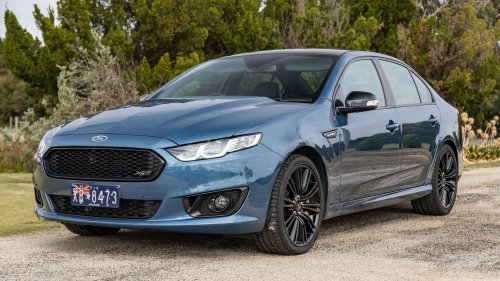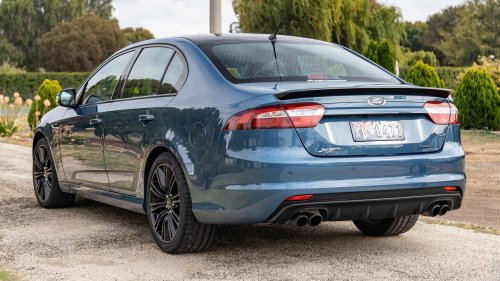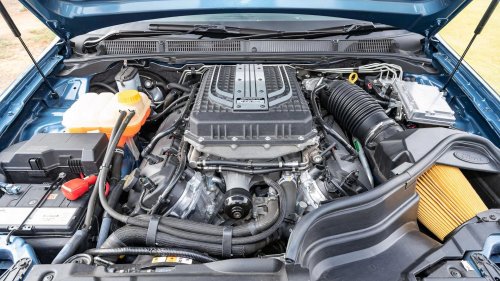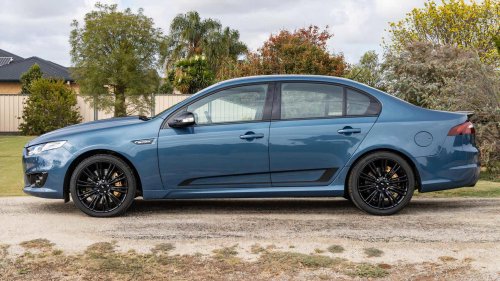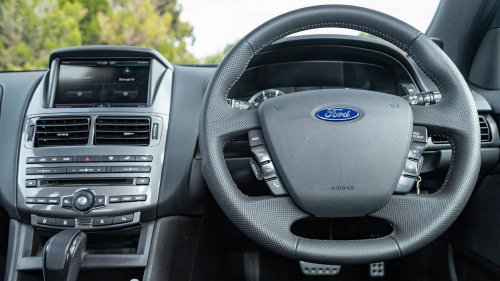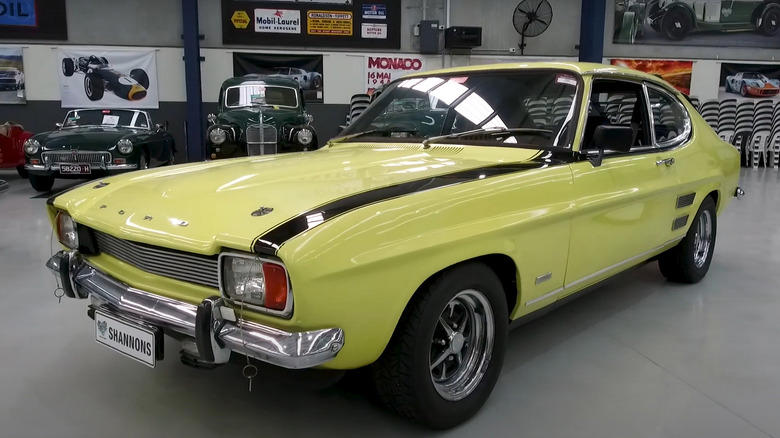





















When you think of Fords with V8 engines, you're likely thinking American muscle cars. The USA is where many of the best V8-powered Fords have come from, so that's not surprising. What a lot of people often forget, though, is that V8 Fords aren't exclusive to America. In fact, some V8 Fords were never available to American customers.The V8 Fords on this list come from several different eras and several different territories. Most of them are from the southern hemisphere, and are a mixture of classic carsand modern cars. But, there's one V8-powered classic here that's from a country Americans might be surprised to see a V8 Ford from. Ford Capri Perana Car and ClassicIf you know anything about Ford's European model lineup in the '60s and '70s, you'll know all about the Ford Capri. Europe's equivalent to the Mustang, the Capri was an affordable sporty coupe that had some great engine choices. But, none of them were a V8. That is, if you lived in Europe, anyway. If you lived in South Africa, you could get a version of the Capri that had the same 5-liter V8 that Americans got to enjoy in the Mustang! This version is called the Ford Capri Perana, and it was the brainchild of Basil Green Motors.Basil Green Motors hails from Edenvale (near Johannesburg), and back then, they raced Fords in domestic racing series in South Africa. They were great at preparing Fords for the race track, and that included being very good at anything to do with engines. The Capri Perana was initially available with the Essex V6. But, after Ford decided to make that a standard engine on the Capri, the team at Basil Green Motors decided they needed something more powerful. That's where they got the idea to give it the Windsor V8 from the Mustang. In the Capri Perana, this produced around 281 bhp and around 300 lb-ft of torque. That went through either a 4-speed Ford Toploader manual transmission or a 3-speed Ford C4 automatic transmission.The Ford Capri Perana has become a very desirable car in the years since it was made. Considering the absolute unicorn this car is, that's not surprising. It's one of the best examples of the European and American sides of Ford coming together, facilitated through a small company based all the way down in South Africa. Ford Falcon GT (XB) Australianmusclecarsales.com.auThe Ford Falcon XB GT is a car that needs no introduction if you know about your Australian muscle cars (or, alternatively, if you're a fan of a certain movie franchise). This was a proper Ford Australia-built car, featuring a 5.8-liter Cleveland V8 that produced 300 bhp and 380 lb-ft of torque. That power went to the rear wheels through either a 4-speed manual or a 3-speed automatic transmission.What non-Aussies will know this car best for is its role in the classic dystopian road movie Mad Max and its sequel. The Ford cars featured in the movie were based on the Falcon. That led to the Falcon becoming a famous car outside its homeland, and its desirability got pushed through the roof as a result. Some other non-Aussies may also know the Falcon XB GT through the story of the example owned by Australian actor Eric Bana. Bana has owned his Falcon GT since he was basically able to drive, and it's easily his most prized possession. Ford Falcon XR8 (FG) Skwirril, via Wikimedia CommonsUp until Ford Australia stopped making its own cars in 2016, the Ford Falcon was one of the biggest names in the Australian car market. It competed directly with the General Motors-produced Holden Commodore, which was also built in Australia. The rivalry between the two Australian arms of these American automakers was truly tribal. This fully reared its head at the annual Bathurst 1000 V8 Supercars race, where the fans would get properly violent at times.The FG generation of the Ford Falcon was produced between 2008-2016. A facelift happened in 2014, where its looks got brought in line with the design language of Ford's more global models. There were multiple performance versions of the Falcon, but the one we're interested in here is the XR8. This initially had a 5.4-liter V8 that produced 389 hp and 380 lb-ft of torque. This version of the XR8 was discontinued in 2010 due to emissions regulations. The XR8 name didn't stay gone, however, as it came back when the FG Falcon was facelifted. The new version of the XR8 had a supercharged 5-liter V8 (known as the Miami V8) that produced 449 hp and 420 lb-ft of torque. Both these versions of the XR8 gave you a choice between having a good old-fashioned 6-speed manual transmission or a 6-speed automatic.While the XR8 may not have been a massive sales success (the XR6 turbo, powered by the 4-liter Barra Turbo turbocharged inline-6 engine, was a much bigger seller - it had similar performance to the XR8 and better handling thanks to the engine not being as heavy), it's still really cool to know that Ford made something like this exclusively for Australasia. Ford Falcon XR8 Ute (FG) The FG-generation Ford Falcon XR8 was cool enough as a sedan. But, since this was a car especially made for Australia and New Zealand, it came in ute form as well! This competed with the Holden HSV Maloo ute built by General Motors, and the rivalry between ute enthusiasts was just as tribal as between those who loved the sedans! The XR8 ute had the same engine options as the sedan version, and the same transmission options as well. This meant a ute-style pick-up truck making between 349 and 422 hp, depending on model year.. That's something that you typically wouldn't see in America these days - at least not since the era of trucks like the Chevrolet El Camino SS. Ford Granada Perana The Ford Capri wasn't the only Ford that Basil Green Motors put a V8 into. It also had a go with the Ford Granada, putting that same 5-liter Windsor V8 into this European executive car. The Ford Granada Perana could go from 0-60 mph in 7.8 seconds and onto a top speed of around 129 mph. These were very impressive figures for a car like that at the time.The Granada Perana became a favorite of Ford's chairman Lee Iacocca, and Ford Cologne even bought a couple of them to evaluate whether it would be worth selling it in Europe as well. Unfortunately, the oil crisis of the 1970s, which ruined of many cars during that period, put any plan to start selling the Granada Perana outside of South Africa to bed forever. Ford Landau Sicnag, via Wikimedia CommonsAnother Ford that was exclusive to Australasia, this car is possibly the most American non-American car to ever exist! It's known as the Ford Landau, and it was produced between 1973-1976. It was based on the platform of the XA and XB generations of the Ford Falcon, and also had a rear end that was similar to that of the P5-generation Ford LTD. It was intended to be a luxury coupe, similar to the Ford Thunderbird of the time that Americans got.It was powered by the same 5.8-liter Cleveland V8 as the Ford Falcon XB GT mentioned earlier, producing 290 bhp. The Landau was only available with a 3-speed automatic transmission, but it had a system that allowed you to manually shift the gears if you wanted. Like the Ford LTD of the time, the Landau was one of the first Australian cars to be fitted with disc brakes all around. Ford Sierra XR8 The third car from South Africa on this list, the Ford Sierra XR8, was an incredibly special car that only existed because of motorsport. The domestic touring car championships in South Africa in the 1980s used Group N regulations. As a result, all the cars that competed in it needed to be based on production road cars. To create something that could compete in South Africa's Group One championship against cars like the BMW 745i and Alfa Romeo GTV 3.0, Ford decided to put a small block V8 from the Ford Mustang into the Ford Sierra. The Sierra XR8 was born, and it ended up becoming a South African legend.That 5-liter Mustang engine produces anywhere between 200-216 hp and 243-276 lb-ft of torque, depending on who you ask. This results in a 0-60 time of 6.5-7 seconds (again, depending on who you ask) and a top speed of over 140 mph. This gave it performance that wasn't far off the legendary Sierra RS500 Cosworth that was sold in Europe, a car that was also raced in touring car championships. Ford Pilot Calreyn88, via Wikimedial CommonsWhen you think of a car with the name "Pilot", your mind might be cast to the Honda SUV with that name that's a very common sight on North American roads. This Pilot is very different, though! The Ford Pilot was the first large car built by Ford UK in the post-WWII era. It was based on the chassis of the pre-war Model 62, and produced between 1947-1951 at Ford UK's plant in Dagenham. The Pilot was also built and sold in Australia, imported both as fully-assembled cars and as knock-down kits that could be assembled locally. Pilots that were assembled locally were built at Ford Australia's plant in Geelong.The Ford Pilot came with two different V8 engines. The first was 2.2 liters in size and produced 60 hp, while the second was a 3.6-liter unit that produced 85 hp. The 3.6 was a Dagenham-built version of the legendary "Flathead" engine that was used over in America, while the 2.2 was a smaller unit that was designed to get around British tax penalties on bigger engines. This is a practice that the pre-war Model 62 also used, although its 2.2-liter V8 in that car was completely different from the one in the Pilot.One of the most interesting things about the Ford Pilot is that it was available in a wide variety of body styles. Most Pilots were 4-door sedans, but there were also quite a few "woody" station wagons made. One of those station wagons was a personal car of King George VI of Britain, and it's displayed in the British royal family's motor museum on their Sandringham estate. More utilitarian versions of the Pilot were produced in pick-up truck and panel van format, and Australia got its own Ute version of the car. Some coachbuilders even made Pilot hearses.To any Americans reading this, it might seem odd that this car would become such a normal sight on British roads. But, the American-looking Pilot with its Flathead V8 engine somehow managed that. The Pilot had a rare space in the British car market as a choice for both the wealthy who wanted a powerful and comfortable sedan or station wagon, and as a utilitarian workhorse for anyone who needed a smaller van or pick-up truck. Plenty of Pilots are still running today, and their owners take great pride in them.Sources: Basil Green Motors, Ford