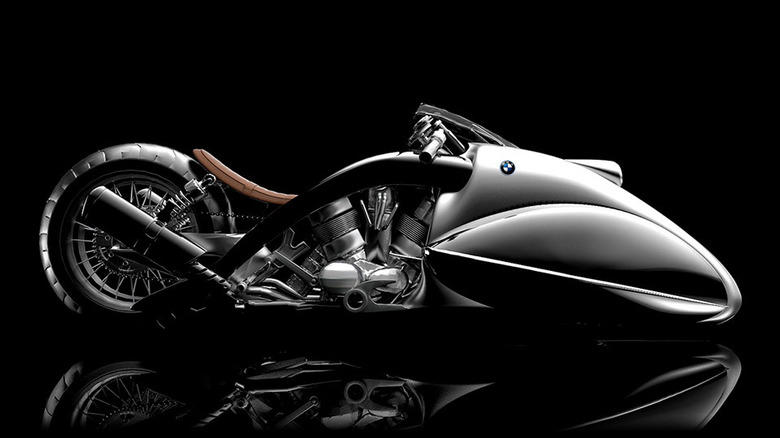
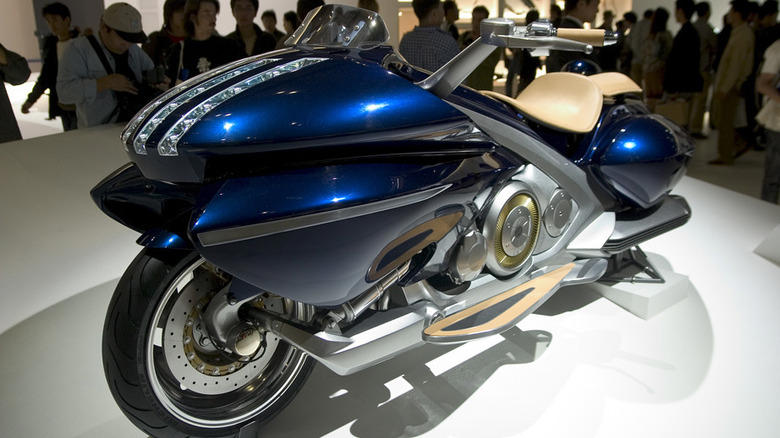
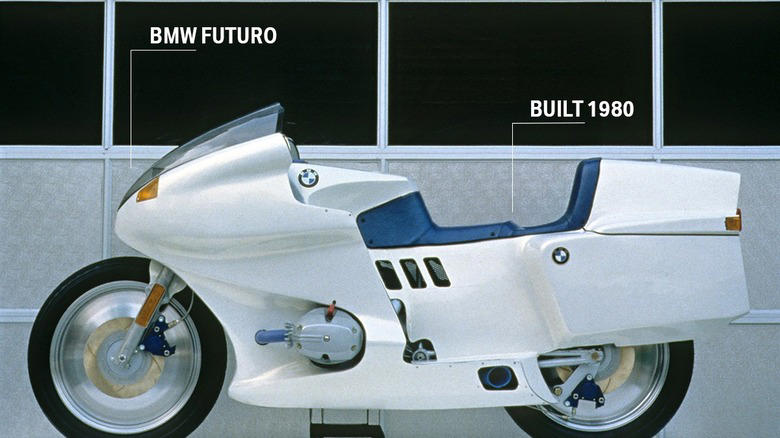



















BMW Apollo StreamlinerHere's something every motorcycle enthusiast has probably idly wondered at least once: "What would happen if you strapped a rocket to a motorcycle?" In real life, probably something very bad, but with a bit of creativity, you can get within spitting distance of the idea. For instance, could you create a bike designed exclusively with speed in mind, something rocket-like without actually strapping a rocket to it? The answer is yes, more or less, and that answer came about in the form of the BMW Apollo Streamliner.Conceptualized by industrial designer Mehmet Doruk Erdem, the Streamliner was designed for one thing and one thing only: going fast on salt flats. While the rear and middle of the bike are fairly normal, notwithstanding the exposed engine and shocks, the front is what draws the eye. The Streamliner's front is covered by a large shroud which resembles the angled nose of a bullet train. This shroud is designed to slice through the wind and ensure the highest possible speed. Of course, since it's so low to the ground, even a slight bump would send the vehicle toppling, which is probably why it was never actually assembled.Yamaha Gen-RYUAlongside electric cars, electric motorcycles have gradually been making themselves known in the automotive world, seeking to bring the same kind of freedom and muscle you'd expect from a bike without all the exhaust. However, automotive makers have been tinkering with the idea of a motorcycle powered at least partially by electricity for decades, with one notable example being Yamaha's Gen-RYU concept.Originally unveiled at the 2005 Tokyo Motor Show, this smooth number looks almost like something you'd find with a Batman action figure on at the toy store, and has the bells and whistles to match. The main attraction of the Gen-RYU was its continuously variable transmission, which allowed it to switch on the fly between its traditional gas motor and an internal electric battery. In addition to that, the Gen-RYU possessed several early versions of smart features that are common on current vehicles, like voice-activated navigation, a vehicle distance warning, hands-free cell phone pairing, and more. The Gen-RYU could be considered a precursor to many modern motorcycle design paradigms.BMW FuturoA motorcycle doesn't look like it'd be that hard to put upright in the event it falls over, but in actuality, most bikes are exceptionally heavy, enough to be difficult to just prop up. This is one of the reasons that good physical strength is vital for riders. What if, however, someone were to make a motorcycle out of lightweight materials that anyone could theoretically lift up with minimal effort? Well, then you'd have the BMW Futuro, a bike from the 80s that, while overshadowed by other major releases at the time, may have had more impact on automotive history than you'd think.Developed in tandem with car customizer Buchmann, the Futuro was unveiled at the Cologne Show in 1980. While primarily an attempt to keep BMW's Boxer engine in the scene, the Futuro is considered by some to be an ancestor of the modern concept bike thanks to its convenient features. One such feature was its weight; thanks to the Kevlar carbon fiber that made up its fairing, the Futuro only weighed around 400 pounds, nearly half the weight of a typical motorcycle at the time. In addition to its relatively light weight, the Futuro also featured various electronic information meters, a novel concept that would go on to become an industry standard.