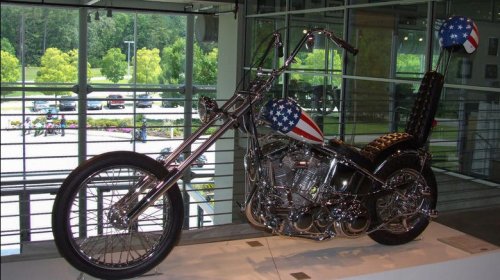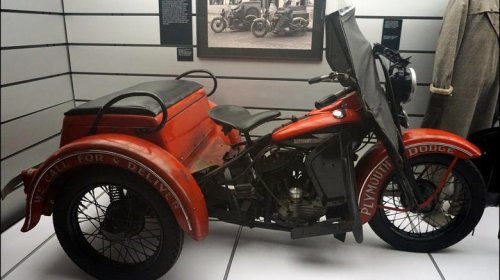
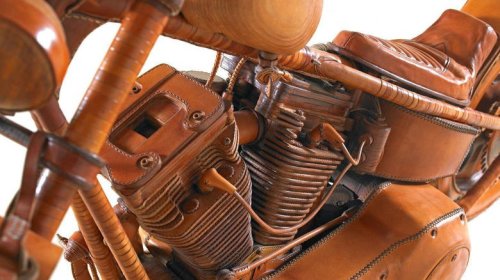
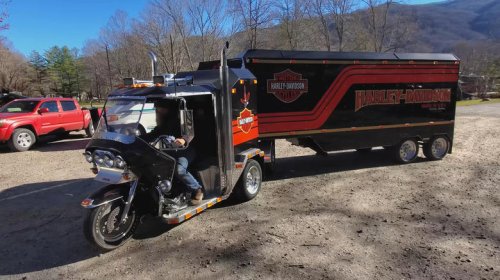
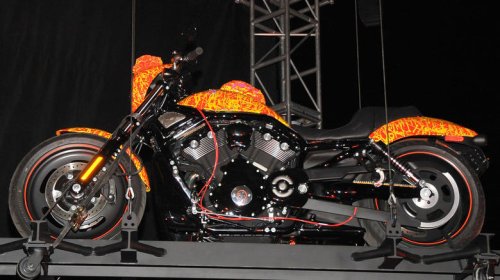



















Servi-Car (1932-1973)The Great Depression was one of the worst periods in recent human history. The global economy collapsed, and most countries were only able to dig themselves out of their economic sinkholes because World War II rekindled numerous manufacturing plants. Before that happened, some companies tried to adapt by producing products that expanded their utility and target demographics.Harley-Davidson's Servi-Car was introduced in 1932, three years after the start of the Great Depression. Unlike most of the company's prior motorcycles, the Servi-Car was designed with utility and commercial purposes in mind, hence its hauling capabilities, storage compartment in the back, and front tow bar. Of course, to make room for the rear trunk, Harley-Davidson widened the back and turned the motorcycle into a tricycle. This design had the added advantage of increasing the Servi-Car's user base — anyone could drive and balance on it regardless of their motorcycling experience.One of the Servi-Car's most popular applications was car delivery. All someone had to do was hitch the motorcycle to the rear of a car, drive the automobile to its intended recipient, unhook the Servi-Car, and drive it away. Harley-Davidson's Servi-Car proved so popular that it outlived the Great Depression, World War II, and most of the Vietnam War. Harley-Davidson finally discontinued its odd motorized tricycle in 1973, making it one of the company's longest-running products.Red Moon Evo Chopper (2000)No two people agree on the definition of art since, quite ironically, almost everyone agrees that art is subjective. To some, art is limited to the paintings and sculptures one finds in a museum; but to others, video games such as "Ico," "The Stanley Parable," and "Okami" are an interactive form of art. More than a few enterprising designers believe motorcycles can be art.During the summer of 2011, the Harley-Davidson Museum opened a collection of Ripley's Believe It Or Not-style oddities to the public. Dubbed "Collection X," this exhibit housed numerous rare prototypes of Harley-Davidson motorcycles, as well as several art projects built using Harley-Davidsons. While you can't see Collection X in person anymore, sites such as CNET posted images of its most noteworthy inclusions for the sake of posterity. One of the strangest items on display was a leather-bound motorcycle.The 2000 Red Moon Evo Chopper was built using a 2000 Harley-Davidson Evo Chopper — the "Red Moon" in its name came from the Japanese company that customized the motorcycle, Red Moon. This studio specializes in leather products, so 20 of Red Moon's employees hand-stitched and wrapped everything from the handlebars down to the wheels in leather, essentially turning the vehicle into a tanned mummycycle. The process took two years, and since every inch of the motorcycle is covered in leather, you can only display the piece, never ride it. Well, you could ride the Red Moon Evo Chopper, but why would you want to ruin all that beautiful leather?The KennyBiltAfter you purchase a motorcycle, how do you get it back to your house? Do you drive it off the lot, or do you have it delivered via truck? How about having a Harley deliver your Harley — one motorcycle customizer imagined what that could look like.In 2022, the motorcycle collectors behind the Wheels Through Time YouTube channel got their hands on the KennyBilt. At first glance, this vehicle looks like a small Harley-Davidson tractor trailer, but when you look at the front cab, you see it's actually a Harley-Davidson motorcycle inside a shell meant to like a tractor trailer. This rig might have nine wheels, but it also retains its original motorcycle's handlebars, complete with odometer. The KennyBilt was built by Kenny Kilpatrick in 1989 and went on several cross-country tours. Oddly enough, some people have posted what looks like the KennyBilt on the WeirdWheels subreddit, but this vehicle has what looks like two motorcycle wheels in the front instead of one. No idea if it's a recreation or modification.Admittedly, this isn't the first time a Harley-Davidson truck hit the road. In 1913, the company produced a "Motorcycle Truck," which looked like a cross between the Harley-Davidson Single and the Servi-Car. However, that Motorcycle Truck was an official Harley-Davidson product, whereas the KennyBilt was a unique custom job. If we had to pick which one looks stranger, it would be the KennyBilt since it actually looks like a miniature tractor trailer.Harley-Davidson Cosmic StarshipIn the world of art, every creative mind has their preferred medium. Some stick to paint or stone, but other artists use more unorthodox canvases. One such person used a Harley-Davison to create art, but what else can you expect from a friend of Andy Warhol?American artist Jack Armstrong (nephew of Neil Armstrong) once turned a 2002 Harley-Davidson V-Rod into a work of art. Unlike most custom bikes, Armstrong didn't add or change any major components to alter the motorcycle's performance; all he did was paint certain parts in his signature "Cosmic Extensionalism" style. The result, dubbed the "Harley-Davidson Cosmic Starship," made the V-Rod look like an '80s hair metal band in motorcycle form.Unlike most motorcycle art projects, the Cosmic Starship is completely functional as a fully drivable motorcycle. Good luck taking this one for a spin, though. In 2012, the Cosmic Starship sold for $3 million, and Armstrong bought it back in 2022 — sort of. He actually traded a painting titled "Star Key #733" for it, but that painting had an estimated value of $50 million, so he basically paid that much money to regain his custom motorcycle. Despite money not actually exchanging hands, many motorcycle enthusiasts consider the Cosmic Starship to be worth $50 million, making it one of if not the world's most expensive custom motorcycles.