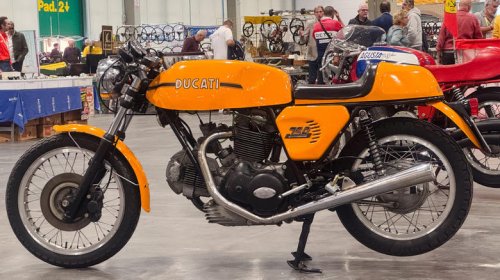
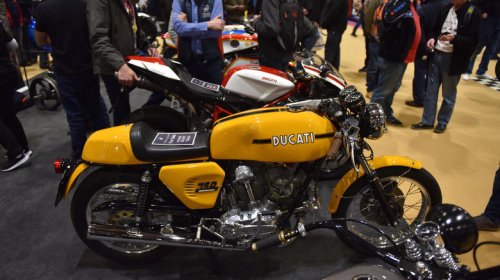
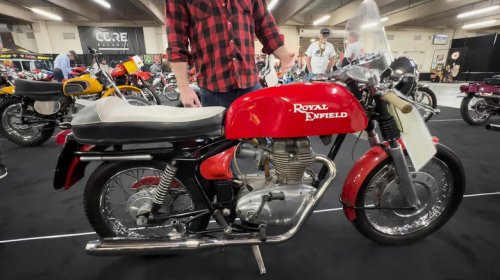
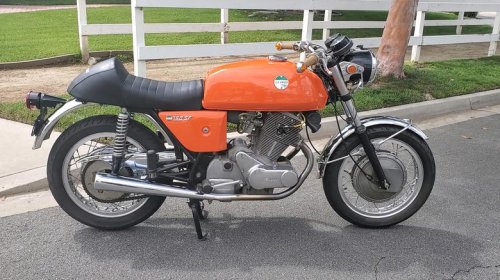
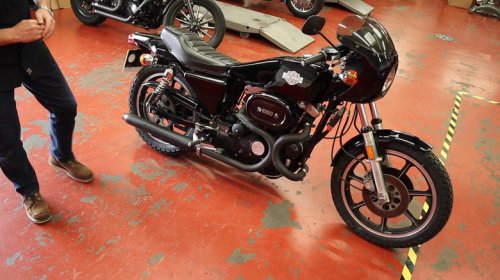
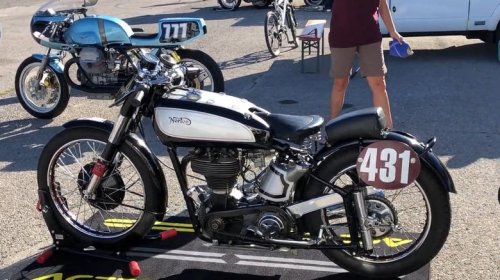

















A yellow Ducati 750 cafe racer motorcycle, finished here in the "Sport" trim with black racing stripe parked indoors.When the cafe racer movement began in post-war Britain, it was mainly British companies like Triumph, Norton, and BSA who dominated the scene. This makes sense, since, at the time, these three were among the biggest motorcycle makers in the country; their stock was easy to find and modify, so their models were popular. However, of these three huge British motorbike brands, Triumph was the leader of the pack, by a country mile. It had released the now-legendary Triumph Bonneville towards the end of the 1950s, and it is this decade (and the 1960s) that is considered the brand's golden era.It's easy to see why Triumph will dominate every single conversation — many of the most iconic cafe racers were built on Triumph bones. However, as early as the 1960s, other makers were catching on to this rising popularity wave and coming out with factory cafe racer builds of their own. At first, the movement relied on riders modifying so-called "donor bikes" with longer fuel tanks, upgraded fairings, and new seating positions, all definitive features of cafe racer bikes. Over time, brands offered these as stock options on their most popular models. Even with available stock options, buying a standard motorcycle and converting it to a cafe racer build remained popular among enthusiasts.However, aside from a few legendary models, many of these bikes remain forgotten today, overshadowed by the dominance of larger names. Here are five from brands other than Triumph. Ducati 750A yellow and black 1960s Ducati 750 Sport on display to a crowd during the MCN London motor show.First up, we have the 750 line from Ducati, available in the GT and S models. The 750 GT came out first and was the company's first two-cylinder road-going offering. The original engine displaced 748 cc across two cylinders, and made an impressive 60 hp paired to a five-speed transmission. However, the horsepower did, as expected, take a long time coming, with peak power only available from 8,000 rpm. Still, it was an insanely performant machine, capable of reaching speeds of 124 mph, or 200 km/h. These 750 GT figures were completely stock from the production line, so a modified version could likely squeeze a lot more power out of that L-shaped twin-cylinder powerplant. Also, the factory 750 GTs of the early 1970s did not come with any sort of cowling, fairing, or windshield, meaning that it was, strictly speaking, not aerodynamic. The addition of a proper fairing and windshield alone would probably net a much better riding experience, and more importantly, performance. Two years later, the 750 S version would be made available with almost no changes to the engine, but with (optional) cafe racer styling elements. The 750 GT came with an elongated fuel tank, a forward riding position, and other styling features that became synonymous with cafe racers of the era. Royal Enfield Continental GTA red and chrome silver 1966 Royal Enfield Continental GT 250 cafe racer on an indoor auction floor with other bikes in the backdrop.Royal Enfield came out with a bike called the Continental GT in the 1960s, just as the Triumph Bonneville, or "Bonnie," was seeing its heyday. The Continental GT 250 was an upgrade to the Royal Enfield Crusader it was based on, featuring a more tuned engine and upgraded internals. Displacement stood at 248 cc across an air-cooled solo cylinder, mated to a five-speed gearbox. Notably, the head of Royal Enfield at the time had noticed that many young people were modifying the company's bikes into cafe racers. So, he reached out to the youngest employees at Enfield dealers and asked them for feedback, which led to the GT 250 in the early sixties. The new features on the new cafe-styled Continental included rear-set foot pegs, ace bars (clip-on versions, of course), minor upgrades to the engine internals, and a new cafe racer style fuel tank. An interesting bit about this fuel tank was that the filler hole was located below the highest point of the fuel tank, meaning you couldn't fill it to the brim without gas spurting out of the tank. Performance was, of course, approximately one-third of the Ducati that we just looked at above — but then again, so was displacement. The Continental GT 250 made a reasonable 21 hp at 7,500 rpm, giving it a top speed of around 85 mph — and UK learners could also use the bike, since it was under 250 cc. Laverda 750 SFA 1972 Laverda 750 SF motorcycle in cafe racer styling finished in a bright orange color parked on a country road with a white fence in the back.The 750 SF was launched towards the end of the 1960s, likely to capitalize on cafe racer popularity. Also, just like the Ducati, the Laverda 750 was first offered in a GT trim level, with an S for "sport" version following a few months later. Eventually, a new and updated model called the "Super Freni" would be launched with an upgraded front brake. Functionally in the same class as the Ducati 750 S that we were introduced to earlier, the Laverda shipped with a 744 cc, twin-cylinder engine. The transmission was a five-speed unit that drove the rear wheel via chain final drive, and fuel was funneled into the compression chambers via carburetors, as was standard for the time. In sum, the total power output for the Laverda 750 SF stood at an impressive 60 hp, and later on, iterations like the 750 SF1 and SF2 would marginally increase this power. Being a bike intended to be sporty but not extreme, insane amounts of torque wouldn't be needed, as bikers who buy this class would be more concerned with riding dynamics, the scream of the exhaust, and how the bike looked. To that end, the 750 SF weighed 507 pounds, and that's with all fluids installed. It had a top speed of 115 mph, though this would vary according to rider profile, weather conditions, and riding profile. Harley-Davidson XLCRA black Harley Davidson XCLR cafe racer motorbike from the late 1970s standing on an orange floor with a man next to it.In the long, storied history of the Harley-Davidson brand, the company has been best-known for its line of cruiser/tourer motorbikes. Some aficionados would know about the trike line offerings from the Milwaukee-based company, but only those deeply entrenched in Harley lore would know that it also made a cafe racer, for a very limited time. This bike was the XLCR, and was first released in 1977, so it was a bit late to the cafe racer movement. However, the inspiration for the XLCR was immediately clear, including the long, sloping fuel tank, wide-set handlebars, crouched-forward riding position, front-biased proportions, and available paint schemes. The engine in this gorgeous bit of Americana-flavored UK culture was a 998 cc unit that spread its displacement across twin cylinders. The transmission was a four-speed unit that drove the rear wheel, and the entire package came in around the $3,500 mark, give or take a hundred dollars. Total power output for the XLCR stood at 57 hp, which it made at a decent 6,000 RPM, making it quite a performant machine for the time. A 1980 Harley-Davidson Low Rider made about 67 hp and 67 lb-ft of torque, while weighing 637 pounds wet. The XLCR got quite close to those numbers, and weighed a bit less, coming in at 530 pounds in running order, meaning it was probably a riot to ride. It's a shame the model didn't really catch on among buyers. Norton ManxA 1947 Norton Manx 500 finished in white standing on tarmac, with a blue cafe racer bike behind it.The only other entrant on our list that comes from the UK — the stomping grounds of Triumph motorcycles — is the Norton Manx. Norton, now owned by Indian firm TVS, got its start as a fairly successful racing bike manufacturer before marketing its bikes to private buyers. The Norton Manx 500 was one such example, and it would go on to win several races. The engine was a single-cylinder unit that made about 50 hp at the rear wheel. Initially launched in 1946, this model featured classic cafe racer styling. It had a drooping fuel tank, which the rider had to reach over to get a good grip on the handlebars. The foot pegs were positioned right where the seat started, so your knees would always be around your waist, and there was no fairing on stock models. In other words, it was a cafe racer, through and through. Also, the Manx 500 had a smaller sibling in the form of the Manx 350, which had a different bore and stroke, though both shared the same price at launch in the early 1960s. Today, Norton aims to capitalize on the Manx's legendary history by releasing the Manx R superbike. Want the latest in tech and auto trends? Subscribe to our free newsletter for the latest headlines, expert guides, and how-to tips, one email at a time. You can also add us as a preferred search source on Google.