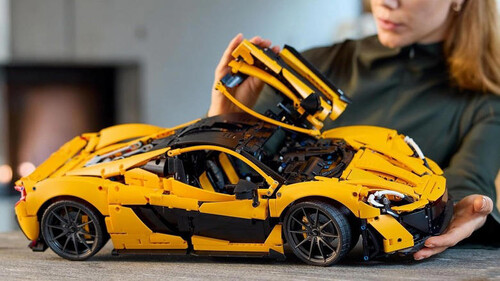
ToyotaIt is impossible to overstate the importance of aerodynamics in racing. Once upon a time, a car's performance relied on stuffing the most overpowered engine into the lightest chassis you could make. Brabham became the first team to test in a wind tunnel in 1963, but it wouldn't become regular until the 1980s. Nowadays, being a hundredth of a second faster can make the difference between victory and defeat, so every facet of car design is explored to the nth degree.Today's Formula 1 cars are so meticulously designed and tested that they could theoretically run on a track upside down at speed, given how much downforce they generate. Wind tunnel testing is expensive and laborious, with purpose-built facilities required. Ford recently spent as much as $200 million on its new facility.When Toyota departed Formula 1 in 2009, McLaren saw an opportunity. The Japanese builder had a wind tunnel facility in Cologne, Germany, not too far from McLaren's headquarters in Woking, U.K. Striking a deal, McLaren began testing its cars in Toyota's facility starting in 2010. Since then, the tunnel has been used to develop McLaren F1 cars from the MP4-26 up through 2023's MCL60.Though McLaren ultimately built its own wind tunnel, its relationship with Toyota grew during the nearly 15-year period they worked together in Cologne. In 2024, McLaren signed Toyota factory driver Ryo Hirakawa in a deal that included sharing simulator and testing programs. The best may yet come for the Toyota and McLaren partnership.VDL Bova FuturaNot every partnership results in podium appearances and record-breaking production cars. Though McLaren is a huge name, it remains a smaller company compared to Ford, Toyota, or Mercedes. While those industrial behemoths enjoy the advantages of economies of scale, McLaren and its ilk can hardly develop every little piece of its cars from scratch. That's where VDL Bova Futura comes in.If you're wondering why you haven't heard of such an exotic-sounding performance car producer, don't worry, you don't have to relinquish your gearhead certification just yet. VDL Bova Future is about as far from a performance company as possible. Its main claim to fame is building coaches for tour buses.We've seen coach builders collaborate with performance companies in the past, but unlike Bertone, Pininfarina, Ghia, and Zagato, VDL Bova Futura did not provide a body for a supercar. It provided lights. That's right — the incomparable McLaren F1 you read about above used bus lights.If you've ever been in traffic huffing diesel fumes and ruminating about the bus in front of you, and thought something about it looked familiar, that may be because its rounded taillights also grace the glossy pages of supercar magazines on the rear end of the McLaren F1. Hey, not every component can be bespoke carbon fiber or the result of complex BMW engineering. Cheap, readily available, and functional, the bus lights work just fine.LegoMcLaren didn't just stick to the video game world for its entertainment collaborations. In 2015, it teamed up with Lego to create the Speed Champion McLaren P1 set, providing an option for anyone who wants to build their own McLaren. Since then, Lego and McLaren have developed multiple models, including the 720S, Solus GT, and F1 LM.Most impressively, the collaboration built the Lego Technic McLaren P1. Made up of over 340.000 Lego Technic parts and powered by an electric motor, this life-sized Lego weighed about 2,700 pounds, could achieve speeds up to 31 mph, and actually took a lap around the Silverstone circuit with F1 driver Lando Norris at the wheel.As if that weren't enough, McLaren really drew its corporate partners together in the "Forza Horizon 4" expansion, "LEGO Speed Champions." In the expansion, players trade Forza's realistic graphics for a trip into Lego Valley, where they take control of the McLaren Senna (amongst others) in a Lego-rific rally. What's next? Richard Mille watches for your avatar?PirelliTires are more than just a car's feet. They can make or break a race, and more importantly, they guarantee a safe stop at a rainy intersection. Their role in ensuring safety is paramount, and they endure incredible forces on the daily. When a car goes as fast as a McLaren, not just any tire will do. That's why McLaren got together with Pirelli.When a car operates near the top echelon of what is possible, it often uses specialized tires. One such example is the McLaren MP4-12C, now known as the 12C. Pirelli and McLaren collaborated to craft custom tires, each with unique features tailored for the Grand Tourer. This partnership also led to the creation of tires for the 570S, 540C, 570GT, and Artura, each designed not only for speed but also for noise cancellation, ensuring a serene Sunday drive even in a roaring supercar.The partnership between McLaren and Pirelli continues to thrive, with Pirelli serving as the trusted supplier for McLaren's Formula One race cars. In January 2026, the two concluded testing for the 2026 tires in France at the Circuit Paul Ricard.