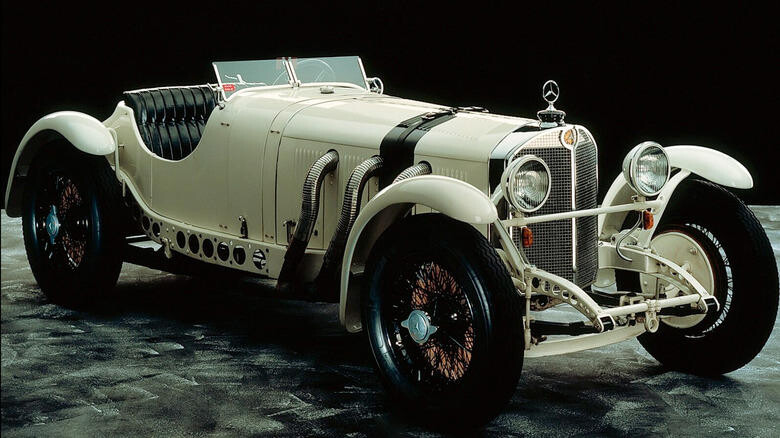
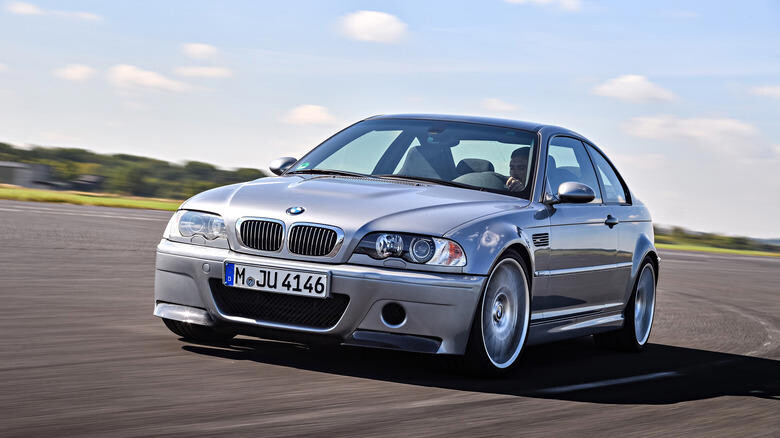
Mercedes-Benz SSK/SSKL Roadster (1927 to 1933)Mercedes-Benz produced the world's first car and ever since it has been synonymous with advanced engineering and technology. In the 1920s, the company broke speed records with the SSK Roadster, a car so advanced its numbers look impressive even today. Designed by a certain Ferdinand Porsche, it was like the Bugatti Veyron of its era — a two-seater with grace, finesse, and speed no other car could match.The SSK was first introduced in 1928 with a 7.1-liter inline-6 engine. The unit provided 140 hp (160 hp from 1929), with a supercharger to boost it to 200 hp. Thus, SSK drivers had two distinct driving mode options — a feature now standard in every modern car today. Paired with a four-speed manual, the SSK could reach 115 mph (185 km/h), which was unthinkable for the era. More powerful SSK Roadsters were also offered; the 170/225-hp and 180/250-hp versions reached 119 mph (192 km/h).However, these "pedestrian" models only served as a teaser while Mercedes-Benz worked on a much more powerful sports car: the 1931 SSKL. This was the ultimate version, with 240 hp standard and 300 hp after engaging the supercharger. The SSKL was not only more powerful, but it was also more than 440 pounds (220 kilograms) lighter than the SSK — it clocked in just over 3,300 pounds (1,500 kilograms)! As a result, it could reach an unprecedented 146 mph (235 km/h), making it by far the fastest car in the 1920s and 1930s.Porsche 959 (1987 to 1993)While the Ferrari F40 might be the more sought-after supercar from the late 1980s/early 1990s, the Porsche 959 paved the way for more civilized yet still very capable supercars. It was just as much of a game-changer for supercars as the Audi Sport Quattro was for rally homologation specials. Notably, this was the first automobile with sequential turbocharging and active suspension while also incorporating all-wheel-drive for maximum traction.However, it's the numbers the 959 produced that broke the automotive world. The all-aluminum, flat-six 2.85-liter twin-turbo engine produced 444 hp, propelling the supercar to 60 mph in just 3.6 seconds, certainly aided by the excellent AWD traction. Still, the 959 won't stop pushing past the 60 mph mark; it reaches 100 mph in 8.8 seconds and won't stop until the needle shows 193 mph (310 km/h). Later, Porsche launched an even more bonkers "959 S" version with 515 hp that was also 220 pounds lighter. The 959 S reached a staggering 211 mph (339 km/h), a figure that is still impressive today.Although crazy fast, the 959 was very accessible and easy to drive. The AWD system certainly made it more stable, but the aerodynamics also played a part in keeping it planted at higher velocities. Reviewers praised the smooth ride and quiet cabin, which was the total opposite of the Ferrari F40's raw nature. Overall, it was a testament to Porsche's engineering prowess — pretty nice, considering it was imagined as a Group B rally car initially.BMW E46 M3 CSL (2003 to 2004)Unlike Audi, BMW always puts a lot more effort into the driving experience. They need to be fast, but they also need to provide balanced handling, sharp steering, and good throttle response. And the BMW E46 M3 CSL did all that almost perfectly. From the sonorous, naturally-aspirated inline-6 to the sharp and agile handling, this particular M3 will get you nearest to driving nirvana of (probably) any other German car in history.The CSL was the improved, lightweight edition of the standard (already tremendous) E46 M3. It knocked 242.5 pounds (110 kilograms) off the regular model — without even losing the rear seats! This was the result of painstakingly cutting the weight on any part possible. The M3 CSL was even the first BMW with a carbon-fiber roof, something way more exotic in the early 2000s than it is today.However, the car's inline-6 masterpiece steals the show. In the M3 CSL, the 3.2-liter unit produces 355 hp @7,900 rpm and 272 lb-ft of torque, enough for a 0-62 mph acceleration time of just 4.9 seconds. Moreover, the sound it produced is probably one of the best in the automotive history. Angry and with racecar tonality, the M3 CSL engine still sends shivers down your spine.It's a shame that BMW went with a slow and clunky robotized SMG transmission for the CSL, as it takes away from the experience. Do a manual swap, though, and the E46 M3 CSL will become the culmination of driving excellence.