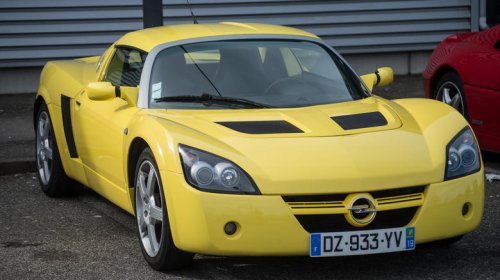
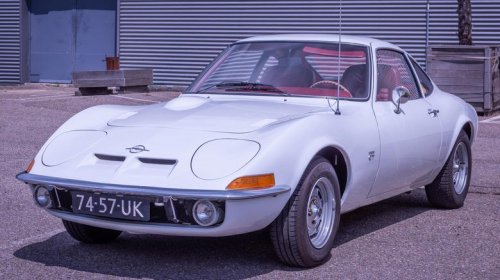
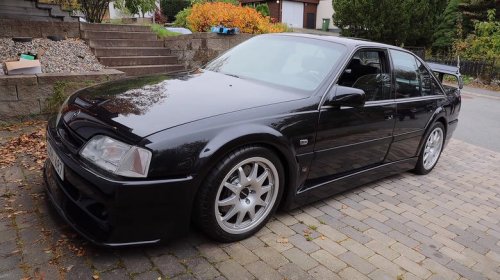
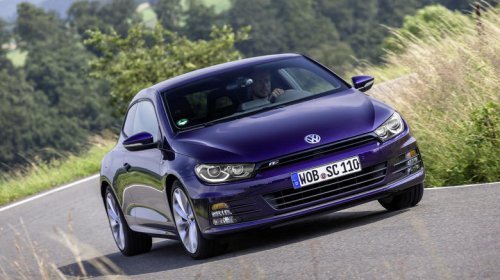
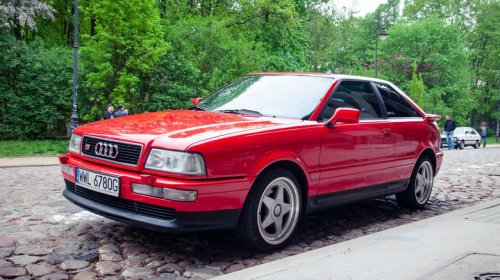
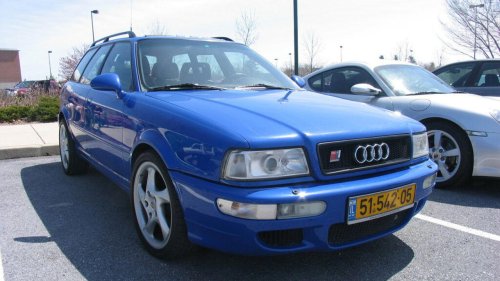
Opel Speedster (2001 to 2006)The Opel Speedster, also sold as the Vauxhall VX220 in the U.K., is a sports car that few people have heard of, but it definitely deserves its place in the pantheon of greats. It has all the perfect ingredients for a great driver's car. To begin with, it weighs only 1,918 pounds, thanks to the stiff aluminum chassis tub it borrowed from the Lotus Elise. Moreover, its engine sits in the middle for that perfect weight distribution, mated to a five-speed manual for a more engaging ride.Opel offered the Speedster with two GM-sourced engine options because, at that time, General Motors owned the Opel brand. The base motor is a 2.2-liter naturally aspirated unit that produces only 147 hp, but that's still enough to propel the Speedster to 62 mph in just 5.9 seconds. However, there was also a 200-hp 2.0-liter turbocharged option, which cut the 0-62 mph sprint to 4.7 seconds. The most powerful version of the turbocharged engine, though, delivers 217 hp and takes only 4.2 seconds to reach 62 mph.But there is more to the Speedster than just the sheer numbers. Thanks to the low weight, stiff suspension, and talkative steering, this sports car is a joy to drive on a twisty road. The Opel Speedster is a ray of sunshine from an era when the traditional sports car weighed almost twice as much. Expect it to rise in popularity in the coming years.Opel GT (1968 to 1973)The Opel GT is a lightweight sports coupe few enthusiasts know about, simply because it was overshadowed by the Corvette. Naturally, the Vette was GM's darling, as it has always shown what the company is capable of regarding performance. However, GM's German subsidiary, Opel, had a different idea of a sports car; instead of numbers, its GT sports car was all about style and fun-to-drive dynamics in an affordable package. Think of it as the baby Corvette, and you won't be far off.You could even call some version of the GT more of an "embryo Vette." The base model came with a measly 1.1-liter engine producing only 67 hp. It wasn't particularly fast, but the low curb weight of 1,880 pounds made up for the motor's lack of power. If you wanted more oomph, there was the 1900GT, packing a 1.9-liter engine with 102 hp and weighing 2,072 pounds and a four-speed manual. The "performance model" was good for a 0-60 mph time of 10 seconds and a 115-mph top speed. Still not quick, but okay for an affordable sports car of the era.It's easy to overlook the Opel GT because of its not-so-stellar numbers. However, the styling more than makes up for the performance deficiencies. The good proportions, swooping body lines, and stylized pop-up headlights turn heads even today.Opel Omega Evolution 500 (1991)Ask someone to name three German sports sedans from the 1990s, and they'd probably mention the BMW M5 E34, Mercedes-Benz C36 AMG, and Audi S4. However, there is another sedan that is not often talked about and seriously underrated: the Opel Omega Evolution 500. This was a super-limited RWD sports sedan developed as a DTM homologation special, with quite a remarkable engine and a five-speed manual.Namely, Opel made some serious changes to its 3.0-liter inline-6 unit from the regular Omega, amping it up to 227 hp @6,700 rpm and 206 lb-ft of torque @3,500 rpm. It was all done without any forced induction — here, it was all about the revolutions. To begin with, the engine has a very short 2.75-inch stroke and a relatively large 3.74-inch bore, meaning it was designed for high-end power. However, Opel engineers made it even "revvy-er" by reducing the weight of each piston by 150 grams and using a forged crank with eight counterweights, compared to 12 for the regular engine. Acceleration was very brisk for the era, with 0-60 mph taking 7.1 seconds.But there was an even faster version with a 4.0-liter inline-6 engine, producing 272 hp @5,800 rpm and 291 lb-ft of torque @3,300 rpm. Although not as revvy, the larger engine provided a serious performance boost — 0-60 mph took only 5.5 seconds, and the top speed was a Porsche-beating 168 mph. This is fast even today, particularly when you consider the fact that the Omega A EVO 500 4.0i weighs 3,417 pounds.Volkswagen Scirocco R (2009 to 2017)The Scirocco R is rarely mentioned among the front-wheel-drive immortals, yet it's one of the finest sports cars of its type. Much like the Corrado, the Scirocco was envisioned as a more stylish version of the Golf, designed to appeal to a younger audience. Due to the lower roof and three-door hatchback body, it was always less practical than its sibling, but younger enthusiasts never cared about that, anyway. They wanted something eye-catching — a low-to-the-ground sports car with enough power to get the blood pumping — and the Scirocco delivered.That is particularly true for the peppiest version, the Scirocco R. Packing VW's excellent 2.0-liter turbocharged engine with direct injection, the Scirocco R produces 280 hp @6,000 rpm and 258 lb-ft @2,500-5,000 rpm in the European version, with the North American version being 19 hp short. It is lighter than the sixth-gen Golf R by 300 pounds, largely thanks to the missing AWD hardware, and comes with either a 6-speed dual-clutch or a 6-speed manual. With the quicker dual-clutch option, it sprints to 60 mph in just 5.2 seconds despite driving only the front wheels.However, the lower weight didn't only benefit performance. Coupled with the lower center of gravity, the Scirocco R is a much more agile sports car than the sixth-gen Golf R, with better handling dynamics. When new, the Scirocco was even cheaper than its more famous sibling, though it was undeservedly overlooked for not having AWD.Audi S2 Coupe (1991 to 1995)The Sport Quattro and RS2 are perhaps the most legendary Audi sports cars of the 1980s and 1990s, and rightfully so. However, a less-known Audi sports car launched at the beginning of the 1990s, meant as a successor to the Sport Quattro while also serving as the sporty coupe variant of the RS2 sports wagon. It was called the S2 Coupe, and in our eyes, it deserved more attention from the enthusiast crowd. It had all the ingredients necessary for a good performance car.The S2 wasn't well received at first, but that's not surprising, as it had the job of replacing a true icon in the Sport Quattro. Journalists deemed it too sterile compared to its predecessor and not any faster. Even its design was more conservative, with Audi taking few risks. Still, despite lacking the verve and rally pedigree of the Sport Quattro, the S2 is a more grown-up car, made to work better on public roads. The interior is more luxurious and impeccably finished, and the S2 rides better, too.At launch, the S2 was heavy for a sports car, weighing 3,130 pounds. Today, though, that is considered lightweight, especially given that the S2 is equipped with Audi's Quattro AWD system. Under the bonnet, the S2 packs a turbocharged 2.2-liter inline-5, producing 220 hp initially (paired with a 5-speed manual) or 230 hp in the facelifted 1993-1995 version (6-speed manual). The result: a 0-62 mph time of 5.7 seconds and a top speed of 154 mph!