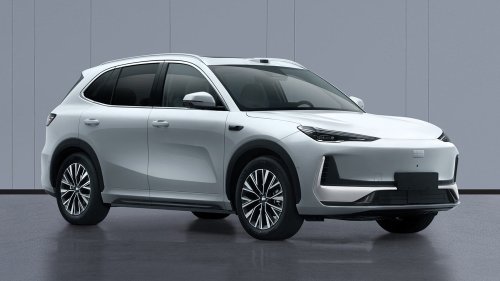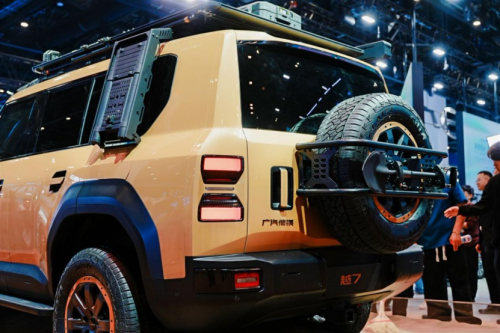
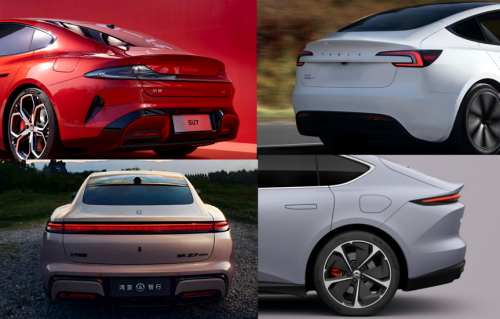
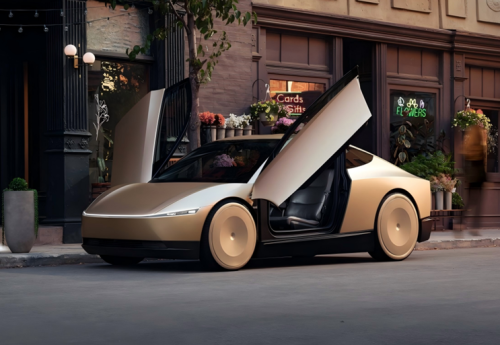
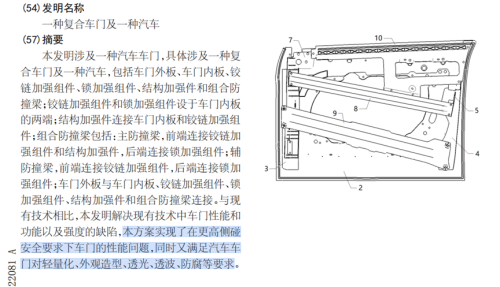



















Gasgoo Munich- As the industry obsesses over in-cabin screen wars and an arms race for computing power often exceeding 1,000 TOPS, the recently concluded 2026 Beijing Auto Show has thrust a seemingly contradictory trend into the spotlight.Following the "ducktail" spoiler craze, this year's Beijing show saw an explosion of "boxy" designs. GAC Trumpchi, BAIC BJEV, and Chery Automobile debuted over a dozen rugged SUVs, with designers using minimalist geometric facets to outline a new aesthetic. Yet, autonomous driving engineers are bringing the battle to the car door. Notably, models featuring LiDAR at this year's show surpassed 200, as various perception hardware is being densely packed into tailgates and side panels.This tug-of-war between minimalist styling and complex sensing is pushing doors onto an unprecedented engineering battlefield. Traditional metal components are simultaneously hitting the ceiling of design freedom, the physical limits of lightweighting, and a signal deadlock caused by electromagnetic shielding. As the industry adage "new materials, new cars" becomes a practical reality for doors, NIO, BYD, and Leapmotor have already offered their answers at this exhibition.How "New Materials" Are Saving "Automotive Design"?Design is a car's first language, but for too long, designers' imaginations have been held hostage by metal stamping processes.Boxy SUVs featuring clean lines are becoming a mainstream trend this year; Source: GAC TrumpchiThis contradiction was amplified at the Beijing show. The surge of boxy models imposes stricter styling requirements on doors, such as high-tension anti-R corner character lines and deep, continuous light grooves. However, the flow characteristics of metal sheets during deep drawing mean sharp features are prone to tearing or uncontrolled springback. When the R-radius approaches physical limits, manufacturers are often forced to compromise between yield rates and design intent.Respectively: The all-new Xiaomi SU7, Tesla Model 3, Shangjie Z7, and NIO ET5This conflict was previewed by the recent "ducktail" trend. From the Tesla Model 3 to the NIO ET5, Xiaomi SU7, and Shangjie Z7, creating that highly recognizable crease above the taillights—and integrating it seamlessly with the light assembly and sensor areas—is no simple feat on a tailgate.To mask defects caused by physical limits, engineers have had to piece together spoilers and D-pillar trims from multiple parts. This not only increases vehicle weight and part count but also runs counter to platformization and lightweighting goals. To designers pursuing ultimate minimalism, stamping marks, weld spots, sealant beads, and surface steps are merely scars of compromise.More troublesome is electromagnetic compatibility. At this year's show, models like the new AITO M9 and XPENG GX—boasting L3 autonomous driving capabilities—took center stage. As market demands for on-board perception precision intensify, traditional stamped metal struggles to accommodate embedded sensor layouts. Worse, the electromagnetic shielding properties of metal panels create a dilemma: sensors must either be exposed, ruining the aesthetic, or installed in holes with wave-transparent panels, adding process steps and failure risks.This isn't an isolated struggle for one automaker but a common industry challenge. An engineer involved in body design at an OEM told Gasgoo during the show: "We are looking for a closure panel solution that simultaneously satisfies design freedom, weight reduction, and signal penetration." Source: TeslaIn his view, the concept perfectly realized by Tesla's Robotaxi, the CyberCab. Its body makes extensive use of glass-fiber reinforced thermoplastic "super plastic" composites. Their natural transparency to light and signals, combined with flexible embedded sensor layouts, achieves a fusion of minimalist, seamless design and perception integration.Notably, this solution is not mere conceptual hype. Composite doors are hardly new globally, with giants like Plastic Omnium and Magna laying the groundwork for years. But focused on the Chinese market, the speed at which this technology is moving toward mass production is particularly rapid.NIO ES9 with 31 high-performance perception hardware units densely distributed; Source: NIOThis is particularly evident in NIO's product line. From the ET5 to the ET9, that sharp ducktail crease has become a design signature. Complexity is pushed even further with the upcoming ES9, an intelligent electric executive flagship SUV. This full-size tailgate, comparable to an MPV in area, must machine extremely deep continuous grooves for the taillights while embedding numerous AQUILA Super Sensing System components without compromising surface integrity. It challenges the boundaries of metal stamping at every turn. Ultimately, the composite solution allowed the design to move from blueprint to assembly line. A partial screenshot of a patent for a composite door publicly released by Yanfeng Plastic Omnium this AprilBeyond breaking process bottlenecks, composites offer a superior integrated visual effect. On a BYD platform model, despite identical exteriors, the EV version's composite tailgate inner panel features a unified matte black finish—a texture far surpassing the metal door of the DM-i version, which requires color separation due to hemming.Comparing the technical paths of NIO and BYD, a clear trend emerges: leveraging the high forming freedom and natural signal transparency of composite materials to achieve deep integration of the vehicle's electrical/electronic architecture and body structure, transforming the tailgate into a highly integrated smart component. Driving the mass production of these solutions is local supplier Yanfeng Plastic Omnium.When physical limits are shattered, designers no longer agonize over "can this be built?" The aesthetic appeal of the automobile truly enters its intelligent era.When Doors Are No Longer "Iron Sheets," How to Cross the "Trust Gap"?Design freedom solves the "looks," but in the coming era of L3 autonomous driving, the door—as the vehicle's largest closure—must evolve from a passive "iron barrier" into an active "smart skin" capable of perception, interaction, and protection. Yet, material innovation still faces a hurdle of trust: can current solutions pass scrutiny when the stereotypes of early thermoset composites—poor crash performance and difficult recycling—linger?Today, the technological roadmap has completed a critical leap from "thermoset" to "thermoplastic" materials. This shift fundamentally solves the recycling puzzle and enhances impact toughness.Building on this, top-tier suppliers are constructing scientific load paths through ingenious structural design. Take Yanfeng Plastic Omnium: by combining a "composite outer panel + metal skeleton inserts + glass & carbon fiber reinforcement + variable wall thickness design + main beam structural reinforcement," they ensure complete energy transfer. This helped the aforementioned BYD EV model's tailgate achieve a 27.1% weight reduction while meeting all stiffness targets.Additionally, primer-free, solvent-free, low-VOC structural cold bonding processes effectively avoid the thermal deformation and corrosion risks associated with traditional welding. Weight reduction and performance are no longer an either/or choice.With safety and durability assured, the final loop of trust lies in daily usability. Thanks to high elastic recovery, composite doors can rebound automatically after low-speed impacts that don't damage the substrate—eliminating the need for bodywork, hammering, or putty filling. In severe accidents causing cracks or structural damage, the maintenance protocol mirrors that of metal doors: assembly replacement. This avoids the precision loss and corrosion risks post-repair, offering a worry-free experience over the vehicle's full lifecycle.If the tailgate is the "entry-level exam" for structural durability, the side door is a far stricter "hell-level" test. It must withstand increasingly stringent energy management requirements for side-impact regulations while maintaining stability over hundreds of thousands of opening and closing cycles. Today, relevant composite side door solutions have already entered mass production on luxury brand models like Yangwang.This technological path is undergoing large-scale verification. According to Gasgoo monitoring, led by local suppliers like Yanfeng Plastic Omnium, cumulative installations of composite tailgates and side doors have surpassed 3 million units. Coverage ranges from luxury brands to the main forces of new energy like NIO, BYD, and Leapmotor. A market base of over 3 million units and real-world driving data are gradually dispelling market stereotypes and safety concerns about this new material.Why Automakers Are Betting Big on Integrated Smart Doors?As the auto industry descends into the ultimate strangulation of "price wars" and "specification wars," the competitive focus for OEMs is shifting from "stacking features" to "reconstruction." Against this backdrop, why are composite doors becoming a must-have for more mainstream models?The answer lies not just in "lightness," but in how the triple value of "fast," "stable," and "saving" is reconstructing the manufacturing and cost logic of OEMs.First, "saving." In the current era of slim margins, this is the OEM's most sensitive nerve. The investment in metal stamping lines and molds—running into the millions or even tens of millions—is essentially a one-time "heavy tax" levied on a single model. In contrast, integrated composite solutions feature injection molds with longer lifespans and friendlier amortization. Styling adjustments during model cycles are more flexible, enabling OEMs to achieve truly asset-light operations.Source: LeapmotorThen, "fast." This stems from the deep coupling of modular supply and structural adhesive cold bonding processes. Thanks to one-step injection molding of inner and outer trim panels, which are then glued into a closed cavity, the parts arrive at the final assembly line as modular assemblies. This means OEMs can eliminate welding, electrophoresis, and painting—three high-energy-consumption steps. Production line investment and floor space drop precipitously, while the modification cycle for new model introduction shortens significantly. In an era where model iteration is measured in months, this speed advantage is competitive power in itself."Stable" is the scarcest value amidst current global geopolitical turbulence. With aluminum and steel prices seesawing, vertical integration in the supply chain is becoming crucial. Take Yanfeng Plastic Omnium as an example: they have integrated the full-chain layout from material formulation to process manufacturing. This self-control provides OEMs with rare cost certainty and delivery guarantees.Viewing the broader industrial landscape, data from research firm QYResearch shows that composite tailgates—valued for high strength, weather resistance, and dimensional stability—are widely used in luxury flagships and mid-to-high-end new energy vehicles. Their share in the non-metal electric tailgate market is projected to rise further to 45% by 2032.The underlying logic of this growth resonates deeply with the "fast, stable, saving" values OEMs are chasing. And with actual verification data from over 3 million vehicles, these theoretical advantages have turned into quantifiable commercial value. While traditional metal doors are still debating "can it be used?", composite doors have already won the market by answering "is it worth it?"Conclusion:The evolutionary path of the car door has never lacked designers' imagination, nor the OEMs' willingness to innovate. What has been missing is a process solution that can truly bring styling ambition and intelligent necessities to the ground.From the early moves of international giants to the rapid response of the local supply chain, from the engineering verification of new materials to the cost reconstruction of the entire industry chain, the competition in this hidden battlefield of doors is no longer a comparison of single products, but a reshaping of the entire manufacturing system and business model.This is not merely a material substitution, but a reconstruction of automotive logic. A shift from "heavy asset stamping" to "modular integration." As doors evolve into "smart skins" integrating perception and interaction, those supply chain enterprises capable of closing the loop at the underlying material logic will truly define the automotive form of the next decade. This quiet revolution has only just begun.