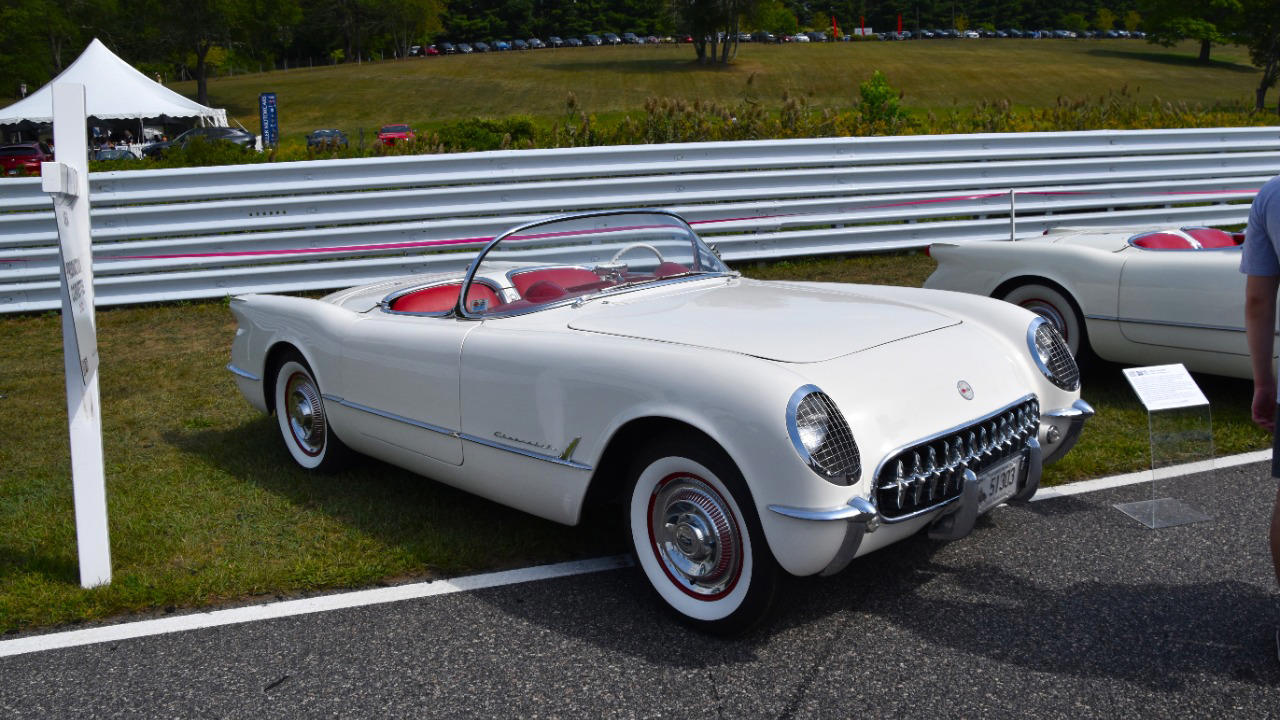



















When the 1953 Chevrolet Corvette tested America’s sports car appetiteThe 1953 Chevrolet Corvette did more than introduce a new model line. It functioned as a live experiment to see whether American drivers would embrace a homegrown sports car in a market dominated by European imports. Built in tiny numbers, hand assembled and mechanically modest, it tested appetite rather than raw performance, and the response reshaped General Motors and American car culture. Seven decades later, a Polo White convertible photographed in San Francisco with the Golden Gate Bridge in the background still carries the weight of that question. The first-year Corvette now reads as both a design object and a survey result, proof that enough buyers were willing to trade practicality for style to justify a permanent American entry in the sports car arena. Motorama as a national focus group The experiment began under the bright lights of the GM Motorama, a traveling show that turned concept cars into theater. On January 17, 1953, the Corvette made its grand debut at the GM Motorama in New York, presented as America’s Sports Car in a hall otherwise filled with futuristic showpieces that would never see production. European sports cars were for a narrow clientele, and the pitch in that room was that an American alternative could be attainable for anyone willing to save and sacrifice. Motorama itself operated as a kind of rolling focus group. Touring America’s principal cities, General Motors used the 1953 Motorama to pull in crowds like the 55,000 New Yorkers who lined up to see its chrome fantasies. Those visitors did not fill out surveys, but their reactions, their time in line, and the way they clustered around certain displays gave executives a real-time sense of what excited the public. Another key observer moved through that crowd. At the same Motorama, Zora Arkus Duntov, already a gifted engineer and racer, first saw the Corvette and recognized the potential hidden beneath its show-car gloss. His later work would turn the car into a genuine performance machine, but his initial reaction in that exhibition hall already signaled that the concept resonated with people who cared about driving, not just styling. From prototype promise to limited production Encouraged by the reception for the Motorama roadster, Chevrolet executives did something unusual for such an experimental vehicle. From prototype to production, they pushed the Corvette into a short production run only months after its show debut. Just six months after Motorama, Chevrolet began limited production of the 1953 Corvette in Flint, Michigan, treating the first batch as both product and proof of concept. On June 30, 1953, Corvette history was born when the very first Corvette rolled off the line in Flint, Michigan, a sleek white convertible that turned a traveling exhibit into a real car on real streets. The 1953 Corvette was America’s Sports Car in name and in intent, but it still had to earn that identity in dealerships and on highways rather than on a rotating display stand. Workers in Flint did not yet have a dedicated sports car factory. They hand-assembled the early cars in a delivery garage off Van Slyke Road in Flint, Michigan, an improvised production space that suited the experimental nature of the project. General Motors produced just 300 Corvettes in 1953, a Number Built figure that reveals how cautiously the company approached the first model year. Designing an American answer to Europe The Corvette that emerged from Flint was shaped as much by aspiration as by engineering. The body was a low fiberglass shell, a material that let Chevrolet create complex curves without the cost of steel tooling. Painted Polo White, with a red interior and a wraparound windshield, the car echoed European roadsters while still reading as distinctly American in its proportions and detailing. Under the hood, Chevrolet introduced the Corvette in 1953 with a 235ci inline six. That Blue Flame six was tuned for sports car duty, and period specifications list an output of 150 horsepower. It was paired exclusively with a two-speed Powerglide automatic transmission, a choice that reflected Chevrolet’s mass market roots more than racing ambitions. The drivetrain signaled that this first Corvette was aimed at drivers who wanted style and open-air cruising more than lap records. Even the options sheet told a story about positioning. Contemporary technical data lists a Price at Introduction of US$3250, with Options such as RPO 101A Heater at $91. Those figures placed the Corvette above typical family sedans yet below many imported sports cars, reinforcing the idea that it was aspirational but not untouchable for middle-class buyers. Testing appetite through scarcity By keeping Years of Manufacture for the first generation launch to 1953 and 1954 and limiting the Number Built in that first year to 300, General Motors effectively ran a controlled trial. The company could watch how quickly those cars sold, who bought them, and how they were used. The Corvette was not just a product; it was a data point in a larger question about whether America wanted a domestic sports car. The small production run also created an unintended side effect. Scarcity turned the first-year cars into instant curiosities, with each Polo White convertible acting as a rolling advertisement for the concept. When one of those early Corvettes appeared in San Francisco with the Golden Gate Bridge behind it, the image carried more than scenic value. It showed that the car had left the stage and taken its place in everyday traffic, exactly the kind of real-world test General Motors needed. If the experiment had failed, those 300 cars might have remained a historical footnote. Instead, their presence on American roads demonstrated that drivers were willing to accept some compromises in practicality in exchange for style and image. The Corvette and Flint, Michigan, became linked in enthusiast memory as the place where that gamble first paid off. Performance myths and early reality Modern enthusiasts often associate the name Corvette with speed, power, and freedom. As one retrospective on the Shocking Truth About the 1953 Corvette notes, few remember that it all began with a relatively modest six-cylinder car that relied more on aura than on outright acceleration. The first Corvette was quick enough for its time, but its real task was to feel different from a sedan, not to dominate a racetrack. Technical summaries of the 1953 Corvette describe an Engine and Drivetrain package built around a 235.5 cubic inch Blue Flame inline 6 cylinder, producing 150 horsepower at 4,200 rpm. That combination, paired with the Powerglide automatic, delivered relaxed cruising and a distinctive exhaust note rather than explosive launches. The car’s fiberglass construction and low seating position amplified the sensation of speed even when the numbers remained within reach of other contemporary Chevrolets. In that sense, the Corvette’s first year of performance acted as another part of the market test. Chevrolet had to learn whether American buyers would accept a sports car identity built more on styling and driving feel than on raw power. The answer, measured in continued interest and later upgrades, turned out to be yes, especially once V8 engines and manual transmissions arrived in subsequent years. From cautious trial to enduring icon The early history of the Corvette reads today as a carefully staged experiment that exceeded expectations. From prototype to production, Chevrolet treated the car as a limited-run test, yet the reaction in show halls and on the street convinced executives that the concept had the potential to evolve. The Corvette that started it all in Flint, Michigan, therefore occupies a dual role: it is both a collectible artifact and the first data point in a long-running conversation between American drivers and their sports car. More from Fast Lane Only Unboxing the WWII Jeep in a Crate 15 rare Chevys collectors are quietly buying 10 underrated V8s still worth hunting down Police notice this before you even roll window down