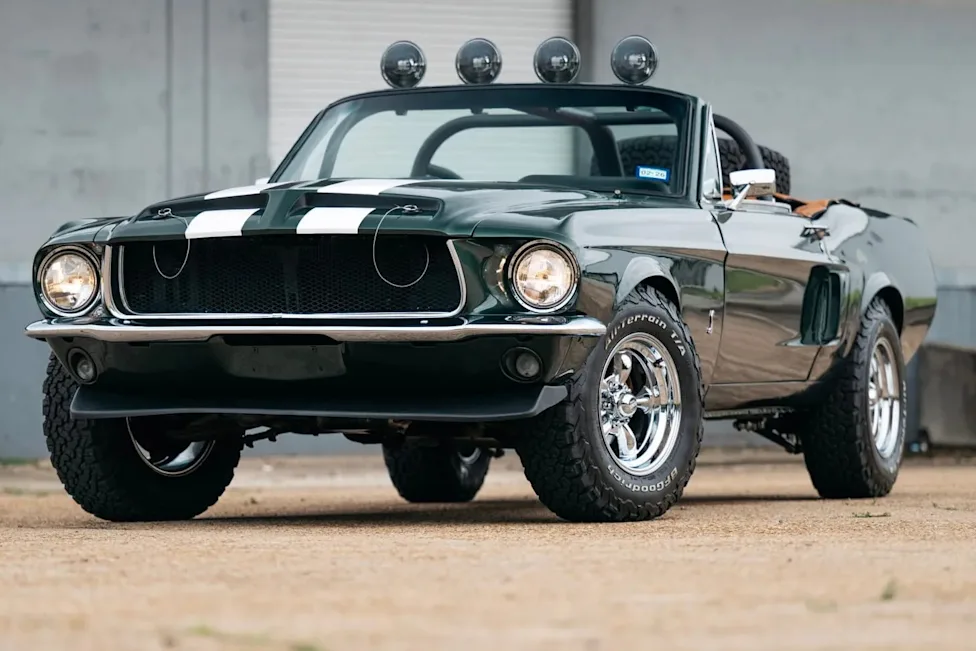


















This Thomas Crown-Style Mustang Wasn't Born a Convertible. That's the Whole Story.A 1968 Ford Mustang finished in deep British Racing Green with white stripes, a black roll cage, auxiliary lighting, and an externally mounted spare is sitting at $30,000 with no reserve on Bring a Trailer, with eight bids logged and roughly two days left on the clock. The seller built it as a tribute to the convertible Pierce Brosnan's character drove in the 1999 remake of The Thomas Crown Affair, and on looks alone it earns the comparison: Shelby-style bodywork, a wood-rimmed wheel, AutoMeter gauges, and a lifted stance on 15-inch Torq Thrust-style wheels that gives it more of a rally car's posture than a boulevard cruiser's. It is, by any honest measure, a handsome and well-executed build.It is also not the car its silhouette suggests. The title lists it as a 1968 Ford Mustang Coupe. Somewhere along the way, a fixed steel roof came off, a folding top and structure went on in its place, and a car Ford never built as an open car became one anyway. The listing calls this what it is, a convertible conversion, and that candor deserves credit. But it is also why this Mustang belongs in a conversation about what actually constitutes a collector car, rather than a conversation about what it might bring at auction.A Reference Is Not the Same as a LineageHollywood has been good to the collector market for exactly as long as collectors have been willing to pay for a story. The trouble is that not every story carries the same weight, and that is where the comparison to the industry's best-known movie tributes falls apart. Ford Mustangs sold as licensed Eleanor continuation cars, the widebody fastback built around the Gone in 60 Seconds character, carry a documented chain back to the film's production and its rights holders, and that paper trail is exactly why one sold for $550,000 at Barrett-Jackson's inaugural Columbus sale this summer. GMMG's Dick Harrell Camaro program works on a similar principle: a numbered 30-car run, an active owners registry, and dealer documentation standing behind every chassis.AdvertisementAdvertisementThis Mustang has none of that. It is a private owner's interpretation of a scene from a 27-year-old film, executed with real skill but backed by nothing beyond the build sheet the seller chose to publish. That does not make it a bad car. It makes it a different category of car, closer to a well-built hot rod with a cinematic mood board than to a documented tribute program with institutional standing behind it. Collectors who confuse the two are pricing sentiment as though it were provenance.The Detail That Matters More Than the ColorFord's VIN system for 1968 encodes body style directly into the sequence, coupe, fastback, and convertible each carry their own code, which is exactly why this car is titled as a coupe despite having no roof. That is not a flaw in the system. It is the system working as intended, flagging a modified car for what it is on paper regardless of what was done to the sheet metal.What deserves more scrutiny is the seller's disclosure that the VIN is painted over on the warranty tag. Here it reads as a byproduct of a repaint rather than an attempt to obscure anything, and the listing is otherwise forthcoming about every modification, down to the crate 289 and the retrofitted Ford 9-inch rear end. But coupe-to-convertible conversions have a checkered history in the muscle car hobby precisely because factory convertibles have always carried a premium over hardtops, and that gap has tempted plenty of sellers over the decades to blur the line between styled like and originally was. The lesson is not that this seller did anything wrong. It is that any buyer looking at a car that used to be something else owes it the same VIN and title verification, done independently of the listing photos, that they would apply to a car making no claims at all. We made a similar case recently about a kit-built GT40 prototype offered on eBay: the market has a line between homage and history, and it is drawn with paperwork, not paint.What No Reserve Actually SignalsA $30,000 entry point on a car this labor-intensive tells you something about where this build sits in the market, and it is not a knock on the work. No-reserve online auctions have become the default on-ramp for exactly this kind of car, heavily personalized, low mileage on the build, no factory documentation to anchor a higher estimate, because both buyer and seller understand the resale pool is thinner and more subjective than it is for a numbers-matching original. That is not a defect in the format. It is the format doing its job, letting the market rather than a reserve number decide what a one-off personalization project is worth this week.AdvertisementAdvertisementThat bifurcation is becoming one of the more reliable patterns in today's collector market. Documented, factory-correct cars anchor the top of every sale, while craftsmanship-driven customs and tribute builds fill out the rest of the room at a fraction of the price, exactly as they did at Barrett-Jackson's Columbus debut this summer, where the real divide was never Ford versus Chevrolet, it was provenance versus craftsmanship. The same pattern showed up in Reno this year at the Estate of John Harrah sale, where resto-mod craftsmanship carried real money precisely because it was being bought and sold as craftsmanship, not misrepresented as anything else.What Serious Buyers Should Take From ThisNone of this means the Mustang is a poor buy for the right owner. It means the right owner is someone buying a driver's seat experience and a good story, not a line item in a collection built around documented history. Anyone bidding on it, or on the next well-built tribute car to cross an auction site, should treat VIN and title status as the starting point of due diligence rather than an afterthought buried in the equipment list. Ask what the frame stamping shows, not just the data plate. Ask whether styled after comes with anyone's blessing beyond the builder's own taste. And price the car for what it demonstrably is, not for the two hours of screen time it is borrowing its identity from.The real story here was never going to be the hammer price. A coupe wearing a convertible's clothes is a tidy reminder of a rule that holds across the entire hobby: a good story can make a car desirable, but only documentation makes it a collector car. Everything else is a very well-executed opinion.Join our Newsletter, follow our Instagram page, and follow us on Facebook.