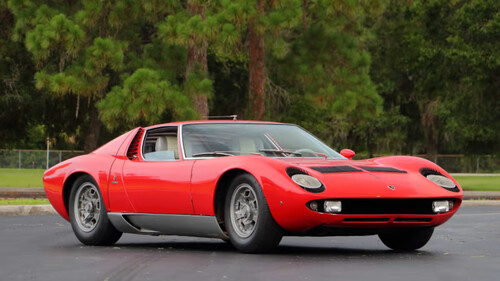
Certain cars show up long before the world is ready for them. The ones that don't just challenge the norm, but that completely ignore it altogether. These cars don't follow trends or chase headlines. They just exist. And quietly find a way to rewrite the rules for everything that comes next.Before the term "supercar" meant carbon fiber, active aero, and launch control, one machine was already out there doing its own thing. And no, it didn't come from Italy. It wasn't a machine that wore a prancing horse or a bull. But what it did have was a radical layout, absurd power, and a reputation for being so unforgiving that only the bravest dared to tame it.Most people don't talk about it today. But if you trace the roots of every mid-engine rocket on the road, you'll find this machine lurking in the shadows, waiting to tell its own story. The Birth Of A Beast: How The Auto Union Type C Redefined Race Car Engineering Auto Union Type CIn the 1930s, Auto Union wasn't just a German automaker. No, it was a government-backed engineering powerhouse formed by the merger of four companies: Audi, DKW, Horch, and Wanderer. According to Audi, this original combined logo, four interlocking rings, is still used by Audi today.Backed by the Nazi regime, Auto Union was given a clear mission: to help Germany dominate Grand Prix racing. And, yes, even if it meant outpacing fellow German rival Mercedes-Benz in the process. Thus, the Auto Union aimed to dominate with sheer innovation and firepower prior to the outbreak of World War II. So, what was Pre-War Germany's secret weapon? That'd be the 1936 Auto Union Type C. It was a machine so far ahead of its time that it didn't just move the needle. It ripped it clean off.Developed under the direction of Ferdinand Porsche, the Type C wasn't just an evolution – it was a revolution. There was no front engine and no compromise with the Type C. It was just a wild, mid-engined V16 rocket that redefined what a race car could be, setting the stage for everything that came after.The Type C's radical mid-engine layout offered better weight distribution and handling, though it also made the car notoriously difficult to control. According to Supercars.net, paired with its featherweight aluminum body, the Type C could reach over 180 mph, and up to 195 mph in its streamlined speed record configuration. It was terrifyingly fast in an era when many passenger cars struggled to reach half that speed.But make no mistake, the Type C was no showpiece. It was purely and simply a race winner. Piloted by Bernd Rosemeyer, it conquered circuits across Europe, giving Mercedes a run for their money and changing the narrative around what a race car could be.Tragically, Rosemeyer would later lose his life behind the wheel of a streamlined Type C during a 1938 land speed record attempt on the Autobahn. According to Historic Racing, a sudden crosswind sent the car out of control at over 268 mph, killing him instantly and sealing the Type C's reputation as both groundbreaking and unforgiving.What makes the 1936 Auto Union Type C remarkable today is how much it foreshadowed the modern supercar formula: high horsepower, mid-engine balance, low weight, and extreme speed. In a time when most racers were still chasing reliability, Auto Union went straight for revolution. And through their rebellious engineering process, the Auto Union truly helped invent the future. Mid-Engine Madness: The Layout That Supercars Would Later Copy V16 engine installed inside a Type CThe supercars of today thrive on a mid-engine configuration. It's certainly the norm in 2025, anyway. But back in the 1930s? A mid-engine configuration was practically unheard of. Thus, that's what made the Auto Union Type C so groundbreaking. While the rest of the racing world was still clinging to front-engine platforms, Auto Union was flipping the script. Yes, quite literally, by placing its monster V16 engine behind the driver. 1936 Auto Union Type C Specs HagertyThis rear-mid-engine configuration wasn't just for show, either. By shifting the engine behind the driver, the Type C gained a serious edge in weight distribution and traction, especially when rocketing out of corners at those dangerous, breakneck speeds. According to Hagerty, the car's layout drastically improved balance, but also made it notoriously tricky to control, especially with 520 horsepower trying to break loose at the rear wheels.It would take decades before mainstream automakers caught on. Per Auto Evolution, Ferrari didn't make the mid-engine switch in racing until 1961 with the introduction of the 156 F1 "Sharknose." Furthermore, Ferrari didn't debut its first mid-engine road car until the late '60s. Lamborghini followed with the Miura, and McLaren wouldn't build its first mid-engine road car until the 1990s.While other automakers were slow to catch on, Auto Union was already there, laying the groundwork in 1936 during the pre-World War II era. And the layout that now defines modern performance cars? Yep, the Type C did it first. From Forgotten Prototype To Supercar Godfather: The Type C’s Untamed Legacy Auto Union Grand Prix Type C racecarThe Auto Union Type C didn't just blaze past its rivals in the 1930s. No, this Nazi-backed automaker somehow found a way to redefine the future of the automotive world altogether. And yet, despite its out-of-this-world performance and sheer engineering brilliance, the Type C has somehow slipped into relative obscurity.So no, you won't find a 1936 Type C headlining auctions or stealing YouTube thumbnails. But don't get it twisted. The 1930s Auto Union Type C became the blueprint for the modern supercar, decades before the term even existed.With its mid-engine layout, lightweight body, and 520-horsepower V16, the Type C embodied everything we now associate with exotic high-performance machines. But unlike the refined supercars of today, the Type C was raw. It didn't have ABS or traction control. It had no room for error and demanded absolute precision from the driver. Only the bravest of the era dared to sit behind the wheel of the original supercar. It took nerves of steel just to keep it pointed straight.The Type C’s DNA is still alive and kicking, burning rubber wherever it meets pavement. Its blueprint can be seen peaking through machines like the Ferrari F40 or the Bugatti Veyron, today.Even if few people talk about it today, the Type C's influence is quietly embedded in every carbon-fiber missile that calls itself a supercar. The 1936 Auto Union Type C wasn't a fluke. It was a warning shot from the past. It was a car so ahead of its time that the world needed another 50 years just to catch up. Other Pre-War Machines That Helped Redefine Engineering 1938 Mercedes-Benz W 125 V12 carWhile the Auto Union Type C was the OG, it wasn't the only pre-war machine rewriting the rules of speed and design. A few other icons from the 1930s also laid crucial groundwork for what we now recognize as supercar engineering.Take the Mercedes-Benz W125 Rekordwagen, for example. Built in 1938, this one-off land-speed monster packed a supercharged V12 pushing over 700 horsepower. According to Concept Carz, it reached a blistering 268.9 mph, which is a record for public roads that stood for nearly 80 years. With its fully enclosed aerodynamic body and outrageous power, it showed that top speed wasn't just about displacement. It was about streamlined efficiency and bold engineering.Then there's the 1938 Alfa Romeo 8C 2900B Mille Miglia. Widely considered one of the first true performance grand tourers, this 1930s machine paired a supercharged inline-eight with exotic styling and a competition pedigree. Capable of over 110 mph on Italian roads, it proved that speed could wear a sculpted and elegant face long before Ferrari ever sold its first car.The Mercedes-Benz W125 Rekordwagen and the 1938 Alfa Romeo 8C 2900B Mille Miglia weren't mass-produced machines or status symbols. They were rare, dangerous, and deeply ahead of their time. Together with the Type C, they formed the backbone of pre-war automotive innovation. And these three helped define the supercar blueprint long before "supercar" became part of any gearhead's vernacular.It's safe to say that the Auto Union Type C never did and will never become a household name. But just ask any true gearhead. Its fingerprints are all over the cars we obsess over today. From its wild mid-engine layout to its unapologetic thirst for speed, it wasn't just ahead of its time. It was operating in a different dimension altogether.The Type C didn't just race. No, the 1936 Auto Union Type C rewrote the rules, quietly laying the foundation for everything we now call a supercar. So the next time you see a carbon-fiber missile tearing down a back road or a V16 prototype on a concept stand, just remember, it all started long before the world was ready. And the Auto Union Type C was there, waiting for the rest of the world to catch up.