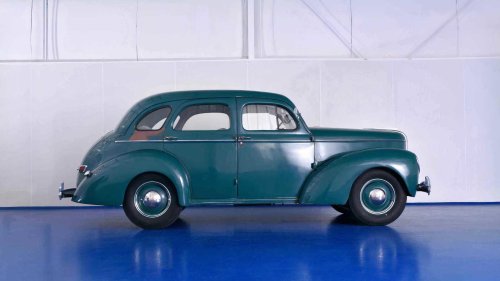
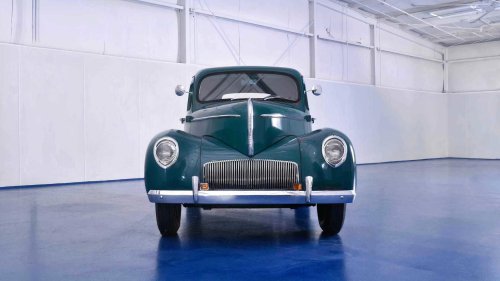
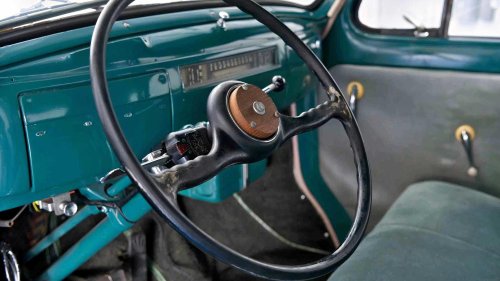
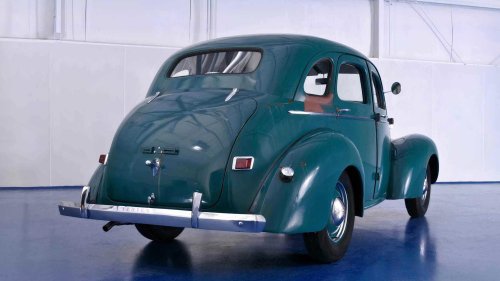
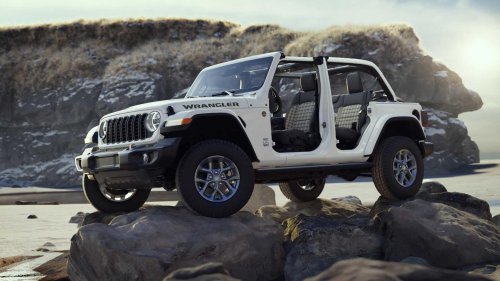


















Jeep sedans and coupes sound like a patently ridiculous idea in 2026. Not that we would mind seeing Jeep's take on a rally car, but the brand was the early pioneer of the American SUV, and it would be absurd for Jeep to steer away from the segment it carved out now that it dominates the market. But, Jeep's forebear, Willys, actually produced a number of car-type cars in the pre-war era, and even during World War II.Perhaps the most iconic of these early cars, and one with a nameplate that Ford probably wishes it had come up with, would be the Willys Americar. The Americar was first built in 1937, available in coupe, sedan, wagon, and pickup body styles, and was ultimately phased out during the Second World War as Willys shifted its attention to the effort overseas. Here's what you need to know about the most popular Jeep before there was any such thing as a Jeep. The Americar Helped Willys Stay Afloat After The Great Depression Sugar Creek Collection via Hagerty Willys is an older company than you might think, dating back to 1909, when John North Willys (pronounced like Bruce Willis, not like you've got a case of the willies) bought the Overland Automotive Division of Standard Wheel Company. He renamed it the Willys-Overland Motor Company in 1912, and, for a moment, the brand was second only to Ford as America's largest automaker.The Americar came along in 1937, based on an earlier model, the Willys 77. It was the brainchild of Joseph Frazer, who felt that the way forward for the brand (which was struggling to stay relevant by the mid-1930s) was to develop an affordable compact car with a sleek modern look.The "Americar" name didn't come around until the 1941 model. Before that, the car was known by its model year. The Willys 37, the Willys 38, and so on. But, obviously, once you come up with a name like "Americar," it's going to stick.In 1941, Chevrolet sold 1,008,976 vehicles, and Ford sold 691,455 units. Meanwhile, Willys' flagship Americar moved a relatively modest estimate of 22,000 units. While that's not exactly giving the big three a run for their money, it did keep the company's head above water after a particularly rough period through the Great Depression. Willys would go on to sell around 7,000 units in 1942, and then scrap the model entirely. Suffering From Success Sugar Creek Collection via Hagerty September 1939, World War II is declared. 1940, Willys, Ford, and American Bantam collectively produce 8,598 army trucks for the American Armed Forces. November 1941, production on the Willys MB, or simply, the Jeep, begins.In order to keep up with demand, Willys shut down production of all civilian vehicles, and the Americar was no more, with the automaker devoting itself entirely to the war effort. By the end of WWII, Willys had produced 362,841 of America's 647,870 Jeeps. During the brief period wherein the two were being made simultaneously, the Americar was marketed as a "brother under the hood" to the army truck, owing to their shared 2.2-liter straight-four.In order to find success as a manufacturer for the American military, Willys-Overland had no choice but to abandon its hopes of building a mainstream sedan for the American civilian. Ultimately, it worked out better that way.Willys-Overland filed a trademark application for the "Jeep" name in early 1943, but the brand wouldn't be awarded ownership of the title until 1950. At this point, Willys was struggling to find its place in a post-war America. The final attempt at fitting in with the sedans and coupes that dominated American highways in the mid-1950s would be the Willys Aero, a compact produced from 1952 to 1955.But, the Aero wasn't the last time the Willys name would be attached to a coupe or a sedan. Maybe the most obscure piece of Jeep history – to the best of our knowledge – would be the Willys Interlagos, which was an Alpine A108 rebranded for the South American racing scene. But that's a whole other story. Are Any Of These Americars Still Around? Sugar Creek Collection via Hagerty These days, it's difficult to find a Willys Americar anywhere but an automotive museum, like the Western Antique Aeroplane & Automobile Museum, where you can see a still-functioning 1942 model. Willys officially produced fewer than 30,000 of these cars under the "Americar" nameplate, and many of them wound up in the hands of customizers and hot-rodders, back when going 0-60 mph in under a minute felt like being strapped to a rocketship. So, a stock Willys Americar in one piece is a gem.The only auction that even turns up on Hagerty, for instance, is a listing for a 1941 DeLuxe sedan which sold in 2025 for $6,750, and the shape it was in could best be described as a fixer-upper. Before that, we were able to turn up an eBay listing for a working 1941 model, selling for $100,000 more than 10 years ago after 28 bids. The Automotive Market Eventually Caught Up With Jeep Sugar Creek Collection via Hagerty It may sound silly to say this about a brand that we associate with nostalgia for the Greatest Generation and the post-War era, but Willys-Overland's biggest challenge in the mid-20th century was being a little too far ahead of the curve. Willys always struggled to fit in with the four-door family cars of the American highway's golden age, but the entire automotive industry would eventually come around to seeing things Jeep's way, producing more SUVs and crossovers than sedans and coupes.We've covered in the past how Jeep actually laid the groundwork for the Japanese SUV market, when a captured army truck served as an inspiration for what would become the Toyota Land Cruiser. But we don't even need to get into a history lesson, you only need to take a look at market share among the various automotive segments over the last few decades to see how these larger family cars have usurped sedans and coupes as the go-to means of transportation for a typical American driver. SUVs Make Up More Than Half Of All New Vehicle Sales Jeep According to the Federal Highway Administration, SUVs made up 6.9% of the marketplace in 1995, then 10.2% in 2000. From 2021 to 2025, SUV market share grew from 46% to 52% of all new vehicle sales. Meanwhile, sedans and coupes have become relatively niche, making up around one in five new vehicle sales.The advent of more nimble crossovers certainly played a part in warming the general public up to SUVs. What had once been regarded as a rugged, off-road oriented segment would soon come to replace station wagons, minivans, and large sedans as the go-to option for family vehicles. With cushier seats, road-tuned suspension, and more car-like handling, an SUV like the Toyota RAV4 could do just about anything a sedan could do, but with more headroom and a couple of extra inches of ground clearance in case the road gets rough.Additionally, SUVs routinely outperform sedans when it comes to crash test ratings, another key consideration when buying a car to chauffeur your family.Willys-Overland might not have known that the body type it had helped to pioneer would one day dominate the American highway. In fact, Jeep has retained its rugged, adventure-vehicle identity even as it has rolled out more versatile, highway-oriented family vehicles. All the same, what we've seen since World War II has ultimately been closer to an entire industry adapting to Jeep's way of doing things, rather than Jeep successfully adapting to what the rest of the industry was doing.