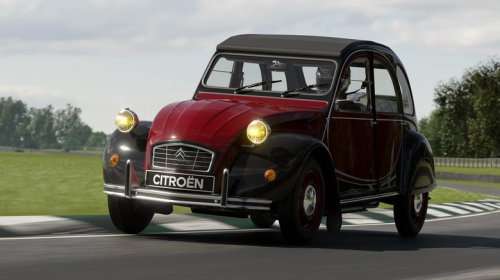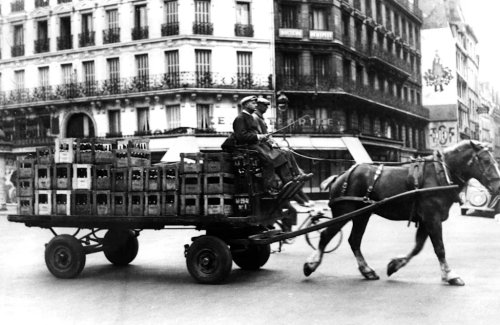
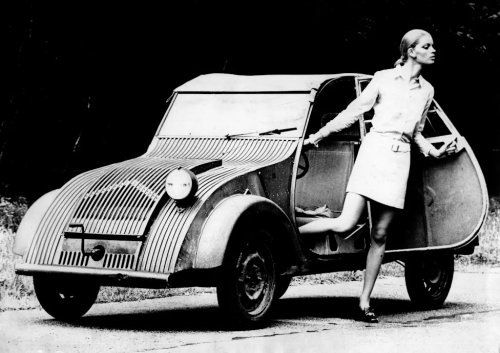
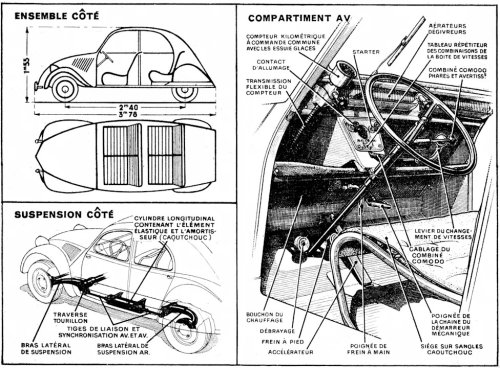
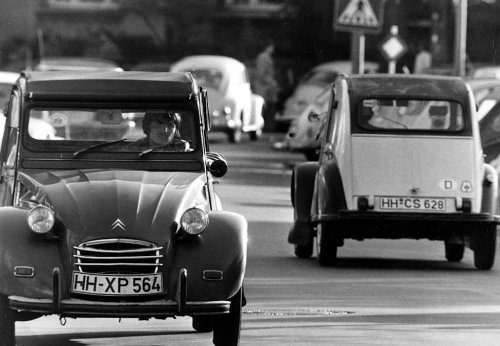




















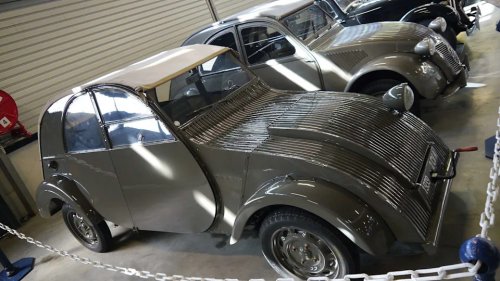


Autoblog and Yahoo may earn commission from links in this article.A Very Serious TestSomewhere in a French field in 1939, an engineer is driving a strange little prototype car across a freshly plowed field with a basket of eggs sitting on the passenger seat. He is not doing this for fun, and he is not doing it for a photographer either, because there was no launch planned yet that anyone outside the company knew about. He is doing it because his boss demanded, in writing, that the car be capable of exactly this: crossing rough farmland at speed without cracking a single shell — and if it fails, it's back to the drawing board, no exceptions and no partial credit. That's no marketing gimmick; it was an actual, literal engineering requirement for what would become the Citroën 2CV, one of the most beloved cars ever built.In the 1930s car companies were chasing horsepower, styling, and prestige, competing on the same handful of metrics as everyone else in the industry. Citroën, under new ownership and genuinely desperate for a hit that would reach an entirely different customer, was instead chasing something almost nobody else cared about: whether a basket of eggs could survive a bumpy field. That single, oddly specific priority tells you almost everything you need to know about who this car was actually built for.The Tire Guys and CitroenThe origins of the 2CV dates back to the 1930s. At the time, Citroën went bankrupt, and the company that took it over had very different priorities than the one that had run it before. The company's largest creditor, tire giant and haute cuisine guide curators Michelin, took it over in 1934. But unlike the private equity firms of today, the tire guys were actually invested in growing the automaker. Its new owner commissioned an actual market survey of rural France to figure out what buyers there genuinely needed.AdvertisementAdvertisementWhat they found was stark: millions of farmers in the French heartland still relied on horses and carts because cars, as they existed at the time, were priced entirely out of reach for that population. This wasn't a niche gap in the market, in their eyes was an economic injustice: the auto industry of the day had largely ignored a huge, underserved segment of the French population.In response, Citroën vice president Pierre Boulanger handed his design team a brief that reads more like suggestions and ideas than a spec sheet. He wanted something low-cost; what he described as an "umbrella on four wheels:" a car that could carry four people and 50 kilograms (~110 lbs) of farm goods to market at 50 kilometers an hour (30 mph), across muddy, unpaved roads, using no more than 3 liters of fuel per 100 kilometers.If those instructions weren't vague enough, Boulanger stated that if the suspension of this new car couldn't keep a basket of eggs intact over a plowed field, the car wasn't any good, no matter how well it performed on every other metric. It wasn't a quality that it dreamed up for giggles; it symbolized the kind of real-world conditions that its engineers were tasked with. ullstein bild/ullstein bild via Getty ImagesWorld War II Interrupted Its Development By 1939, Citroën's boffins had built about 250 prototypes, which it called the TPV (Toute Petite Voiture, or "very small car" in English), and was set to debut the finished product at the Paris Motor Show that October. Years of development were finally about to pay off in front of the public, but something completely out of the automaker's reach threw a monkey wrench into its plans. Just a month before the show, France declared war on Germany, the launch was scrapped and abandoned, and the entire project turned from being an engineering achievement to a liability almost overnight. Like much of civilian life, French industry both large and small was controlled by the Germans during its occupation of France in World War II. Boulanger personally refused to collaborate with German authorities, and his resistance was so prominent, the Gestapo listed him as an "enemy of the Reich;" effectively giving him a big, red target on his back. With this in mind, Boulanger had TPV prototypes buried in secret locations and even worked with the French Resistance to relabel the rail cars containing its tooling before it could be captured. AdvertisementAdvertisementWhen the war ended, France was left with a shattered road network and a fraction of its prewar vehicles still running. Once a nation of two million cars, just 100,000 remained on French roads. Reflective of this reality, the horse and cart had crept back into daily life out of sheer necessity; the exact kind of situation Citroën had prepared for, now made dramatically worse by half a decade of war. Once conditions allowed, Boulanger revived the project and brought in engineer Walter Becchia to design a new air-cooled flat-twin engine suited to the car's original brief and launched the finished 2CV at the 1948 Paris Salon.Patrice Cartier / Hans Lucas / AFP via Getty ImagesView the 2 images of this gallery on the original articleAusterity and Optimism In the years after World War II, western automakers and its customers looked ahead and were putting the wartime life of rationing behind them. With this in mind, it was easy to say that upon its release, the international motoring press wasn't quite impressed with the 2CV. Its no-frills, barebones nature was a far cry from other post-war motors from like the British Morris Minor and then-contemporary offerings from Ford and Chevrolet over in Detroit. A review in Britain's Autocar at the time noted that the 2CV was the work of a designer who'd "kissed the lash of austerity with almost masochistic fervour," while an American motoring journalist reportedly asked if it came with a can opener. In the end, none of it mattered, and its sales numbers and demand made that clear almost immediately. In just a few months after it launched, Citroën amassed a three-year waiting list for the 2CV. By 1952, the waitlist stretched to five years. Keeping in line with his mission to mobilize the masses, Boulander declared that 2CVs be sold preferentially to "those who have to travel by car because of their work and for whom ordinary cars are too expensive to buy," including country vets, doctors, midwives, priests and small farmers will have priority. In a nutshell, there was so much demand for the 2CV, that it was the late-40s motoring equivalent of a Lububu. Used 2CVs were worth more than a new one, simply because the buyer didn't have to wait half a decade for delivery. Hans G. Lehmann/ullstein bild via Getty ImagesView the 3 images of this gallery on the original articleThe 2CV Represents Many Different Things During Different PeriodsAlthough the 2CV was no conventionally pretty or luxurious item, the car was a clever piece of work from an engineering perspective. At a time when automakers used leaf springs, the 2CV featured a fully independent suspension that used interconnected horizontal coil springs and mass dampers, which gave it its characteristically soft ride quality. Like many of today's rugged SUVs, it was set up for long-travel, which allowed the 2CV to be useful offroad. Though the car was extremely underpowered by today's standards (the first 2CVs made a whopping 9bhp), its lightweight makeup and reputation for durability helped cement itself as a French motoring icon. AdvertisementAdvertisementIn the years and decades after its release in 1948, the 2CV was consistently updated with additional quality of life and engine updates, including bigger windows, additional lights and even features like ashtrays. Different variants of the 2CV appeared throughout its production run, including the Fourgonnette van, and the four-wheel-drive, twin engine Sahara. Over its 42-year production run, more than 3.8 million examples were built, making it Citroën's most successful model.They were everywhere, driven by everyone and even used as taxis in cities like Paris. Even Roger Moore drove one as James Bond in For Your Eyes Only, when his Lotus Esprit self-detructed. By the time production ended in 1990, the 2CV had become far more than basic transport. It was a cultural icon, symbolising practical ingenuity and a uniquely French approach to automotive design.Blick/RDB/ullstein bild via Getty ImagesView the 2 images of this gallery on the original articleConclusionThough it enjoyed steady success in the 40s and 50s, the 1970s was when the 2CV came into its own. The 1973 oil crisis triggered its best sales year in 1974, and after then, it had become an youth icon as a form of stylish, cheap transportation. Throughout its run, Citroën has tried its best to replace the 2CV with more contemporary economy models like the Visa and AX, though newly introduced emission standards in Europe would be its ultimate demise. AdvertisementAdvertisementToday, the 2CV stands as a testament to practical engineering and resilient design that defined an era of French motoring; one that Citroën is using as direct inspiration for some of its current and future offerings. In 2022, it collaborated with Caselani for the Berlingo 2CV Fourgonnette, a special coachbuilt conversion for the Berlingo van that is inspired by the 2CV-based commercial vans that roamed European streets for decades. In addition, Citroën announced in May 2026 that it'll return to the Paris Motor Show in October with a new electric 2CV, which may potentially target a sub-$17,000 price point.The term "people's car" is one that is thrown around loosely, but optimally reserved for cars like the original Volkswagen Beetle and the original Mini, cars that were bought in the millions that were meant to mobilize the masses. The 2CV is cut from the same kind of cloth; Boulanger demanded a car that was not only cheap, but inexpensive enough for a farmer to move on from the horse and cart. He wanted a car that was not just comfortable, but smooth enough to carry a crate of eggs across a plowed field without breaking. It's the difference of a car of the people and a car for the people; an occurrence when company and customer sees eye to eye for the betterment of the world. This story was originally published by Autoblog on Jul 27, 2026, where it first appeared in the Features section. Add Autoblog as a Preferred Source by clicking here.