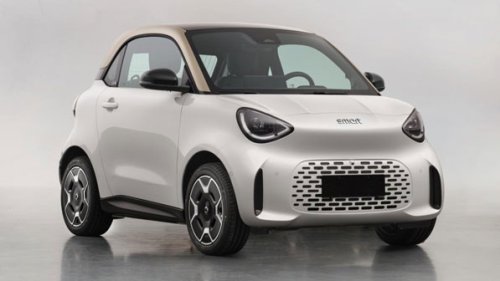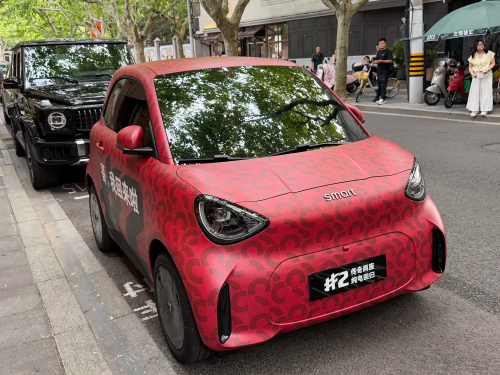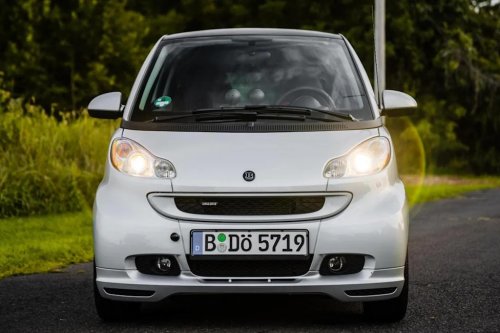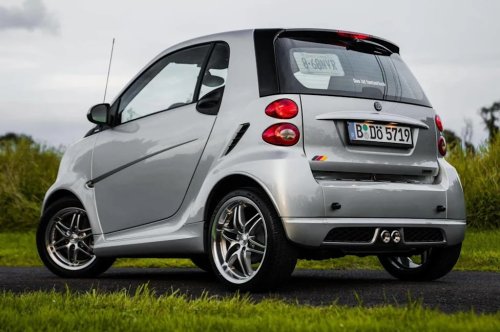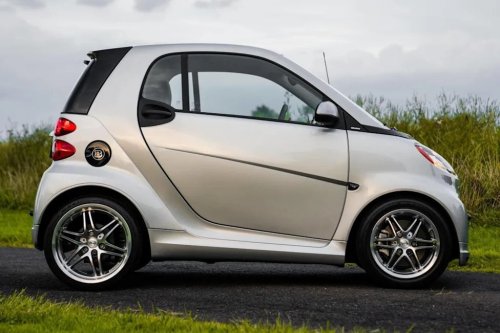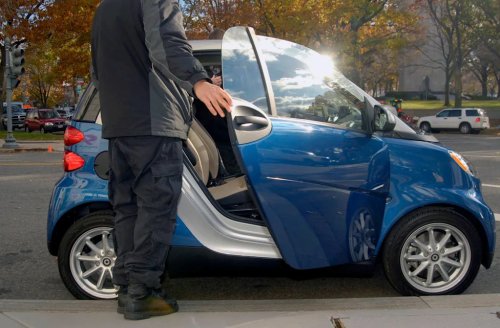
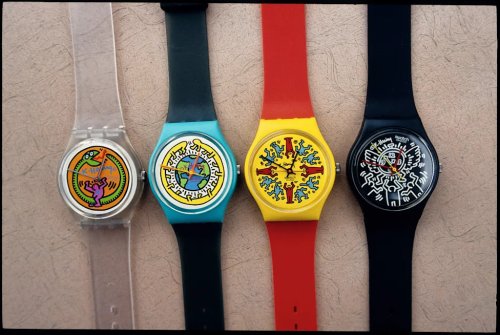
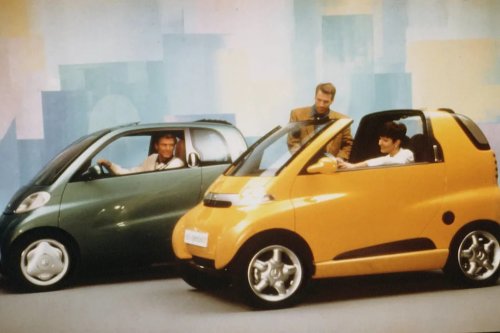
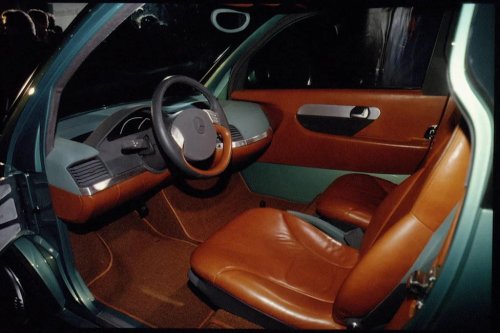
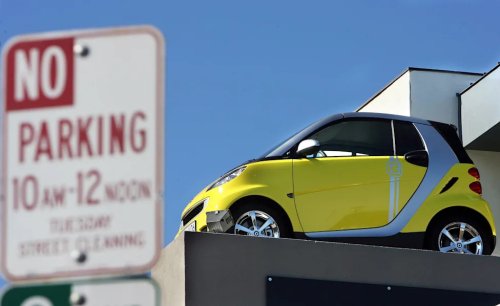



















Autoblog and Yahoo may earn commission from links in this article.A Watchmaker Walks Into a ShowroomIf you say the name "Smart car" out loud, most people, whether they are car enthusiasts or not, will picture the same thing: a tiny two-seater that looks like it got cut in half. It's the kind of car that seems to be built almost as a joke about how small a car could possibly be and still be road legal. From 2008 to 2019, Mercedes affiliate Smart sold the Fortwo officially in the United States, a pint-sized city car designed for mobility within the urban jungle. You probably remember this vehicle. Throughout its short, but memorable lifespan in the U.S. market, they were everywhere. The infamous Car2Go service got its start renting out smart cars. Simon Cowell and Justin Bieber owned customized ones, while Paramore pulled up to the 2008 VMAs in them.Jay Mallin/Bloomberg via Getty ImagesView the 3 images of this gallery on the original articleAdvertisementAdvertisementFor its 11 years on the market, it made quite an impression on American motorists as both a beloved vehicle and a comedic punchline. After the 2019 model year, Mercedes-Benz officially withdrew the Smart brand from the U.S. market due to low sales and high federalization costs.Although most can picture a smart car in their head, almost nobody has a clear picture of how it originated. It didn't come from thin air, or the bowels of a backroom conference room in Stuttgart; it was the brainchild of Nicolas Hayek, a Swiss watch executive. The Smart car's origin story has nothing to do with automotive engineers dreaming up a clever new city car. It started with the man who created Swatch and an idea so far outside the watch business that it's genuinely strange it ever got built at all.The Man Who Saved The Swiss WatchTo understand how a watch company ends up designing a car, you have to understand Hayek and his savior-like role in the Swiss watch industry. In the late 1970s and early 1980s, the Swiss watch industry faced a crisis that could've ended the generations-long industry for the small, neutral nation's horological artisans. This period, known as the "quartz crisis," was driven by the sudden arrival of inexpensive, highly accurate quartz watches from Japanese manufacturers like Seiko, Citizen, and Casio. By 1978, quartz watches became more popular than mechanical ones, plunging the Swiss watchmaking world into turmoil. Bound by centuries of tradition, Switzerland's iconic watch houses hesitated to innovate, which led to a dramatic decline. Between 1970 and 1983, the number of Swiss watchmakers reduced from 1,600 to 600, while employment across the sector plummeted from 90,000 to just 28,000 by 1988.Sabine Wunderlin/RDB/ullstein bild via Getty ImagesView the 2 images of this gallery on the original articleAdvertisementAdvertisementAfter two of the largest Swiss watchmaking giants in the country merged with the assistance of a massive bank bailout, Nicolas Hayek was tapped to help restructure the industry. Apart from streamlining and simplifying most of the processes, he steered toward a product that took an approach that the old-guard watchmakers didn't take. To recapture the entry-level market taken over by Japanese competition, he used plastic, mass production, and playful design to launch Swatch in 1983 as a genuinely disposable, fashion-forward watch that people would buy multiples of rather than one expensive piece meant to last a lifetime.It worked. Swatch became a global phenomenon through the 1980s and beyond, and Hayek became something close to a folk hero in Switzerland for pulling an entire national industry back from the edge. Somewhere in the middle of that success, Hayek started thinking bigger than watches, and landed on an idea that seems almost absurd in hindsight: applying the exact same philosophy behind Swatch for a car. He envisioned something that he reportedly dubbed the "Swatchmobile," a minimalist urban runabout meant to bring the same disposable, personalizable design logic that had reinvented the watch industry to the automobile.Charles Caratini/Sygma via Getty ImagesWin Some, Lose Your MindAmbition and vision can only get a car idea so far without an actual automaker helping you actually develop and sell said car. In 1991, Swatch entered into an agreement with Volkswagen to share development. However, the entrance of CEO Ferdinand Piëch in 1993 brought a sudden end to the collaboration; favoring their own city car project instead — the Volkswagen Lupo. Hayek eventually partnered up with Mercedes-Benz's parent company Daimler-Benz. In 1994, they entered into a joint venture called Micro Compact Car AG to bring the concept to production. At a news conference to celebrate the occasion, Hayek envisioned the vehicle as a car for the masses, stating that it would "permit all peoples in all countries to achieve the dream of personal mobility that we have achieved in the industrialized lands." AdvertisementAdvertisementWhile it may have seemed like a marriage of equals, the partnership was never equal to begin with. While Swatch brought the marketing magic and artful energy, Daimler-Benz brought the big guns. Along with the suits and number crunchers, they appointed designer and engineer Johann Tomforde; the leader of Mercedes' own city-car project, which had been working on a similar concept since 1972. With this upper hand, they were prepared to say no to anything. Hayek initially wanted a hybrid or electric powertrain in his car, but his appeals would fall on deaf ears. He also wanted the car to be named Swatchmobile or "Swatch Car," but the name that eventually emerged from the partnership was Smart. It was a portmanteau built directly from the collaboration; the letter "S" stood for Swatch, "M" for Mercedes, and "art" for the design ambition behind the whole project. Reuter Raymond/Sygma via Getty ImagesView the 4 images of this gallery on the original articleIn fact, the 1994 news conference to establish the Benz-Swatch partnership in Stuttgart was also host to unveiling of two concept cars: the "eco-sprinter" and "eco-speedster", two proto-designs that were styled by Tomforde's team. Functionally, the car would be a Mercedes engineering project wearing Hayek's original concept as a marketing story. Without having much input on anything from the name, to the car's design, Hayek grew so frustrated that he and other Swatch officials walked away from the project before a single car was built. Shortly after the launch of the original Smart City-Coupe in 1998, Daimler took full control of the brand and kept the name because it had already built recognition. In a 2001 statement to German business magazine Brand eins Online, Swatch stated that the eventual product that was pumped out wasn't theirs, stating that cars like the Fortwo are purely Daimler-Benz products that have "nothing in common with the plans of the former Swatch team." Nonetheless, Daimler-Benz and later Mercedes-Benz AG continued developing the City Coupe and cabrio into the Fortwo. By the mid-2000s, the Smart brand became Mercedes' lower-cost, youth-oriented brand that had BMW's Mini in its crosshairs. Beyond the Fortwo, it expanded the Smart brand with new models like the sporty two-seater Roadster, as well as the two-row Forfour.GABRIEL BOUYS/AFP via Getty ImagesWhat's In a NameWhat's left of that origin story is the name itself, sitting on badges that most drivers assume refers to intelligence or technology rather than the actual truth. There's something almost poetic about a watchmaker's philosophy getting engineered out of the finished product while the traces of the origin stuck around as part of the brand name for the next three decades. On June 28, 2010, Nicolas Hayek died of a cardiac arrest at the Swatch Group headquarters. Since 2019, Smart has been operating as a joint venture between Mercedes-Benz AG and Zhejiang Geely Holding Group, who plans to manufacture the next version of Smart-branded vehicles in China. AdvertisementAdvertisementThe Smart car was never smart in the way people assume. It was smart in the way that Nicolas Hayek had demonstrated for most of his career: audacious, contrarian, and willing to bet an entire industry's reputation on the idea that small and playful could beat big and serious. That bet mostly worked out for Swatch. For the car that carried its name into showrooms decades later, the results were considerably more modest, and its brainchild wasn't even around for the ending by the time it arrived.This story was originally published by Autoblog on Aug 26, 2026, where it first appeared in the Features section. Add Autoblog as a Preferred Source by clicking here.