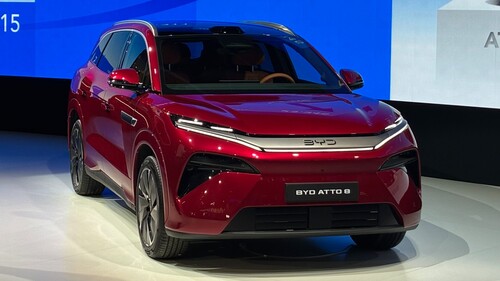
Gasgoo Munich-On August 25, 2026, China’s autonomous driving sector cleared a hurdle it had long struggled to surmount.That day, a draft revision to the Road Traffic Safety Law was submitted for its first reading at the 24th session of the Standing Committee of the 14th National People's Congress.Image Source: XinhuaOne change demanding the auto industry’s attention is the inclusion of a dedicated chapter on "special provisions for autonomous vehicles." The draft specifies that if a traffic violation occurs while the autonomous driving function is active, the vehicle’s manufacturer or importer is responsible for handling the penalty. Conversely, if the function is inactive or the vehicle is only equipped with driver-assistance features, it is managed as a non-autonomous vehicle.Cui Dongshu, a secretary-general at the China Passenger Car Association (CPCA), summed up this shift as moving from "human driving" to "vehicle liability." In his view, a key significance of this amendment is drawing a sharper line between driver assistance and autonomous driving—giving consumers a clearer institutional expectation on "who is driving, and who is liable when things go wrong."That assessment captures the most immediate change in the amendment.But a concept here still needs to be unpacked.The draft currently clarifies administrative liability for traffic violations—determining who handles penalties for offenses like speeding or running red lights while the system is active. This does not equate to a total transfer of civil compensation, product liability, or even criminal liability to automakers the moment an autonomous driving accident occurs.Because of this, "from human driving to vehicle liability" is more of a direction than a completed allocation of responsibility.The truly complex questions are just beginning. As the law starts distinguishing between "human driving" and "system driving," where exactly does liability begin and end after an accident?On real roads, the trickiest scenarios likely aren't "fully human" or "fully automated" driving.The system may have controlled the vehicle for a long time, only to demand driver takeover seconds before danger strikes. The risk forms while the system is running, yet the collision occurs after it has reverted to manual control.Once the system disengages, can liability disengage immediately too?That may be the hardest question to answer once autonomous driving truly enters society.Question: The "Gray Zone" of Human-Vehicle HandoverOn March 29, 2025, a standard version Xiaomi SU7 was involved in a serious accident on the Chizhou-Qimen section of the Deshang Expressway in Anhui.Construction had closed the original lane, requiring a detour to a contraflow lane. The system flagged the risk and decelerated as it approached the obstacle. The driver then took over, NOA disengaged, and the collision occurred.To this day, no authoritative allocation of liability for this accident has been made public.Thus, it cannot serve as proof of whether the driver or the automaker should bear liability. But as a real-world sample, it raises a typical question: If the danger formed during the assisted driving phase but the collision happened after the driver took over, which moment actually counts?If we look only at the instant of collision, the answer seems simple: the system was out, the human was driving.But accidents don't materialize suddenly in the split second of impact.When did the system detect the construction zone? When did it start slowing down? When did it request intervention? How much time did the driver have to reassess the environment, judge the risk, and execute an evasive maneuver?If the accident was already unavoidable by the time the driver truly took control, can a formal system disengagement completely sever the link between the system's prior actions and the crash?This isn't just a debate within the industry. Over a year later, national standards have formally addressed similar scenarios.On June 27, 2026, the mandatory national standard GB 47955—2026, "Safety Requirements for Combined Driver Assistance Systems of Intelligent and Connected Vehicles," was approved and set to take effect on January 1, 2027. The standard establishes a unified safety baseline for combined driver assistance and adds relevant testing and safety requirements tailored to China's road environment.This change signals something critical: the fact that the driver bears driving responsibility does not mean the assisted driving system has no floor for its own safety capabilities.At the L2 stage, the driver must still continuously monitor traffic conditions and control the vehicle—a product positioning clearly defined by the standard.But "the driver should be ready to take over at any time" cannot be used in reverse as a get-out-of-jail-free card for a system's inability to handle complex scenarios.Image Source: HuaweiIn other words, two concepts need to be separated: driving liability is one thing; whether the system meets safety requirements is another.At L3, this distinction becomes even more pronounced.On July 30, 2026, the national standard GB 44721—2026, "Safety Requirements for Autonomous Driving Systems of Intelligent and Connected Vehicles," was approved, effective July 1, 2027. Applicable to L3 and L4 autonomous systems, it mandates requirements for system safety, driver takeover capability monitoring, and minimal risk strategies.The logic behind this isn't complex: true autonomous driving cannot simply dump the final few seconds on the driver when it can no longer resolve a danger.Therefore, in future accidents involving human-machine handover, relying solely on "who held the steering wheel at impact" will become increasingly difficult.What truly needs reconstruction is the entire process: when the system detected the risk, when it reacted, when it requested handover, whether the driver had a reasonable reaction window, and exactly when the risk materialized.Thus, the first liability hurdle autonomous driving must clear isn't "human vs. vehicle responsibility," but rather how responsibility is handed over between the two.Industry: From Capability Wars to Liability Commitments?This shift in liability could also reshape the competition for intelligent driving among automakers.Today, some advanced city NOA systems can already handle complex maneuvers like car-following, lane changing, navigating intersections, and entering and exiting ramps. Data from the Ministry of Industry and Information Technology shows that since 2026, the market penetration of new passenger cars equipped with combined driver assistance in China has reached 70%, with the penetration of models featuring NOA exceeding 30%.For ordinary consumers, the experience of some high-end L2 products is getting closer and closer to "the car driving itself."But the legal attributes haven't blurred as a result.GB 47955—2026 still explicitly states that combined driver assistance provides aid only on the premise that the driver continuously monitors traffic conditions and controls the vehicle.Only upon entering L3 does the system begin to assume dynamic driving tasks under specific conditions.This means that while technical capability may improve incrementally, legal liability undergoes a distinct phase transition.For this reason, evaluating an automaker's autonomous capability in the future won't just be about asking "how many cities, how many kilometers," but adding another question: How much liability is the company willing to shoulder for its system's performance?Cui Dongshu also judges that post-amendment, industry competition may shift from "who has flashier features" to "whose system is safer and who has a stronger capacity to bear liability." But at least for now, this shift is just beginning.This May, BYD provided a noteworthy pilot case to watch.Image Source: BYDOn May 28, BYD announced it would provide one year of city navigation safety underwriting for users of its "God's Eye" A and B systems. If an at-fault traffic accident occurs while using the City NOA function within the prescribed scope, BYD will cover the direct economic losses— including vehicle repairs, third-party property damage, and personal injury. BYD later clarified that this service is not insurance and cannot replace compulsory traffic insurance or commercial vehicle insurance.Here, too, boundaries need to be drawn.BYD currently provides L2 driver assistance; this underwriting is a proactive commercial commitment by the company and does not imply that legal driving liability has shifted from the driver to the automaker.Close behind, Huawei announced new coverage and service benefits for its ADS high-function package, extending protection to urban NCA, highway NCA, and full-scenario parking.The coverage is similar to BYD's: if an accidental accident occurs during normal use of driver assistance, causing personal injury or property loss to the occupant or a third party, the company bears the cost.However, several details in Huawei's plan are worth noting. First, the coverage period is linked to the purchase date: users who bought the high-end package before the July 1 price adjustment get one year of coverage, while those buying after get three years.Second, Huawei attributed the price adjustment to rising hardware costs. Data shows spot prices for high-end automotive-grade DDR5 have surged over 300%, with demand for high-compute chips from AI companies squeezing automotive-grade chip capacity.Meanwhile, the one-time buyout price for the ADS Max high-end package reverted from 32,000 yuan to the standard price of 36,000 yuan. The final price after automaker subsidies rose from 12,000 yuan to 15,000 yuan.Huawei's confidence in underwriting also stems from data accumulation. As of May 2026, Huawei's Qiankun Intelligent Driving ADS system had accumulated 11.47 billion kilometers of assisted driving. The monthly active user rate reached 95.1%. Huawei stated that the underwriting benefits are based on technical confidence derived from massive real-world road test data.But so far, these remain isolated cases. Whether this develops into a new industry-wide competitive dynamic depends on whether more companies follow suit.Yet these samples raise an interesting question: in the past, companies proved their intelligent driving prowess by citing city coverage, takeover mileage, chip computing power, and algorithm routes.As capabilities across brands converge, will the amount of economic risk a company is willing to bear for its system's performance become a new form of product differentiation?To some extent, this is easier for consumers to grasp than a vague claim that "our intelligent driving is safer."Technical specs are complex, but "what the company is willing to cover if things go wrong" is concrete.This doesn't mean the intelligent driving race has entered a so-called "liability competition."More accurately, liability commitments are becoming, for the first time, a perceptible variable in the intelligent driving competition.And if true L3 arrives at scale, this shift could become even more pronounced.Because by then, companies will face not just product performance, but system safety, data recording, human-machine handover, accident investigation, and far more complex legal and compliance challenges.When autonomous driving truly crosses the L3 threshold, companies won't just be crossing a technical barrier.They will be crossing a liability threshold as well.Institutions: Who Proves, Who Pays, Who Foots the Bill?As liability boundaries become more refined, another question grows in importance: after an accident, on what basis do we determine who is at fault?After a smart vehicle accident, the truly critical information extends beyond surveillance footage and impact marks.When was the system activated? When did it detect the obstacle? What judgment did it make? When did it brake? When did it request a takeover? When did the driver intervene? Was the vehicle executing system commands or human commands immediately before the crash? Which OTA version was running? All this information can directly influence liability determinations.And a vast amount of this critical data resides first and foremost with the automakers.This raises a question the autonomous driving era must face: the potentially liable party may also be the holder of key evidence.So simply requiring vehicles to "record data" will not be enough in the future.How long data is saved, whether consumers have the right to read it, and how authorities access it are critical. Unifying data formats and allowing third-party agencies to independently reconstruct accidents also require supporting institutions.OTA updates will complicate this further.When a traditional car crashes, investigators analyze a basically fixed mechanical product.A smart car, however, may alter its perception algorithms, control strategies, or even functional boundaries after a single software update.Future accident investigations will need to ask not just "what model is this," but: which version of the system was this specific vehicle running on the day of the accident?As algorithms gradually participate in or even take over driving tasks, vehicle data ceases to be merely engineering data and increasingly takes on the character of evidence.The next step is insurance.The current draft amendment proposes a direction for "the state to establish and improve an insurance system for autonomous vehicles."This is critical.Traditional auto insurance primarily addresses risks related to the vehicle and the driver. With the addition of autonomous driving, system capability, software version, autonomous driving mileage, and even human-machine handover mechanisms could all become new risk variables.It is too early to say whether China's insurance industry has formed a mature, differentiated pricing model for different autonomous systems, nor is it appropriate to conclude prematurely that "premiums for a certain intelligent driving system will definitely be lower in the future."But as autonomous driving truly enters L3, insurers will inevitably have to answer a new question: how exactly should the risk of the machine-driven segment be priced?And this will, in turn, influence the business model of intelligent driving.In the past, debates over "free vs. paid intelligent driving" focused mainly on calculating costs for chips, sensors, R&D, and computing power.If companies must also bear higher costs for data storage, compliance, insurance, and risk disposal in the future, the equation will change.But increased liability doesn't necessarily mean intelligent driving will become a paid service.Top-tier automakers with massive scale could continue to offer intelligent driving as standard equipment using profits and economies of scale. Others might bundle higher-level autonomous capabilities with insurance and risk guarantees to create new paid services.The question really worth asking isn't "will intelligent driving definitely be paid in the future?" but rather when autonomous driving evolves from a software feature into a driving service that includes risk assumption, will its pricing logic change accordingly?By then, consumers may not just be buying "can this system help me drive," but also if it drives for me, who bears the consequences if something goes wrong.This is the door this amendment truly opens.In 2026, two mandatory national standards for combined driver assistance and autonomous driving were released in succession. The Road Traffic Safety Law draft followed, adding its first dedicated chapter on autonomous driving. Standards and laws are now sequentially unpacking issues that were previously lumped together.What safety floor should driver assistance systems meet? When can autonomous systems truly take over driving tasks? How can humans and systems safely complete handovers? Who handles traffic violations? After an accident, how should evidence be provided, compensation paid, and liability assigned?These questions cannot all be answered with a single phrase: "automakers are liable."But at least, for the first time, they are being discussed within a single institutional framework.For the past few years, China's intelligent driving sector has repeatedly answered the question can a machine drive?Once truly inside the autonomous driving era, the questions will become:When is the machine considered to be driving?How do you prove it was the machine's fault?And who bears the consequences once proven?From this perspective, the true significance of this Road Traffic Safety Law revision isn't simply announcing a transfer of liability from driver to automaker.The law is finally acknowledging that once the steering wheel can be handed over between human and machine, liability must also have a corresponding set of handover rules.So, "when the system exits, does liability exit too?"There is no simple answer yet.But starting in 2026, this question can no longer be answered simply by saying "driver, please be ready to take over at any time."