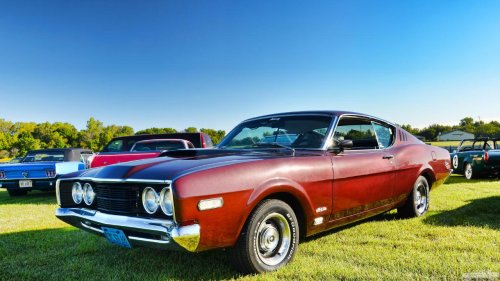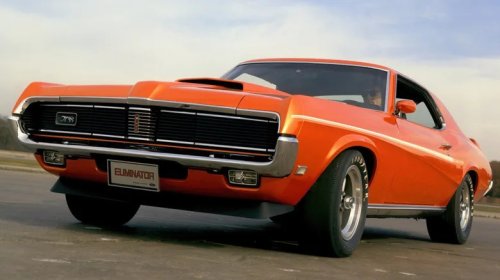

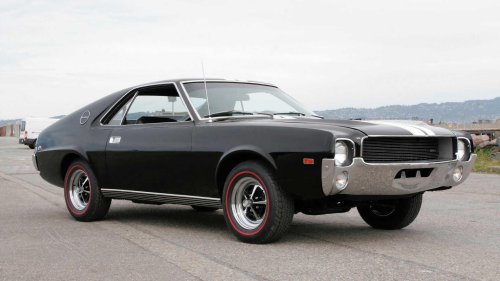























The Golden Age of American Muscle was utterly dominated by Ford, GM, and Mopar, who produced the era's most memorable street machines. The Chevelle, Charger, Mustang, and GTO are enshrined in the Performance Hall of Fame and carved in stone on Muscle Car Mount Rushmore, but there were other lesser-known cars from the classic era that were just as cool. After decades of obscurity, it's time some of these cars were recognized for their badass style and kick-ass acceleration.The AMX, like all AMC models, was tragically underrated at the time and still struggles for attention today in the collectors' market, but it was a seriously cool ride that bridged the gap between muscle cars and sports cars. Under the huge shadow cast by the Ford Mustang, the Mercury Cougar GT-E went almost unnoticed, despite being the most ferocious pony car to ever roll out of Detroit. Neither the AMC nor Mercury brands were considered big dogs of the classic muscle car era, but they each made some killer rides that enthusiasts need to know about.To give you the most up-to-date and accurate information possible, the data used to compile this article was sourced from various manufacturers and other authoritative sources, including Hagerty and Bring a Trailer. AMC AMX Muscle Car Crossover Mecum AMC had been known for making solid economy cars, but with the muscle car craze of the 1960s, they wanted to expand into the performance market. The problem was, they weren't as rich as the Big Three, so they had to put something together on the cheap. They came up with a pony car, but couldn't afford to design both notchback and fastback versions like the Mustang, so they split the difference and combined the styles. The result was the 1968 compact AMX and its slightly larger cousin, the Javelin. For being a budget design, the AMX turned out amazing with sleek, sporty looks and an aggressive stance. Though not targeting the Corvette, the AMX was a two-seater that AMC hoped would appeal to both muscle car fans and sports car enthusiasts. 1968 AMX Power and Performance The biggest secret of the classic muscle car era was how much better AMC cars drove than their more famous competitors. Performance cars in the 1960s and 1970s were designed to go fast in a straight line but absolutely sucked at cornering, plus they came with a lot of bounce and roll in the suspension. The AMC AMX came with a heavy-duty suspension, beefier shocks, springs, as well as sway bars, and rode like a dream through all the twists and turns. The "Go Package" upgrade, which only cost $248, included: Power front disc brakes "Twin-Grip" limited-slip differential E70x14 redline tires Magnum 500 wheels Bold racing stripes AMC's 390-Cubic-Inch V-8 Bring a Trailer AMC didn't have a V-8 that could compete with the Chrysler 426 Hemi, but that wasn't what they were going after with the AMX, and realistically, almost every muscle car on the street had a sub-400-cubic-inch engine. The AMC 390 V-8 provided plenty of power for the AMX to earn respect at a red light challenge. The short-deck 390 used thin-wall construction, making it lighter than most similarly sized engines. With a forged steel crankshaft and forged connecting rods, it was a high-revving, bulletproof powerplant. The high-flow cylinder heads and larger valves helped make this a great, modestly-sized V-8 that turned the AMX into a legit ass-kicker. Fate Of The Furious AMX Bring a Trailer AMC designed the AMX to be their "Halo" car and really hoped it would be their breakthrough model appealing to both muscle car and sports car nuts. It turned out neither camp was very interested in it, and they only moved 19,134 units between 1968 and 1970, when it was discontinued. It is an undeniably cool ride, and it may have just been ahead of its time, as performance compacts weren't really a thing back then. Despite the small production numbers, the AMX's rarity doesn't make it a super-expensive collectible today. In fact, it's easily one of the most affordable classics, with Hagerty setting the good condition value of a '68 AMX at just $24,200. Mercury Cougar GT-E Super Pony Mecum The Ford Mustang, introduced in 1964½, was not just an overnight sensation, but the most successful American car of all time. Mercury got their own version in 1967, known as the Cougar, which was meant to be a more upscale version of the pony car. The Cougar had enough of its own sheet metal and front fascia to be a radically different car, but it never really got away from being Mustang Jr. It also didn't catch fire like the Ford, so in 1968, Mercury built the GT-E version, which they hoped would put the Cougar on the map and take a nice chunk of the pony car segment with it. Until that point, the best a Mustang or Cougar had was a 390-cubic-inch V-8, but the GT-E came equipped with a 427 "Side Oiler" V-8 that made Ford cars legendary on the NASCAR circuit. 1968 Cougar GT-E Power and Performance The name GT-E was an acronym for Grand Touring Experimental, but clearly Mercury missed the memo here. The AMC AMX was named for "American Motors eXperimental," the Plymouth GTX was the "Grand Turismo eXperimental," the Buick GSX was the "Gran Sport eXperimental," and the Buick GNX was the "Grand National eXperimental," so clearly X marks the spot. The GT-E was built to meet NASCAR's 500-unit homologation requirement, but Mercury only ever built 394 cars, so that was abandoned. On top of the big honkin' engine, the GT-E came equipped with heavy-duty springs and shocks, as well as a thicker front sway bar to handle the extra power. It was also equipped with a non-functioning hoodscoop, which obviously did nothing, but made the car look just a little bit cooler. The 427-Cubic-Inch "Side Oiler" V-8 Mecum The Ford 427 "Side Oiler" V-8 is a legendary engine that racked up numerous NASCAR wins and propelled the GT40 to a 1-2-3 win over Ferrari in the 1966 24 Hours of LeMans. With the dual-quad set-up, it produced 425 horsepower, and the "Cammer" variant was a 600+ pony beast. For reasons that defy explanation, Mercury put a single four-barrel carb 390-horsepower 427 in the GT-E, which gave it some shockingly sluggish performance. A very small number, 37 units to be exact, came with the radically underrated 428 Cobra Jet V-8, which took the 15-second GT-E, which was unacceptable, to a 13-second car that was the gold standard during the Golden Age. Limited Success/Limited Production Mecum The Mercury Cougar GT-E was only made in 1968 with fewer than 400 cars rolling off the line (427 W-code: 357 units, 428 R-code: 37 units). Had it resonated with the public, they surely would have been more produced, but it was extremely expensive for the time and didn't create much of a splash. The original MSRP was a staggering $4,221, while a Hemi-equipped Plymouth Road Runner, guaranteed to run in the low 13s, could be had for $3,887. While there are good reasons why the '69 Cougar GT-E was overlooked in its day, it is now extremely cool and rare. Several examples have sold in the six-figures, including that blue beauty pictured above that went for $157,000 on Bring a Trailer in 2022. The Lasting Legacy Of These Underdogs Bring a Trailer As phenomenal as a '68 Dodge Charger Hemi R/T or '70 Chevrolet Chevelle SS 454 LS6 are, their presence at car shows is commonplace, and seeing several of them lined up in a row is almost anticlimactic. You rarely see a '68 AMC AMX or Mercury Cougar GT-E anywhere, so when one pops up, it's reason to get excited. Both of these rides are extremely rare and never got the due they deserved in their time. Now, however, people take notice, if for nothing else, because they look cool but are unidentifiable.If you pull up next to a casual fan at a red light in an AMX, they will inevitably ask, "That's awesome, what is it?" Pulling into the parking lot of Bob's Big Boy in Burbank, CA, on a Friday night behind the wheel of a Cougar GT-E is going to wow the hell out of the hardcore classic car fanatics, because they've never seen one in person before. The AMX and Cougar GT-E may have slipped through the cracks back in '68 and still struggle for recognition today, but when either one shows up, they turn heads, and that's a testament to their inherent greatness.