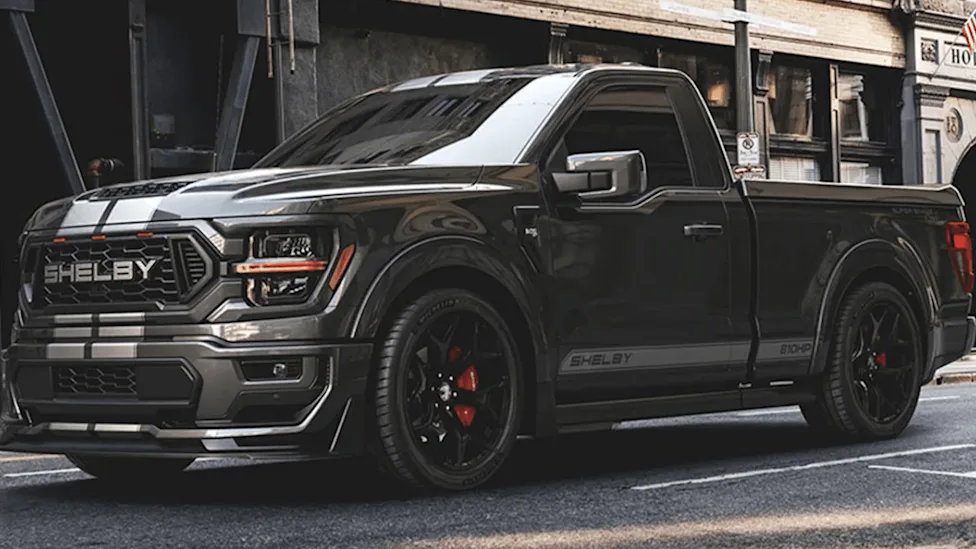
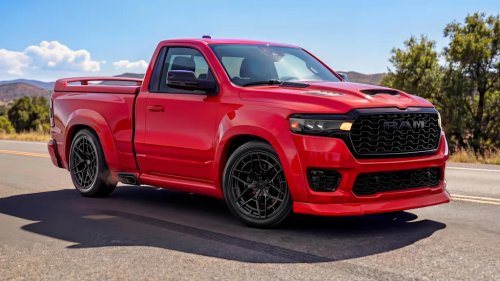
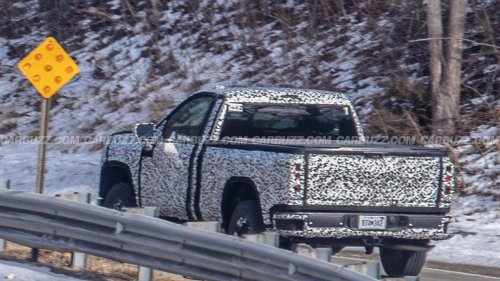
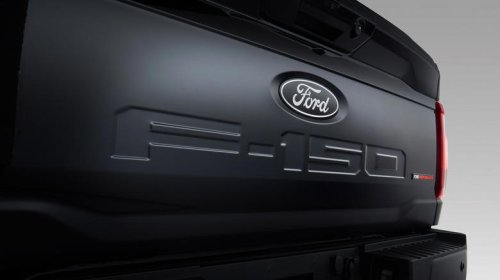
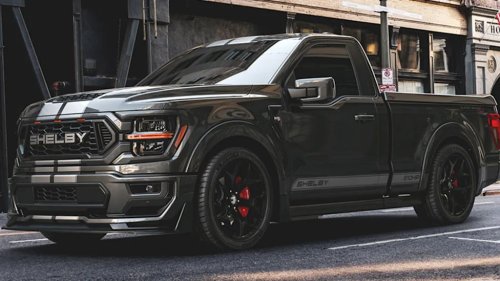
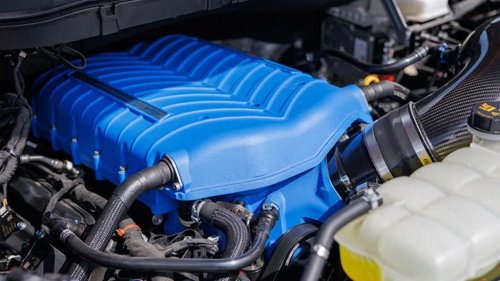
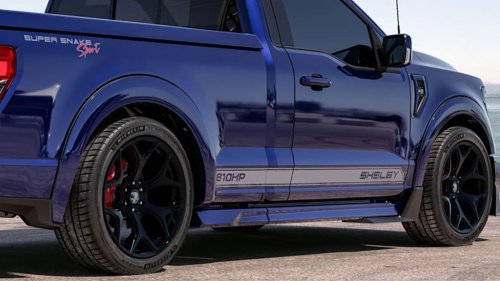
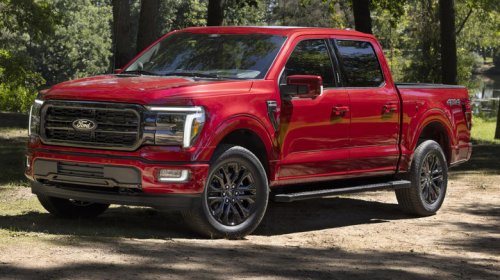
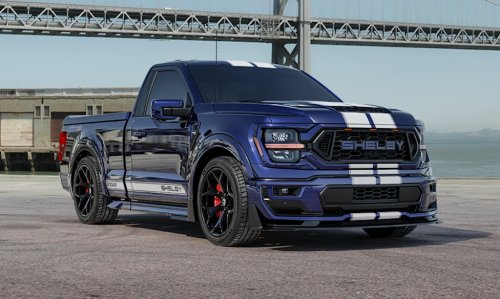
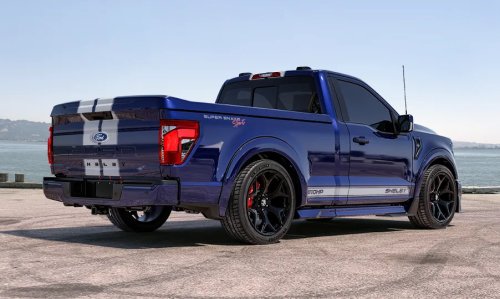
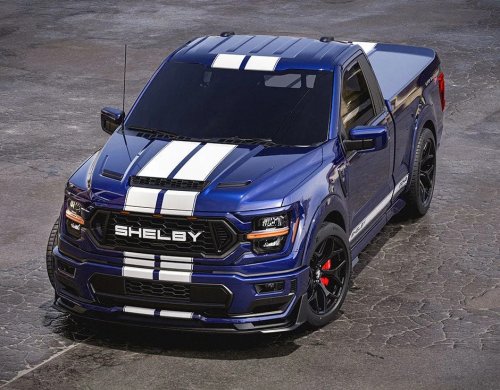
The Fine Print On Shelby's 810 HP Regular-Cab F-150 Deserves A ReadShelby American's press release for the returning F-150 Super Snake Sport leads with 810 horsepower, a regular cab, and a $115,795 window sticker. Fine. But the document worth reading is the digital brochure on Shelby's own site, because the footnotes underneath the feature list tell a more complicated story than the headline does — including one line that directly contradicts the press release.Start with what you're actually buying. Shelby's product page states plainly that the $115,795 price includes a 2026 F-150 XL 4x4 — the fleet-spec base trim — and the brochure repeats it. The press release issued five days earlier describes the donor as a Lariat 4x4. Both documents came from Shelby. The XL is the correct answer, since Ford's regular cab lives at the bottom of the F-150 range, and it's also why the leather seat covers and carbon-look trim exist: Shelby is dressing a work truck.And the 810 hp is optional. Standard output is the 5.0's factory 400.AdvertisementAdvertisementThe blower is a Whipple, and that mattersShelby's own vehicle page identifies the Stage 2 kit as Whipple-charged on the Gen 4 Coyote — a detail the press release omits. Whipple builds twin-screw positive-displacement superchargers, which is a meaningfully different animal from a centrifugal blower. A twin-screw makes boost proportional to engine speed from just off idle, so peak torque arrives early and stays flat. In a 4x4 pickup that has to launch hard from a stop, that's exactly the right characteristic, and it's why Shelby can credibly claim its quickest street truck ever.Related ArticlesNo-Reserve 2008 Jaguar XK Convertible With 36,000 Miles Draws $8,000 BidFerrari Classiche-Certified 1963 250 GT/L Lusso Headed to Monterey Auction BlockThe cost is heat. Twin-screws generate a lot of it, which is why the parts list includes a performance aluminum heat exchanger. That's the front-mounted radiator for an air-to-water charge cooling loop, and it means the truck has a second coolant circuit with its own pump, reservoir, and fluid that needs to be checked and flushed. Most owners never learn this until the intake air temps start climbing and power quietly disappears on a hot day.AdvertisementAdvertisementFuel matters too. The brochure specifies a minimum of 91 octane in supercharged trucks, with the 810 figure climate-adjusted on 93. In much of the western United States, 91 is the best pump gas available, so the number on the badge is a Midwest and East Coast figure.Also worth noting: the press release equipment list includes upgraded 5W50 motor oil. Ford specs 5W-30 for the truck 5.0. Jumping to a 50-weight is what you do when bearing loads go up and you want more oil film at temperature — a quiet acknowledgment of what doubling output does to a stock long block.Read the brake line item carefullyThe parts list specifies Baer oversized drilled and slotted rotors and red caliper covers with a Shelby logo. Covers. There are no new calipers, no new pads, and no larger pistons listed anywhere in Shelby's own documentation.AdvertisementAdvertisementBigger rotors add thermal mass and leverage, which is genuinely useful. But if you're planning to use 810 horsepower with any regularity, ask the dealer what pad compound is fitted, because stock truck pads on a 5,000-pound vehicle running Michelin street tires will fade before the rotors do.The chassis work is more substantial: a Shelby-exclusive lowered setup on KING adjustable coilovers, rear traction bars, and a four-wheel alignment. Traction bars aren't decoration on a short-wheelbase regular cab. Leaf-sprung pickups wrap their axles under load, and a two-door has less wheelbase to damp the resulting hop than the SuperCrew does. Adding 400 horsepower to that geometry without controlling axle wrap would be an expensive way to destroy U-joints.The part nobody puts in a headlineTwo footnotes from Shelby's brochure deserve to be read together.AdvertisementAdvertisementThe first: "Supercharger not-included in green states. Purchase and installation of supercharger sold separately in green states." That's the CARB problem. California and the states that follow its emissions rules require an Executive Order number for aftermarket forced induction on a road-legal vehicle, and Shelby doesn't cite one anywhere in its materials. Note that the same brochure specifies 50-state compliance for the window tint. If the blower had an EO, they would say so.The second: the supercharger is post-title only. This isn't a quirk — it's the entire legal architecture. Selling a completed truck with the blower already installed would put Shelby in the position of manufacturing or altering a certified vehicle, triggering federal emissions and safety certification obligations it has no interest in. Titling the truck to the customer first turns the supercharger into an aftermarket part installed on a customer's own vehicle. It's how every serious tuner in America operates, and buyers should understand that the "810 hp truck" is two transactions wearing one price tag.The warranty contradictionShelby's press release states that "The powertrain warranty from Ford Motor Company remains intact."AdvertisementAdvertisementShelby's brochure states: "Equipment may void factory powertrain warranty."Those cannot both be true, and the brochure is the one with legal fine print at the bottom of the page. Federal law lands somewhere in between. Under the FTC's interpretation at 16 CFR 700.10, a warrantor cannot void coverage merely because an aftermarket part is present, but it explicitly may deny liability for damage it can demonstrate that part caused.Related ArticlesFerrari SF90 Splits in Half in Gold Coast Crash, Driver Walks AwayAn Elvis-Delivered 1964 Honda Scrambler Missed Its Reserve. The Market Made the Right Call.Apply that to a Coyote making double its rated output. If a rod bearing lets go, Ford's position that the supercharger caused it is not a difficult argument to win. Practically speaking, the engine and driveline are on you. Shelby's own three-year, 36,000-mile limited warranty covers Shelby components and, per the product page, applies to the original owner only — so it does not follow the truck to a second buyer.AdvertisementAdvertisementInsurance and resale, which are the same conversationHere's the trap. Your VIN decodes as an F-150 XL regular cab. A total-loss adjuster working from that VIN will value a work truck, not a $115,795 one. Anyone buying one of these needs to speak to their carrier before delivery about an agreed-value or stated-value policy with the Shelby content scheduled, and needs to keep the build documentation somewhere other than the glovebox.This is exactly why Shelby's press release makes a point of the CSM serial plaque, Shelby Registry documentation, and a listing in Black Book. Registry paperwork and third-party book value are the mechanisms that get adjusters, lenders, and appraisers to recognize a modified truck as something other than its base VIN. They're not trophies; they're evidence.Where it sits in the marketAdvertisementAdvertisementProduction is capped at 500 for 2026, with the four-door SuperCrew Super Snake limited to 400. Shelby cites limited donor chassis availability as a constraint — reasonable, given the regular cab is the rarest F-150 body style on any Ford lot.The competition is partly Ford itself. The 2026 F-150 offers an STX Lobo package with a two-inch lowered rear, 22-inch gloss black wheels, and the same 5.0 V8, straight from the factory with a full warranty and CARB compliance already sorted. It won't make 810 horsepower. It also won't require two separate transactions and a conversation with your insurance agent.One consolation for the Shelby buyer: because pickups are classified as light trucks, none of this attracts the federal gas-guzzler excise tax that would hammer an equivalently thirsty Mustang. Sometimes the bed pays for itself.Images Via: ShelbyJoin our Newsletter, follow our Instagram page, and follow us on Facebook.