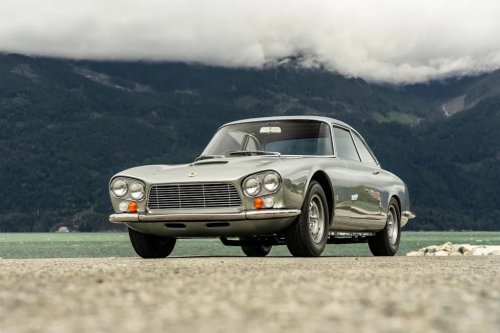
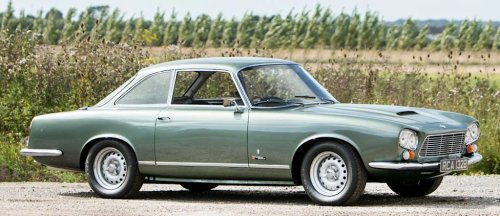
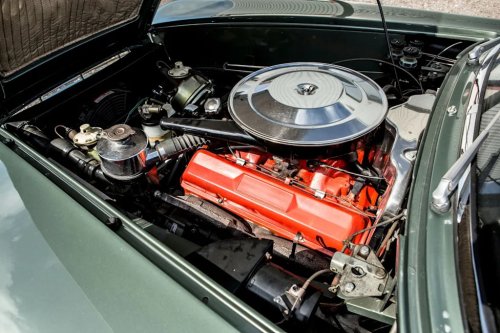
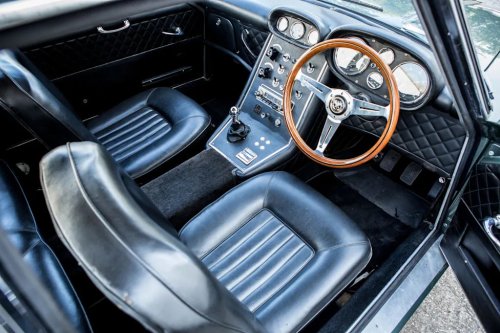


















Meet the Corvette-Powered British GT: Gordon KeebleBonhamsThe very British A-Z of Cars, 1945-1970 by the late Michael Sedgwick, onetime curator of the Montagu Motor Museum at Beaulieu, lists the Gordon Keeble as "nicest of the modern Euro-Americans?" Note the question mark. Most people, if they've heard of the 1964-1967 Gordon Keeble at all, don't know what to make of this gorgeous Corvette-powered GT car that couldn't miss—yet did, spectacularly.Only 100 were made. The cars combined Italian styling with impressive American power and a very traditional British interior, and might have triumphed with more ready cash and a better supply chain.The Gordon-Keeble was launched when John Gordon (then building fiberglass Peerless GTs) and Jim Keeble who ran a tuning and racing garage in Ipswich, got together in 1959. Keeble, who had impeccable racing credentials, had an American Air Force pilot customer named Rick Nielsen who wanted a Peerless (usually with Triumph TR3 engines) powered by a Chevrolet V8. That project got Gordon thinking, before the Cobra—might there be a market for cars like that? He commissioned Keeble to work on it.AdvertisementAdvertisementThe resulting chassis had a square-tube steel spaceframe chassis, triple Rochester carburetors, a close-ratio four-speed manual gearbox, De Dion rear axle, independent front suspension, and Dunlop disc brakes all around, with a 283-cubic-inch Chevy V8 (borrowed from Nielsen's Peerless). At the time, Giorgetto Giugiaro was not the most famous car designer in the world, but a 21-year-old just out of the Army working his first jobs at Bertone. The first car Giugiaro did was the Alfa-Romeo 2600 Coupe, and it has pretty strong styling similarities to the finished Gordon Keeble (initially called just the Gordon) from the A-pillar back.BonhamsThe first Gordon chassis, built in three months, was sent to Bertone in Turin, which completed the body in 28 days. The team, in England and Italy, was racing against a deadline for the 1960 Geneva Auto Show. Like the original E-Types the following year, the car, hastily assembled, was transported to Geneva in a mad dash. On the way it was nearly taken out of action at a border customs post. On the Bertone stand, the new GT was a huge hit. And why not?According to the Britain-based Gordon Keeble Owners Club, the car could attain 70 mph in first gear and top out at 140 mph. "Any more than this was considered to be superfluous in 1960," said the club. Of the 100 Gordon Keebles made, only two are known to have been totaled, and several others are derelict. The survival rate is amazingly high.Unfortunately, it was not until 1964 that the Gordon Keeble GK1 got into production, by which time the initial excitement probably had cooled some. But there were high hopes. Gordon, who brought the prototype GT over on the Queen Elizabeth, went to Detroit and secured a really generous offer from Chevrolet executive Ed Cole and Zora Arkus-Duntov, the father of the Corvette—GM would supply 300-horsepower 327-cubic-inch engines and gearboxes together for £400 each. And that was accompanied by an order for 1,500 to be displayed at American Chevrolet dealerships.BonhamsThe original car was steel-bodied, but the production Gordon Keeble was made of fiberglass supplied by Williams & Pritchard. The cars, with a somewhat misleading tortoise logo (the cars were fast!), were built at an Eastleigh, Southampton, airfield site, in a building originally used to produce the famous and appropriately speedy Supermarine "Spitfire" airplanes. The owner's manual advised whimsically that during the break-in period the car should be as carefully handled as "the contents of your cellar, gently and in moderation." A road speed limit of 70 mph during this interim period would "allow you to keep most appointments without loss of face." Owners were advised against leaving the car idling "while you rush indoors to pay a belated farewell to your wife."AdvertisementAdvertisementThe price was relatively high, £2,798 ($6,995, the equivalent of about $66,000 today), but actually too low to meet the cost of actually profiting from finished Gordon Keebles. And the production line was plagued by supply issues, with a lack of steering boxes being what finally broke the company.Gordon was gone early in the process, but with a new backer named Geoffrey West the company started production again in 1965 at an old Osram lightbulb factory in Sholing, Southampton. A final seven to nine cars were built there before it was lights definitively out in 1967. According to the club, 99 Gordon Keebles were factory built, with enough spare parts to privately build up the 100th example in 1971.Most of the survivors are in the UK; there was never a left-hand drive version. Eight cars made it to the Brooklands Best of British Day in 2023. The car belonging to Nigel Bowater, membership secretary of the Gordon Keeble Owners Club, was one of the eight, and he says the company's quality package has held up well. The tubular chassis sometimes needs attention after nearly 60 years, he said, and door posts occasionally need remedial work. Some have had Jaguar XJS power-steering racks installed.Bonhams"For me, the car has gone from childhood poster car to actual ownership, and proves a joy to drive on every occasion," Bowater said. "It attracts attention wherever I take it, although few have heard of it. And it's a great ice breaker at any car meet. Sadly, the Gordon Keeble should have done better in period."AdvertisementAdvertisementThere was one last gasp of the Gordon Keeble when an American investor named John De Bruyne showed a pair of them at the 1968 New York Auto Show with an eye to US production, but no further cars emerged.Jamie Kitman, contributing editor at Car and Driver and a British car collector, attorney, and band manager, says that the Gordon Keeble sported "a lovely Guigiaro-designed body from the era when the maestro was doing his best work." But, he said, the marque "never achieved a winning rhythm, despite celebrity and titled owners. (Jackie Kennedy had the use of one.) Blame undercapitalization, insufficient profit margins at too low prices, and low volumes that failed to encourage supplier loyalty. A lovely car, and I'd happily own one if I could find one and, more importantly, had the money."Kitman estimates Gordon Keeble values as between $75,000 and $100,000. The problem is that they don't come up for sale all that often. Chassis #24, a 1964 example in good condition after a restoration in the 1970s, was sold by Bonhams at the Goodwood Festival of Speed in 2019 for £51,750 ($66,228).Sotheby's, which sold a Gordon Keeble needing some work for a bargain £17,625 ($23,250) in 2005, said that "John Gordon and Jim Keeble sought to provide Aston performance at a fraction of the cost." The Motor road test from 1966 described the GK1 as an "immensely fast and satisfying car to drive," with performance on par to the Aston DB6 and the Jaguar E-Type. Autocar called it "the most electrifying vehicle that [we have] ever tested."Alas, the poor Gordon Keeble deserved better than it got.