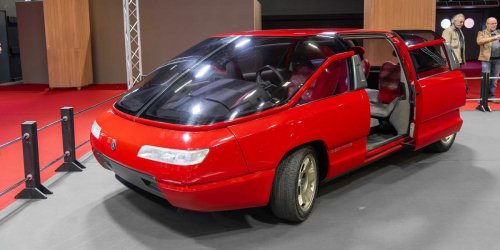
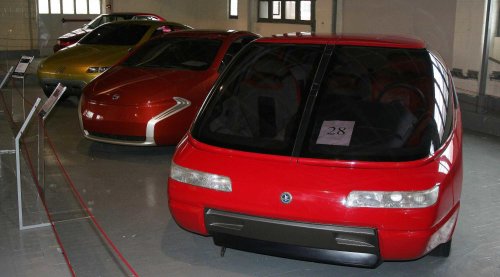
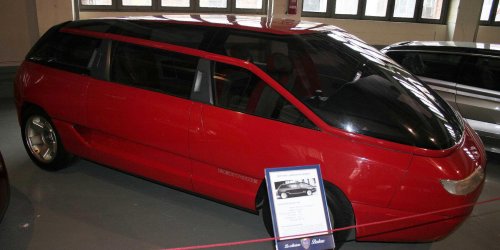
The year is 1989. A rumble echoes off the side of a school as a V12 engine idles down, and a bizarrely exotic minivan pulls up to the student pickup line. After the van loads its passengers, its sliding door slams, its V12 engine screams, and its driver steers for the open road. This absurd scene might have been reality if this Italian concept hadn’t been strangled to death by Detroit.The one-of-a-kind swing at the luxury cars market was born from a bizarre corporate merger. At first blush, it seems like an exercise in 1980s excess. But in hindsight, it was a concept that prophesied the future—in more ways than one. A Parts-Bin Minivan With An Italian Heart Attendees of the 1988 Turin Motor Show were treated to an unforgettable sight. One bright red concept vehicle featured a 455-hp V12 with a spectacular exhaust note. It wasn’t a mid-engine Countach special edition. It was an egg-shaped people mover you could only describe as…a minivan.First off, engine placement: The driver and front passenger essentially sat atop the massive powerplant. They climbed in and out of the space-age vehicle via massive gullwing doors. The doors were so large that when you opened either, half the windshield swung away. The hinges were hidden in a pillar that divided the windshield. The effect was a "revelation," according to AutoCar magazine.The roofline fell away from the elevated front seats. At the rear of the vehicle were two bucket seats for passengers. A fifth seat, a swiveling bucket, was attached near the center of the vehicle. A true “Captain’s Chair” that would look at home on the starship Enterprise. The rear passengers all entered and exited via minivan-style sliding doors.What would possibly inspire such a Frankenstein vehicle in 1988? Honestly, there was only one corporate merger on the planet, at the time, that could have birthed a V12-powered minivan. And the ink was barely dry before company brass ordered this thing from one of the world’s most renowned design firms. More A Lambo With Extra Seating Than Aerostar With A V12 Bring a TrailerTo be clear, this unique vehicle wasn’t just an engine-swapped Chevy Astro. It may have featured a body suspiciously like a minivan. But it was actually a tall new vehicle atop Lamborghini running gear. Its official segment was “Multi-Purpose Vehicle.”The engine was a 455-hp 5.2-liter unit. It was a V12 developed for the Lamborghini Countach Quattrovalvole. The vehicle even shared a 104-inch wheelbase similar to the Lamborghini Espada.Design firm Bertone might have even argued that its similarities to a minivan were a necessity of its function, not an intentional parallel. But considering its creators had bet everything on the minivan segment, that claim would be suspicious. When Chrysler Owned Lamborghini Alexandre Prevot via Wikimedia CommonsLamborghini’s original business model was to build a better Ferrari, no matter the price point. But that business model didn’t pay the bills. Lamborghini went bankrupt in 1978 and the Mimran brothers took over what was left. They expanded the lineup from just the Countach supercar to entire new market segments. Namely, they debuted the Jalpa sports car and the LM002 high-performance 4WD truck. By 1987, the company was in the green and the brothers went looking for a buyer.By 1980, Chrysler—the smallest of the Detroit Three—was also having financial issues. Lee Iacocca, the famed executive behind the Ford Mustang, spearheaded an all-new project. Engineers began with an efficient FWD chassis, added as much room for passengers and cargo as possible, and debuted the 1984 Plymouth Voyager/Dodge Caravan. The all-new minivan segment exploded and put Chrysler back on the map. Iacocca went shopping. In 1985, Chrysler expanded its joint venture with Mitsubishi to build more fuel efficient cars and established one with AMC (which included Jeep) to tackle the SUV segment. In 1987, it bought a huge share of AMC and Lamborghini. Lamborghini And Chrysler’s Minivan By Bertone Andrea Volpato via Wikimedia CommonsLamborghini had already demonstrated that it could expand to new market segments. So, why not build a Lamborghini minivan? Chrysler tasked the famed Bertone design house with building a concept. The result proves just how out of touch boardrooms can be.Chrysler advertised the concept vehicle as drivable. But perhaps it shouldn’t have. Early reviewers found the Bertone Genesis bobbed and weaved all over the road. Its three-speed Chrysler automatic transmission with conservative gear ratios strangled the performance so much that the V12 was nothing but a noisemaker. The 3,968-pound curb weight didn’t help. Chrysler had just bought Lamborghini and seemed determined to show off its new acquisition in something American buyers could relate to. But even as a concept, the Genesis completely missed the mark. The Genesis Signaled Major Market Changes On The Horizon Andrea Volpato via Wikimedia CommonsThe concept vehicle's press kit was quite precise: “In just 4270 days we’ll be in the year 2000 and the Genesis represents a creative exploration of a possible GT car for coming decades, in line with the likely mobility and comfort requirements of the near future.”In several key ways, the concept successfully signaled the future of the industry. For example, its designers imagined a family vehicle with a television in the rear to entertain the kids. The idea seemed absolutely absurd in 1988. Today, many families wouldn’t even attempt a road trip without separate screens for each of the backseat passengers.A “performance-oriented” family vehicle may have felt like a ridiculous concept in 1988. But today, the market segment is full of vehicles with room for the kids that offer a bit more “zest” for the driver. You can splurge on a Cadillac Escalade-V or a Durango with a Hellcat engine. You can even spend German sports car money on a BMW X7 or Mercedes-Benz GLS crossover. Thirty years after the Bertone Genesis debuted in Turin, Lamborghini unveiled its Urus SUV. The Genesis signaled the future of the market better than anyone in 1988 could have guessed it would.Finally, the absurd engine placement beneath the front seats seems like a maintenance nightmare. But Nuccio Bertone defended the configuration, insisting cars would soon be as reliable as a refrigerator was in the 1980s. He wasn’t wrong. In 1990, the average vehicle lasted just 150,000 miles. Today, the average 2015-2026 model year vehicle lasts 200,000-250,000 miles.The Bertone Genesis may seem like it was a miss. But it was actually shockingly close to a famous hit. The AWD, supercharged, mid-engine Toyota Previa minivan. That unique vehicle debuted in 1991 and is beloved by its devoted fanbase.Honestly, as a proof of concept, the first Genesis didn’t need to be highly tuned or even drivable. But if Chrysler/Lamborghini had made another pass at the vehicle—perhaps even engineering it with a more cost-effective powerplant—they could have had a real winner that was ahead of its time.


















 +62 others