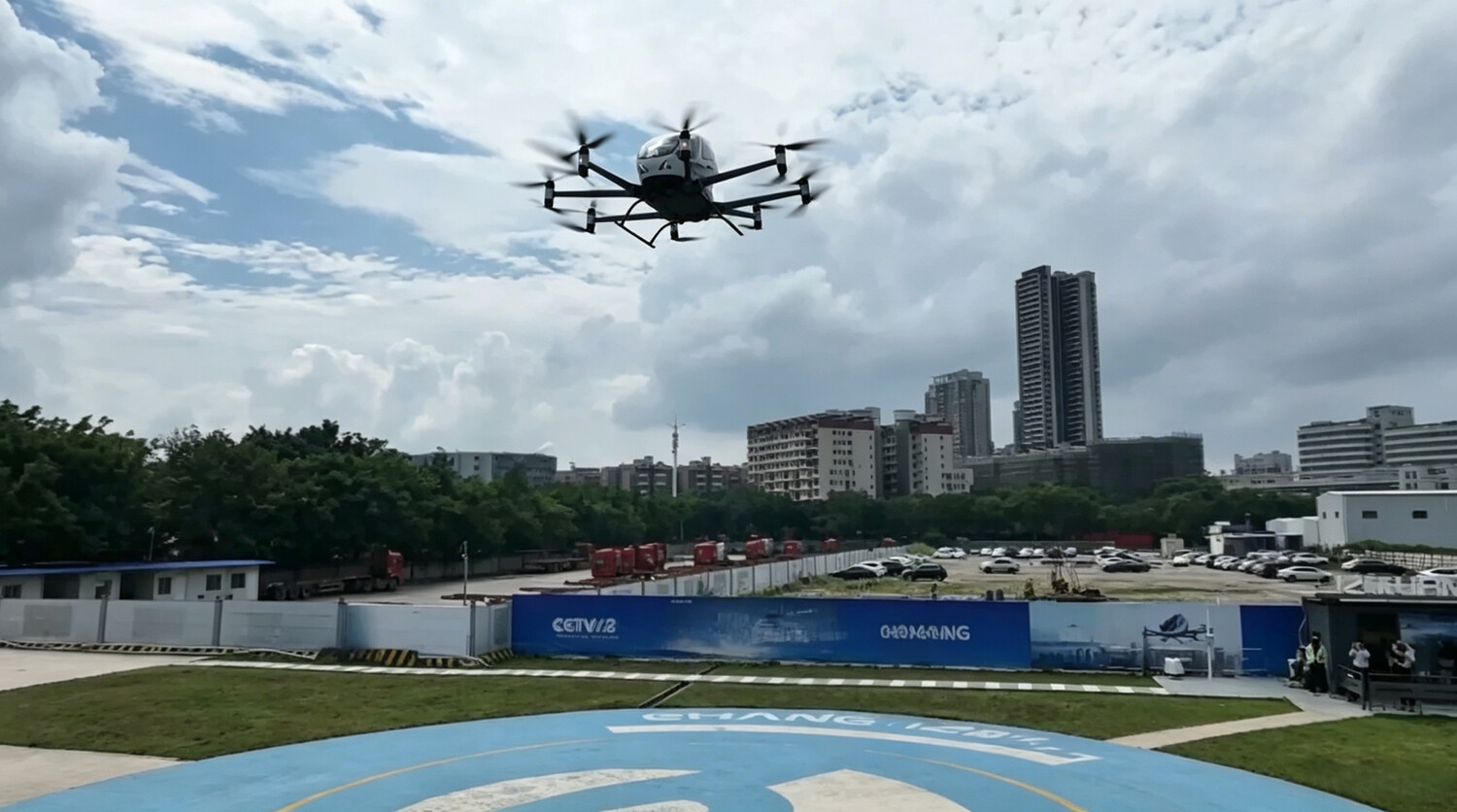
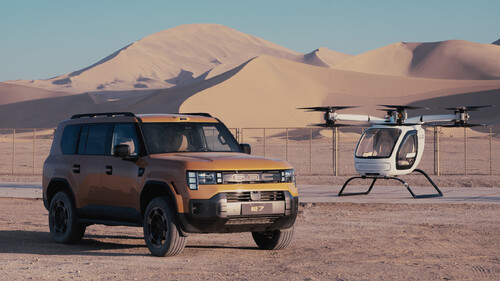
Solid-state battery development is becoming a key focus for China’s low-altitude economy sector. Image enhanced by CNC Understand China EV’s Market Real-time notifications when critical EV data is released All important data in one place 2,000,000+ data points Become a member China’s flying car industry is entering a new phase of commercialisation as manufacturers expand production capacity, advance airworthiness certification programs, and begin integrating next-generation battery technologies into electric vertical takeoff and landing aircraft (eVTOLs). State broadcaster CCTV reported on June 8 that China plans to develop the low-altitude economy into an emerging pillar industry during the 15th Five-Year Plan period. Flying cars are viewed as one of the sector’s core segments, bridging aviation and automotive technologies while enabling passenger transportation applications beyond industrial drone operations. Commercial operations begin to emerge China’s eVTOL sector has moved beyond laboratory development and prototype demonstrations into early commercial deployment. In Guangzhou, a newly commissioned intelligent manufacturing facility combining automotive production methods with aviation-grade standards has begun operations. The facility is designed to produce 100 flying vehicles annually and to manufacture a two-seat multicopter aircraft capable of vertical takeoff and landing, with a maximum range of 30 km. The aircraft is priced at up to 1.68 million yuan (248,300 USD) and has received nearly 2,000 intent orders, primarily from tourism operators and sightseeing projects. Govy AirCab, developed by GAC’s flying car division, is currently undergoing certification work and is expected to begin production after completing regulatory approvals. Meanwhile, autonomous passenger flights have already entered commercial operation through the EHang EH216 series. The aircraft became China’s first certified autonomous passenger-carrying eVTOL and is operating regular sightseeing services from bases in Guangzhou and Hefei. Industry participants cited by CCTV said progress in airspace management, infrastructure development, operational scenarios, and regulatory frameworks has moved the sector into a commercial exploration phase. Larger aircraft target intercity transportation Several Chinese developers are pursuing larger eVTOL aircraft aimed at regional mobility. A six-seat electric aircraft undergoing certification testing in Chengdu targets urban and intercity transportation. The aircraft offers a maximum range of 200 km and a top speed of 230 km/h, enabling routes connecting airports, tourist destinations, and city centres. Another lift-and-cruise aircraft being tested in Guangzhou is designed for cross-city, coastal, and mountainous transportation. The aircraft combines vertical-lift rotors with a separate pusher-propulsion system for forward flight, a configuration that improves cruise efficiency compared with multicopter designs while maintaining vertical takeoff capability. Current applications remain concentrated in high-value scenarios, including emergency medical transport, rescue operations, aerial tourism, and premium passenger transfers. Industry forecasts cited by CCTV expect a larger number of passenger-grade eVTOL models to obtain airworthiness certification around 2028, supporting broader commercial operations. China’s manufacturing ecosystem is also expanding. Last year, Xpeng AeroHT launched what it described as the world’s first mass-production flying car manufacturing line, positioning the company for larger-scale production once certification requirements are completed. Solid-state batteries become a strategic focus Battery technology remains one of the most important constraints on eVTOL development because aircraft require significantly higher energy density and safety margins than ground vehicles. CCTV highlighted the ongoing deployment of solid-state batteries in low-altitude aviation. Unlike conventional lithium-ion batteries that use liquid electrolytes, solid-state designs replace the liquid component with solid electrolyte materials, reducing fire risks while increasing energy density. One of the most advanced demonstrations came from EHang and Shenzhen-based Inx Energy. Their jointly developed lithium-metal solid-state battery uses a metallic lithium anode and oxide ceramic electrolyte, achieving an energy density of 480 Wh/kg. The battery enabled the EH216-S to complete a continuous 48-minute-10-second flight test and increased endurance by 60% to 90% compared with conventional battery systems. The technology has also been demonstrated in a cross-Qiongzhou Strait flight, a milestone referenced in CCTV’s report. Solid-state batteries have become a major focus across China’s broader transportation industry. GAC Govy CEO Gu Huinan recently described solid-state batteries as the “essential path” for flying cars because higher energy density directly expands payload and range. BYD has also disclosed new sulfide-based solid-state battery research as Chinese automakers target pilot production programs around 2027. China’s push for solid-state batteries is supported by the world’s largest EV battery industry. According to China EV DataTracker, CATL led domestic battery installations with a 47.2% market share, followed by BYD at 17.1%, while companies including Gotion High-tech, Calb, Eve Energy, Sunwoda, and Svolt Energy continue investing in next-generation battery technologies that could eventually find applications in eVTOL aircraft. Despite the progress, industry experts interviewed by CCTV said liquid lithium-ion and semi-solid-state batteries will remain the dominant technologies in the near term. Challenges involving manufacturing yield, materials engineering, durability, and cycle life continue to limit large-scale deployment of fully solid-state batteries. The report noted that China’s flying car industry could ultimately support industrial clusters worth trillions of yuan if commercialisation progresses as anticipated. Flying car manufacturers are expanding production capacity as commercial operations begin to emerge.