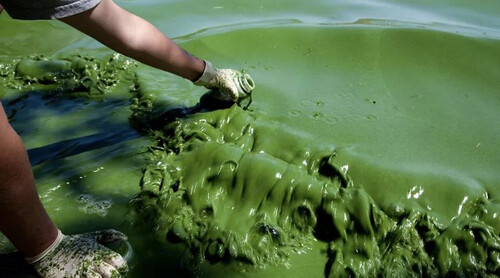
US President Donald Trump has transformed the Reflecting Pool in Washington, DC, into a gigantic showcase for algae cultivation. The big question is what he will make from the stuff, once it is harvested. Nutritional supplements, fish food, and personal care products are among the options. However, considering the President’s determination to exploit domestic energy opportunities to the fullest extent possible, algae biofuel is the more likely focus of attention. The Algae Biofuel Plot Thickens The President does not shower his favors upon all energy resources equally. Nevertheless, his “American Energy Dominance” plan does embrace domestically cultivated biomass, and algae qualifies for support under that standard. Reading into the tea leaves, if algae biofuel is the ultimate goal of the Reflecting Pool demonstration project, that could explain why several people were arrested over the weekend for dipping a hand into its algae-sodden waters. After all, valuable trade secrets may be at stake, and the algae may be a proprietary organism that engineered to optimize reproduction and oil content. The algae growing process itself appears also appears to be a unique approach to algae cultivation, possibly involving additional trade secrets. It seems to require applying a layer of fresh paint to the cultivation tank before filling the tank with water, and then applying hydrogen peroxide to create a peeling effect. Of course, all this is conjecture. However, the hydrogen peroxide step could provide a clue to solving the mystery. Hydrogen peroxide is an effective means of killing a bacteria with algal properties called cyanobacteria, commonly known as blue-green algae. The chemical apparently has little or no effect on plain green algae, allowing them to continue about the business of reproducing among the rotting corpses of the dead cyanobacteria. Still, many questions remain, and the President is clearly determined to protect whatever trade secrets the Reflecting Pool contains. Going by reports, none of those arrested last weekend were caught with sample bottles of green algae up their sleeves or chunks of paint in their pockets. Still, the President is nothing if not cautious. On Monday, workers were spotted arranging a tall chain-link fence around the perimeter of the Reflecting Pool, well in advance of normal precautions taken around the annual July 4 celebrations. Calling ExxonMobil, STAT! For those of you new to the topic, some forms of microalgae are considered ripe for biofuel applications due to their high oil content and rapid rate of reproduction, among other features. Developing an economical pathway from algae to fuel has proved elusive, with many obstacles along the way. A few firms have made some progress in the biodiesel space, but widespread use is far in the future. It’s too bad that ExxonMobile dipped out of the field in 2023. The oil and gas giant was previously known for investing a substantial sum into algae biofuel research, in what some have called an elaborate public relations exercise. ExxonMobile’s research partner in the longstanding, on-again, off-again endeavor was the California firm Synthetic Genomics. It’s possible SG can offer some insights into the Reflecting Pool demonstration project. Or not, as the case may be. In 2021, The company changed its name to Viridos and expanded its attention to include sustainable aviation fuel. However, their focus was on saltwater algae, not freshwater algae of the sort that have been cultivated in the Reflecting Pool. After losing the ExxonMobil funds in 2023, Viridos secured $25 million in Series A funding to continue its R&D work. The effort was spearheaded by the well known firm Breakthrough Energy Ventures, with support from Chevron and the Sustainable Flight Fund branch of United Airlines. Algae Biofuel Persists Viridos eventually filed for bankruptcy last year, another testimony to the hurdles that lie between algae biofuel and commercial applications. Still, activity continues to bubble up on the research end. Last October, a multinational research team from Hawaii and Poland ran reviewed the state of affairs in the publication Plant Biotechnology Journal, with a focus on the microalgae Chlamydomonas reinhardtii, Nannochloropsis spp., and Phaeodactylum tricornutum. “Nevertheless, compared to model organisms like Escherichia coli and Saccharomyces cerevisiae, metabolic engineering in microalgae remains in its infancy, hindered by limited genetic tools, transformation protocols and standardised workflows,” they explain. That doesn’t sound too encouraging, but the team did take note of a fresh wave of research tools, including genome-scale metabolic modelling and new biosynthesis strategies, among others. Municipal Wastewater And A “Living Fuel Factory” Other researchers are turning attention to opportunities that combine algae cultivation with compatible processes to yield an economical result overall. In January, a research team based in Egypt published a study of the potential for applying HTL (hydrothermal liquefaction) to a mixture of algae and cyanobacteria grown in municipal wastewater. “These findings demonstrate that HTL of municipal wastewater-grown microalgae is a viable route for sustainable biofuel production, integrating resource recovery with renewable energy generation, while systematically evaluating key operational parameters and characterizing the resulting biofuel for downstream applications,” the team concluded. Still, much of the attention is focused on finding, or engineering, microalgae that produce more oil, more efficient. In May, a research team at Saitama University in Japan described a new, self-cloning method that sharply reduces the cost of processing. “In many conventional systems, fuel-related lipids accumulate inside the cells, meaning that large amounts of algal biomass must be harvested, concentrated, dried, and extracted. These downstream processes consume substantial energy and cost,” the researchers explain. The researchers worked around those issues by developing new strains of cyanobacteria that secrete FFA (free fatty acids) instead of retaining them, thereby streamlining the oil collection process to a considerable degree. “This extracellular production strategy may also allow continuous fuel production beyond the limits imposed by intracellular storage capacity, while reducing the amount of residual cellular waste,” they add. The researchers also affirm that their cyanobacteria avoid genetic complications that could encounter regulatory obstacles inhibiting outdoor cultivation. The Saitama team also developed an innovative culture system that involves recovering the secreted FFAs into an organic solvent, which is layered above the culture medium itself. The two-phase medium keeps the cells alive to continue their work. “The team also found that strong light stress combined with cultivation at 25°C, lower than the usual optimal temperature of 32°C, markedly increased FFA productivity per cell,” they note. As for what the cyanobacteria need live and produce oil, sunlight and airborne carbon dioxide are all that is needed. The Reflecting Pool demonstration project has both of those in abundance. Reportedly the Reflecting Pool is now being drained, but that doesn’t necessarily mean an end to the algae biofuel experiment. We may know more after the pool is refilled. If you have any insights to offer, drop a note in the comment thread. Photo: Algae biofuel stakeholders continue to encounter obstacles along the path to commercial applications, though work continues apace at the research end (cropped, courtesy of Intertek).