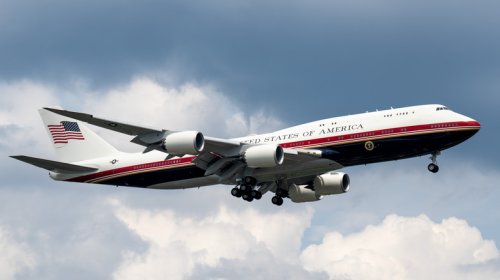
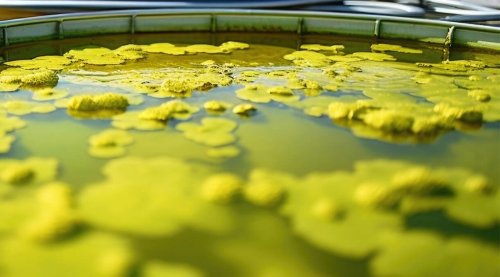
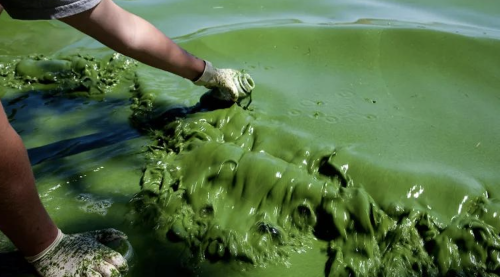
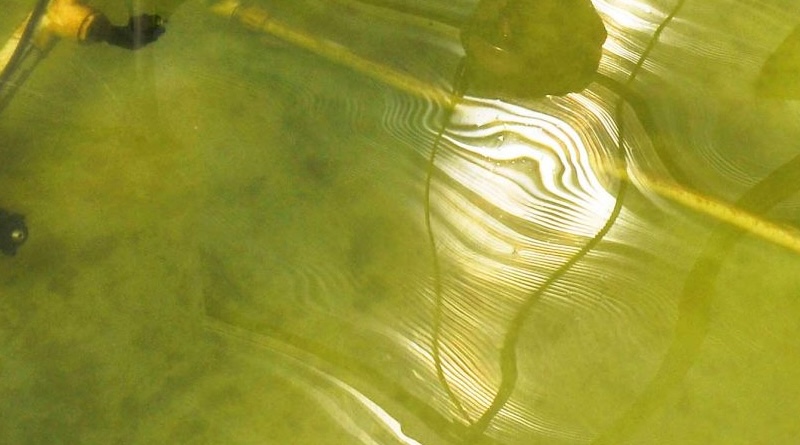
To the surprise of no-one, US President Donald Trump’s much-hyped algae biofuel demonstration project has ended in failure. The once-promising experiment, which launched at the Lincoln Memorial Reflecting Pool in Washington, DC earlier this month, is now hidden from public view behind a tarp-covered chain link fence. Still, the algae biofuel industry persists, if not in the US then elsewhere around the world. The Short Life And Death Of The Great US Algae Biofuel Experiment For those of you new to the topic, researchers have spent years exploring the fuel-producing capabilities of water dwelling microalgae. The tiny organisms are rich in oil, they reproduce rapidly, and they can be cultivated in human-made infrastructure instead of taking up valuable farmland (see more algae energy background here). With its wide expanse of shallow water, full exposure to the sun, and location a relatively warm climate, the Reflecting Pool been a high profile showcase for algae cultivation ever since it was first constructed in 1922. These days it is visited by millions of tourists each year. After the original infrastructure began cracking and leaking, a major overhaul of the Reflecting Pool was completed in 2012. The work included adding a lighter tint to its surfaces, to enhance reflection while potentially inhibiting algae growth. Apparently that did not sit too well with the President, who ordered the pool to be repainted in a darker hue. If stimulating algae growth was the President’s intent, then success arrived within a matter of days. However, the achievement was short-lived. It is difficult to know for sure, but as the saying goes, success has a thousand parents and failure is an orphan. Trump himself has disowned the project, hurling criminal accusations at those responsible for botching the process. “The Reflecting Pool is now in full use after suffering great damage from Criminal, Radical Left Vandals, people that truly hate our Country,” Trump exclaimed over the Intertubes on Monday, somehow forgetting that “full use” should reasonably mean no chain link fence and no tarp. “They cut the lower surface of a very expensive and strong waterproof padding, in the color of American Flag Blue, and put their hands underneath the surface, and ripped it,” Trump elaborated, drawing renewed attention to his choice of a dark tint to enhance algae cultivation in the pool. “It never worked properly until last week,” he continued, “And right after July 4th, when we will drain the water to treat the damage caused by these ‘animals,’ it will again be in perfect shape. In the meantime, it is working well, the criminally made algae is gone, and the grass, which was destroyed, is being replaced shortly.” The FUELGAE Intitiative So, if the “criminally made” algae is banished, will Trump continue to pursue the project? Why not! After all, there is plenty of non-criminal algae cultivation going on around the world. In fact, biomass is one of three forms of renewable energy that the President has embraced through his “American Energy Dominance” policy, alongside hydropower and geothermal energy. The FUELGAE initiative in Europe provides some insights in to the future of algae biofuel research in the US, should Trump continue to pursue that topic. The six-nation, 13-partner program aims to piggyback carbon capture onto algae cultivation, thereby creating an economically viable pathway to biofuel. “Its primary objective is clear: to develop novel methods that capture CO2 emissions using microalgae to produce biofuels,” the program says of itself. “In the FUELGAE project, novel multidisciplinary technologies will be developed based on the capture of CO₂ from microalgae, studies of evolutionary adaptation of microalgae, novel biomass treatments to obtain lipids and sugars, and the development of high-efficiency multifunctional catalysts to obtain biofuels,” adds project leader Silvia Morales de la Rosa. The four-year, EU-funded project launched in October of 2023 with funding of €5 million, at a time when leading US stakeholders — notably, ExxonMobil — were pulling out of the algae biofuel industry. “FUELGAE will have a significant impact on the transport industry, especially aviation and shipping as it seeks to replace fossil-based fuels with advanced biofuels and reduce Europe’s CO2 emissions from these two critical sectors,” they add, somewhat optimistically. The Latest News From FUELGAE FUELGAE is well past the half-way point of its four-year mission, and so far the results have been promising. Last month marked the conclusion of the program’s second period, including research and validation. They cite a list of accomplishments including: — Adaptive Laboratory Evolution (ALE)-enhanced species, demonstrating improved productivity under CO₂-rich conditions — Pilot-scale photobioreactor systems commissioned, supporting real-world validation of microalgae cultivation processes — Development of advanced catalysts enabling efficient conversion of bio-based intermediates into advanced liquid biofuels — Production of biocrude and biochar via hydrothermal liquefaction (HTL) with promising yields and energy content The last phase will include integrating pilot-scale facilities into full scale biorefineries and other functioning industrial operations. “The project will focus on advancing concrete commercialisation pathways, supporting the uptake of microalgae-based fuels by industry, and refining business models for market deployment,” the program emphasizes. That’s going to be tough row to hoe. Cultivating oil-rich algae is just one element in the algae biofuel process, and many things can go wrong at that stage, as capably demonstrated by the Reflecting Pool experiment. Further obstacles await those who try to develop economical, industrial-scale processes for harvesting the algae and processing out the unwanted parts. Meanwhile, Back In The USA… Keep an eye on the US Department of Energy, where the Pacific Northwest National Laboratory continues to support the algae biofuel effort in the SAF field. Last year the lab developed an economical pathway based on piggybacking algae cultivation with other processes, namely, wastewater. “We present a pathway, showing the experimental production of SAF from wastewater-grown algae via HTL [hydrothermal liquefaction], along with a techno-economic assessment to identify opportunities for process improvements,” PNNL explains. “The average minimum fuel selling price of fuels from wastewater-grown algae for breakeven economics was $9.04 per gasoline gallon equivalent (GGE),” they note, adding that fertilizers, cement additives and other co-products could help offset costs. “Ultimately, the selling price is influenced by the scale of the HTL processing facility. Adjusting estimations in the process scale, algae yield, and capital cost estimation can lower the price to $6.51/GGE or raise it to $13.07/GGE,” they conclude. What do you think, is Trump aiming to fly his new Qatar-gifted jet plane on algae. SAF? Drop a note in the discussion thread if you have any thoughts about that. Photo: The US may continue to pursue algae biofuel in one form of another, though the cultivation demonstration at the Lincoln Memorial Reflecting Pool was a flop (cropped, courtesy of Sandia National Laboratory).


















 +74 others