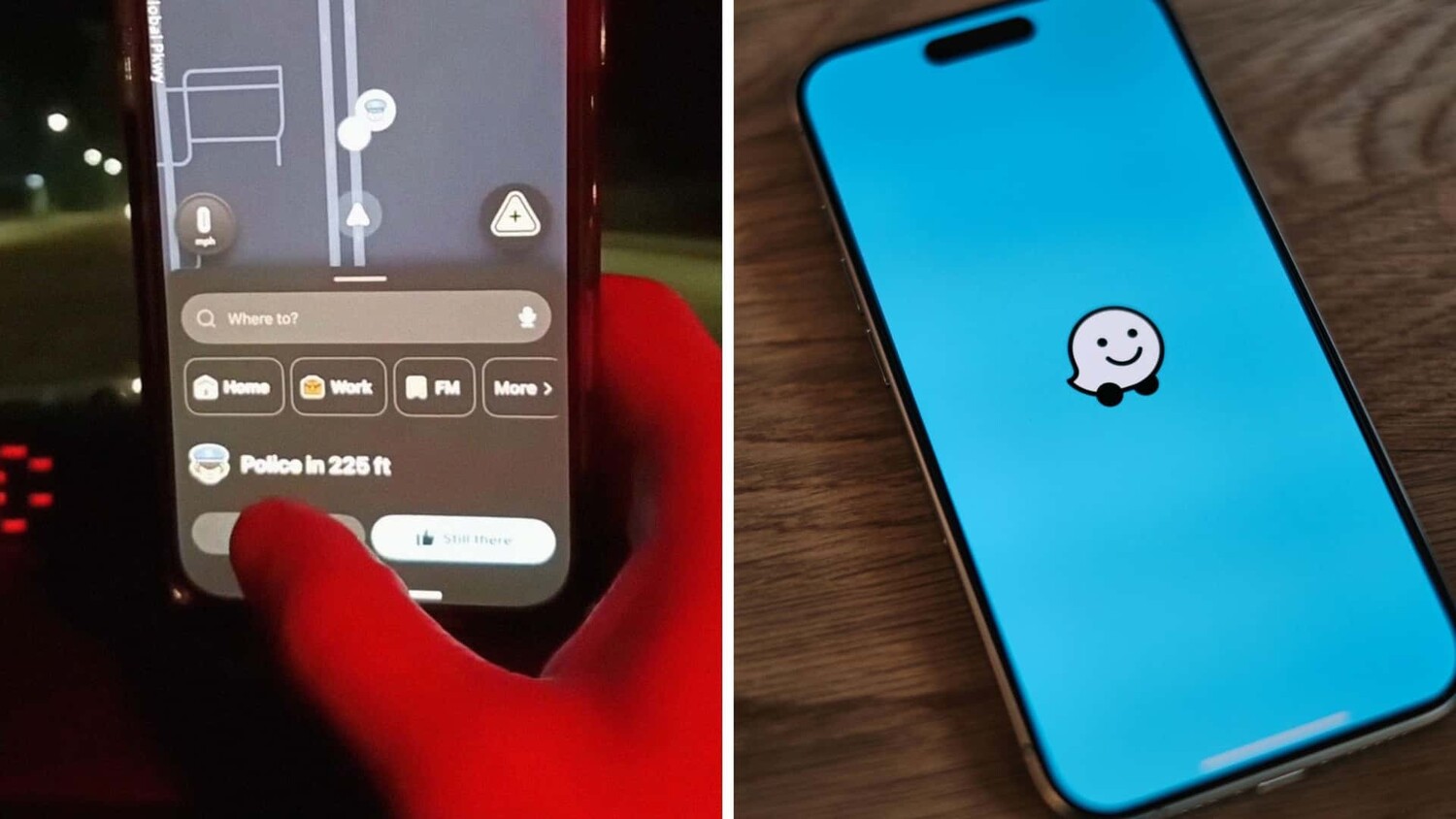
A viral video showing a police officer apparently removing himself from Waze has viewers wondering if law enforcement can manipulate the crowdsourced traffic app. The comments developed into a broad-ranging conversation about surveillance, speed traps, and whether cops can or should conceal their position in navigation apps. Steven Harmon posted the 28-second clip to Facebook, where it has racked up over 1 million views. The video opens with a dash-mounted phone displaying the Waze app at night. The vehicle's interior is clearly that of a police cruiser. The app's screen shows a warning about a cop ahead. Then the officer changes the notification to say that there is no longer a traffic cop in that location. The video then cuts to Harmon, sporting his trademark high-viz vest, as he delivers the take that sparked a debate. "Using Waze can be confusing, and it looks like the police have now infiltrated the app," Harmon says. "I mean, they’re not supposed to be able to do that. It’s almost criminal, or maybe the reverse of criminal. Either way, I don’t like it." Harmon, whose Reels channel specializes in dashcam footage and driving content, says he isn’t satisfied with the way the app currently functions. He calls on Waze to implement a fix: "They need to update their app, like if the vehicle is stationary, they’re not allowed to report if there’s an officer still there or something. Fix it." How Does Waze Actually Work? The good news for drivers relying on Waze alerts is that, according to publicly available information, Waze uses a crowdsourced verification system that requires multiple users to confirm or deny reports before they’re added or removed. When a driver marks a police presence on Waze, that alert stays visible to other users in the area. If someone—cop or civilian—reports "not there," it won’t instantly vanish. According to official Waze Help documentation, reports appear on the map for a certain amount of time and this time changes according to the number of Wazers who react to a report. Clicking "not there" decreases the display time, and confirmations extend it. "It takes several ‘not there’ reports to make it go away," commenter Steven Wiggs explained. "So he’s doing nothing but clearing it from his own screen." Eric G. Hutchins offered his interpretation of the technical mechanics: "Your reports come stamped with a GUID. Repeated submissions from the same origin/location/time range don’t stack. If you report from the same location more than once, it gets ignored. It’s enforcing [independent] behavior with de-duplication and replay suppression." (GUID stands for global unique identifier.) While Waze hasn’t publicly documented these technical details, the app does have anti-spam measures. Users suspected of excessive reporting can be blocked from the map. According to Reddit discussions, all Waze users’ reports are subject to a reputation score based on their report history. In other words, an officer sitting in a patrol car can mark themselves as "not there." But according to publicly available information, unless multiple users corroborate it, it won’t affect what other users see. The concern about police manipulation dates back to 2014, when a Waze forum post asked the company to stop stationary vehicles from removing police reports. Motor1 emailed Waze for clarity on this aspect of app’s functionality. We’ll update this if the company responds. Is It Illegal For Cops To Make False Waze Reports? Several commenters implied that it may be illegal for police to remove themselves from the app, but that is by no means clear. What is certainly true is that law enforcement agencies have used the courts or legal threats to stop Waze from revealing the locations of their officers. As commenter Luis Raganork noted, "The police tried to sue several times and the court said it was legal." In 2015, the Los Angeles Police Department wrote to Google, which owns Waze, demanding the company disable the app’s police-tracking feature, claiming it could be "misused by those with criminal intent to endanger police officers." In 2019, the New York Police Department threatened legal action against Waze for allowing users to report DUI checkpoints. In media reports about those moves, legal experts noted that reporting or publishing information about government conduct is protected by the First Amendment. Some officers have apparently leaned into Waze’s monitoring functionality. "Somewhere I read where a cop said that he would mark himself in a spot to keep cars from speeding," wrote Ruben Juarez. "Seems like that would be the point." Commenter Tony Say, who said he is a former officer, confirmed this: "I did exactly this when I was a cop, especially when we were busy." This inverts the way we usually think about Waze, using information published on the app to encourage compliance without conducting traffic stops. The Great Speed Limit Enforcement Debate, Again Harmon’s video revived familiar discussions about speed limits and whether preventing speeding or generating revenue is the real goal of traffic stops. "Or unpopular opinion, you go the speed limit. Or have ticket/bail money," wrote Patrick Ryan, triggering a massive thread of responses. His comment drew pushback. "Punishable by fine means legal for a price," replied Adrian Smith. Cameron Gallagher added, "My radar detector has saved me more than the 400 bucks I spent on it." Others took a more cynical view of speed enforcement. "Too many municipalities use them to generate revenue on artificially low speed limit roads," James Schmid argued. Some said visibility is preferable to stealth in speed enforcement. "You know what keeps people from speeding? A police cruiser in plain sight," argued Alan Cross, adding, "Police don’t do this much anymore because it affects their monthly quota." Mark Trout shared his town’s solution, posting, "They just park a cruiser beside the road, empty, and people always slow down. They move it so one never knows." The Dance Continues The good news for critics of officers making false reports on Waze is that, despite Harmon’s concerns, according to publicly available information, a single officer, or any single Waze user, can’t effectively remove a police alert from the app. What’s certain is that the cat-and-mouse game between speeders and police has moved from CB radios to smartphones, with both sides continually finding new ways to outsmart the other. Motor1 reached out to Harmon via Facebook direct message. We’ll update this if he responds. We want your opinion! What would you like to see on Motor1.com? Take our 3 minute survey. - The Motor1.com Team