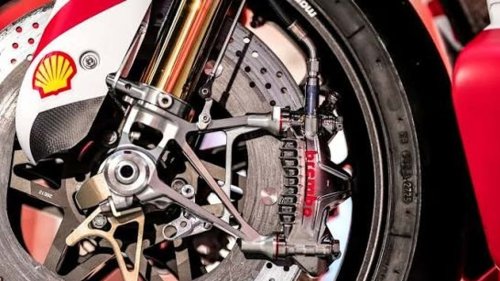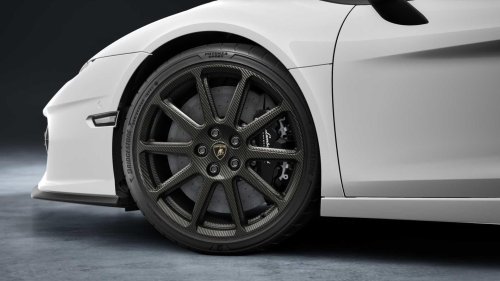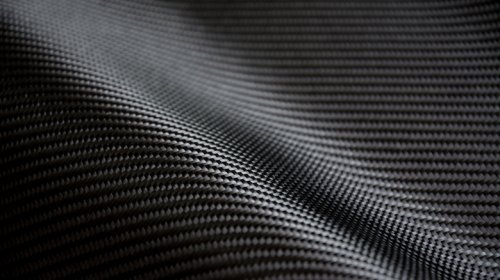
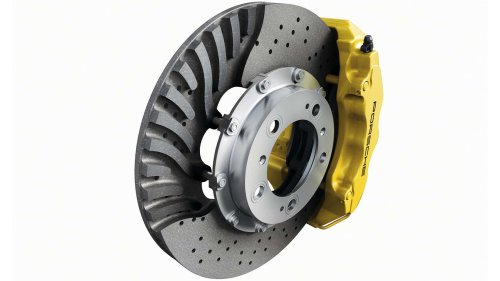
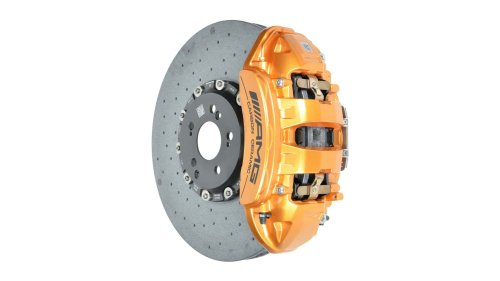
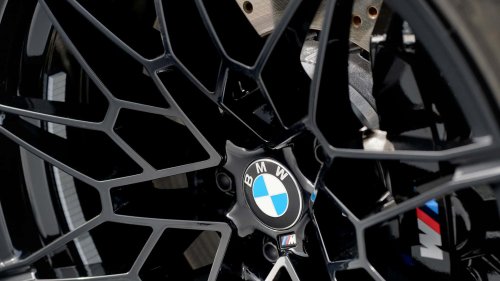
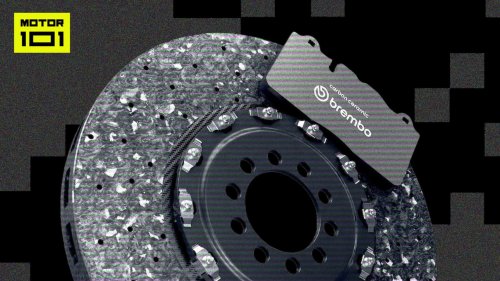



















Congratulations. After years of hustling, saving, and buying six Cayennes in a row from the same dealership, you’ve finally secured an allocation for a Porsche 911 GT3. You’re staring at the configurator, confronted with an expensive question: carbon ceramic brakes or no? You’ve heard of them before, and they’re presumably better than regular brakes—they’d better be, given how much they cost. And they sound exotic. But what is their deal exactly? Do they last longer than regular brakes? Are there any downsides? Motor101 is here to demystify. Here’s a breakdown of what exactly carbon ceramic brakes are, their pros and cons, and our take on whether or not you actually need ‘em. Brake Basics To understand carbon ceramics, it’s important to understand how brakes work in general. Look behind your wheels, and you’ll likely see a disc about the size of a dinner plate with a metal clamp-like device somewhere on its circumference. That disc (called a rotor) spins in tandem with the wheel it sits behind, and when you step on the brake pedal, hydraulic pressure causes the clamp thingy (called a caliper) to squeeze on the rotor, causing the car to slow down via friction. Brake pads, by the way, are the material on the inside of the caliper that makes contact with the rotor and are wear items. Rotors are also wear items, and normal ones are mostly made of cast iron—yes, the same material you might cook a steak on. Cast iron rotors are cheap, easy to produce, and decent at absorbing heat, but they’re also quite heavy. What Are Carbon Ceramic Brakes? Porsche Carbon Ceramic Brake Carbon ceramic brakes (CCBs) are what the industry calls brake systems with rotors that are made of carbon fiber-reinforced silicon carbide with a ceramic coating. They’re almost exclusively offered with high-performance cars. The first ever road car to use them, for example, was the 2001 Porsche 911 GT2. Compared to the equivalent, conventional cast iron rotors, CCBs are about half as heavy, cutting unsprung weight (i.e., weight that isn’t resting on the suspension) significantly. In theory, this improves not just speed and handling but also fuel economy and, believe it or not, ride quality. But who are we kidding? It’s all about the speed and handling… and, if we’re being honest with ourselves, bragging rights. Carbon ceramics can also withstand extreme heat without warping, able to operate between 1,000 and 1,400 degrees Fahrenheit and sometimes even beyond. This is helpful when you’re caning your supercar around Monza, reigning it in from triple-digit speeds aggressively and repeatedly. A lot more resistant to fade, brake maker Brembo also claims that they last "at least four times longer" than cast iron. Carbon ceramic brakes (CCBs) are what the industry calls brake systems with rotors that are made of carbon fiber-reinforced silicon carbide with a ceramic coating. Despite what a salesman might tell you, though, CCBs don’t intrinsically stop shorter than regular brakes, and any improvements in stopping distance are likely a result of reduced unsprung weight or more aggressive tuning by the manufacturer, not an inherent benefit of the carbon ceramic material itself. One tangible benefit of carbon ceramics, however, is a whole lot less brake dust due to the fact that they simply wear down much more slowly. If you’re unfamiliar, brake dust is the stuff that often makes the front wheels of performance cars appear darker than the rears after prolonged or spirited driving. CCBs also look different than conventional brakes, with rotors that are usually darker and have an unmistakably fibrous texture. That surface also often has this pattern on it that looks like it’s cracked—don’t worry, those spiderweb-like cracks are normal. What's The Catch? AMG Carbon Ceramic Brakes So, carbon ceramic brakes are way lighter, last longer, produce less dust, and, depending on who you ask, look cooler. Naturally, there has to be a catch, and boy, is there a big one: price. Take, for example, that 2026 911 GT3 you’ve been eyeing—carbon ceramic brakes are a $10,370 optional extra. BMW, meanwhile, charges $8,500 if you’d like your M4 Competition equipped with ceramic stoppers. Some vehicles do come with CCBs as standard, but those cars often have names that start with words like "Ferrari" or "McLaren." So, carbon ceramic brakes are way lighter, last longer, produce less dust, and, depending on who you ask, look cooler. Naturally, there has to be a catch, and boy, is there a big one: price. It isn’t pure markup, though. Not only is the carbon rotor part more expensive than iron, but the surrounding components, like fasteners, have to last that much longer. The manufacturing process is also very long and labor-intensive, said to take three weeks per rotor versus the 90 minutes for cast iron, according to Engineering Explained. Exacerbate that with the fact that carbon ceramic brakes are produced in much lower numbers than normal iron brakes, and you get a brake option that can cost about as much as an entire 2018 Honda Civic. Even if you have the scratch for such toys, though, ceramic brakes aren’t completely unflappable as mechanical devices. Not all are made the same, so your mileage will vary, but CCBs are often worse at being brakes when they’re cold or forced to operate in heavy rain. Some like to make a squealing sound when slowing down, and some drivers find them to be overly “grabby” in feel. Do You Need Them? BMW M3 Brakes So, do you need carbon ceramic brakes? Short answer: probably not. Longer answer: It depends on what you’re going to use the car for and how much ~$10,000 is actually worth to you. First off, if you rarely, if ever, take your car to the track, you do not need carbon ceramics. The difference in performance on the street will be marginal. Even on the opposite end of the spectrum, many hardcore track rats who have run CCBs eventually switch back to regular because, while carbon does last longer under normal use, aggressive, frequent track work will indeed wear them down eventually, and when that happens, the cost of replacement often involves five digits. And that’s not accounting for the possibility of unforeseen damage. If you have a track day SNAFU or your mechanic accidentally drops a brake on the ground, iron rotors are relatively cheap to replace. With CCBs, that’s a Financial Event. So, do you need carbon ceramic brakes? Short answer: probably not. Longer answer: It depends on what you’re going to use the car for and how much ~$10,000 is actually worth to you. On the flipside, ceramic brakes are far from pointless—the unsprung weight thing is real, and their ability to withstand immense heat over and over again without fading is impressive. And there’s definitely an argument to be made that if you’re in the market for a car that offers carbon ceramic brakes at all, the additional cost is not that crazy and may be worth the increased stamina, potentially superior handling, and dust reduction. Meanwhile, if you’re the sort of buyer for whom money is truly no object, and simply having the most technologically advanced braking system on your car fulfills you emotionally, don’t let anybody stop you from living your best carbon ceramic life. But something tells me if you’re 1,124 words deep on an article titled "Do You Need Carbon Ceramic Brakes?" on the internet, you’re not one of these people. Look, if Porsche ever offers you an all-expenses-covered, go-as-fast-as-you-want lapping session at Laguna Seca, sure, ask for the PCCB car. But for most amateur drivers paying their own way with regular-ish bank accounts, the exorbitant cost of carbon ceramic brakes often outweighs the benefits. FAQs What are carbon ceramic brakes and how do they work? Carbon ceramic brakes are high‑performance brake discs made from a composite of carbon fiber and ceramic materials. They work like traditional brakes—using friction to slow the wheel—but the carbon‑ceramic material offers superior heat resistance, lighter weight, and less fade under extreme use. What are the main benefits of carbon ceramic brakes? The main benefits of carbon ceramic brakes include exceptional heat tolerance that minimizes brake fade, a longer lifespan compared to traditional steel rotors, significant weight reduction which improves vehicle handling and acceleration, and enhanced stopping power, particularly in high-stress or high-speed driving situations. Are carbon ceramic brakes worth the cost? Carbon ceramic brakes are considerably more expensive than standard steel brakes, and for everyday driving they may be overkill, but they are worth the cost for high-performance or track-focused vehicles because they provide superior stopping power, reduced fade, and weight savings that improve overall performance, making them a popular choice among enthusiasts and luxury sports car owners. How long do carbon ceramic brakes last? Carbon ceramic brakes generally last much longer than traditional steel brakes, often exceeding 100,000 miles in regular street use and sometimes lasting the life of the car, though the exact lifespan depends on driving style, conditions, and how frequently the brakes are used under extreme performance situations. Do carbon ceramic brakes require special maintenance? While carbon ceramic brakes require less frequent pad and rotor replacement than steel brakes, they are more sensitive to certain conditions, such as corrosion if the vehicle is driven infrequently, and they also need compatible brake pads and proper bedding-in procedures to ensure optimal performance and longevity. We want your opinion! What would you like to see on Motor1.com? Take our 3 minute survey. - The Motor1.com Team