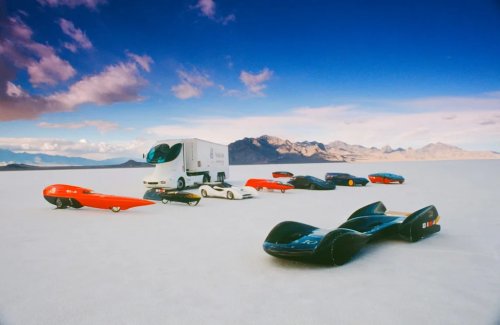
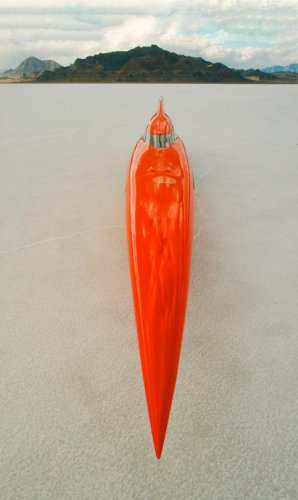
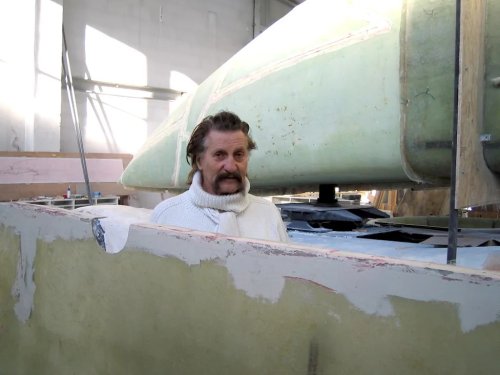
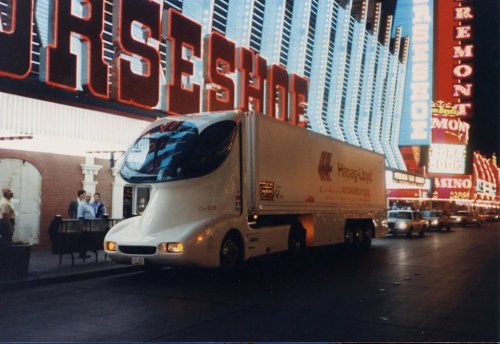
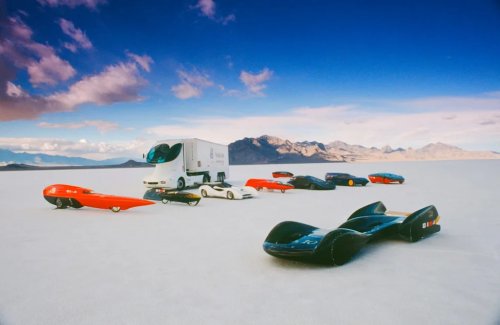
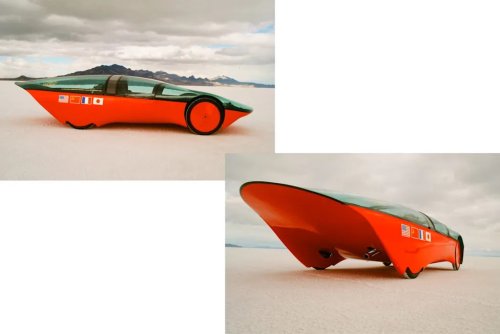
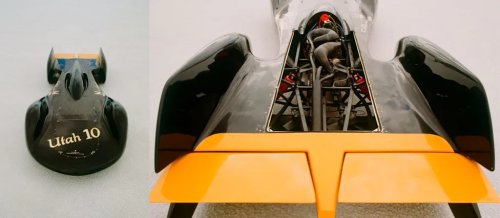

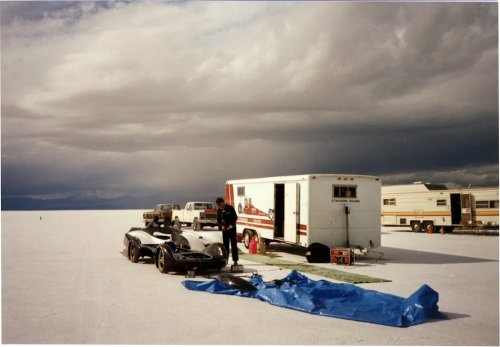
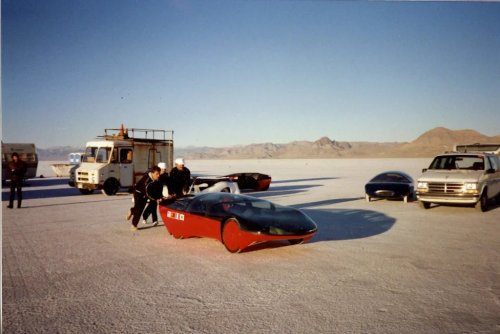
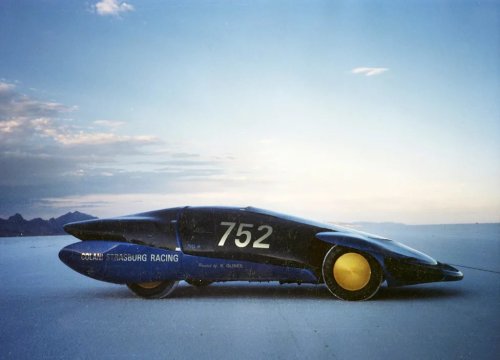
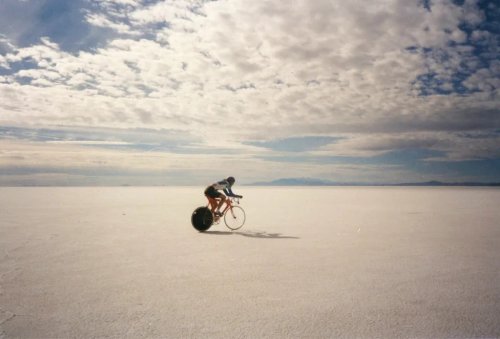
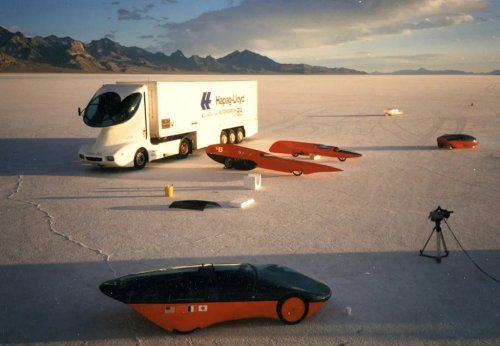
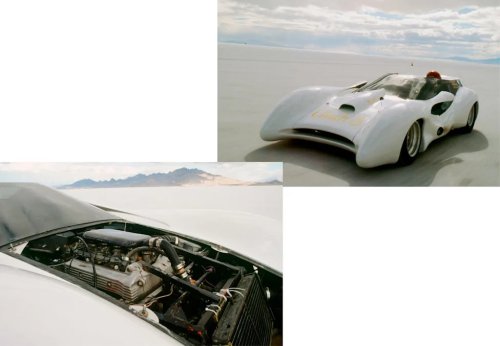
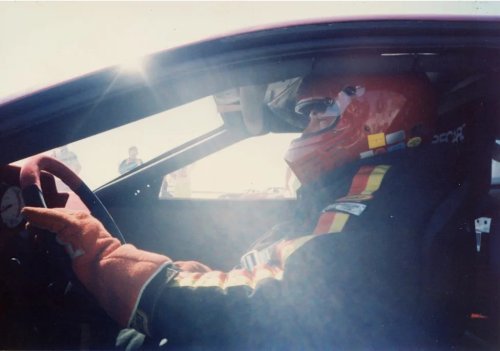
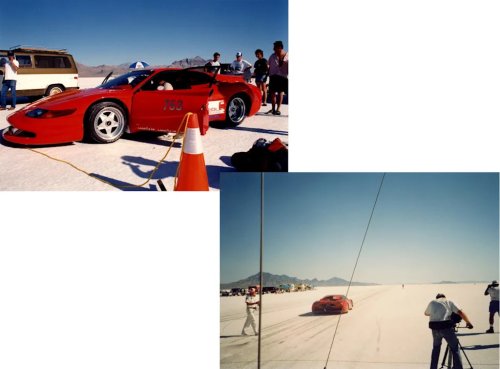



















Parade Of AbsurdityLeslie L BirdDid Colani's designs point to the future, or did they merely imagine a more creative world? Yes.Leslie L BirdLuigi Colani wasn't parodied on The Simpsons, but if he had been, the scene could have written itself. The auteur, draped in a white poncho, his handlebar mustache billowing magnificently, gestures toward a lineup of absurd shapes. A torrent of artspeak pours forth, rendered in sneering Berliner Schnauze by Hank Azaria.Homer watches, blinking. "Wait a minute," he says. "Where'd the car show go?"This story originally appeared in Volume 35 of Road & Track.AdvertisementAdvertisementWith his big-ass 'stache, preachy pronouncements, and wild curvilinear designs, Colani would have been easy to lampoon, but he was hard to pin down. A visionary designer whose creative abandon inspired generations of automotive stylists? Yes. An idealist intent on remaking the world to his own utopian blueprint? Also yes. A showman in the grand tradition of self-mythologizing crackpots? Sure, that too.Colani proudly claimed that he had been featured in the Japanese magazine Car Styling more often than Giugiaro or Pininfarina.Courtesy of Robert WardStill, if anything could have launched the German provocateur and self-described 3-D philosopher into American pop culture such that he'd be immortalized with a kiss of cel-vinyl paint from Matt Groening and company, Automorrow '89 was his best shot.More than three and a half decades on, Automorrow '89 stands as one of the most ambitious and baffling acts of self-promotion in the car world, both for what it was—a traveling festival of future-looking concept vehicles, punctuated by Colani haranguing automakers for their lack of imagination—and for what followed: an unlikely partnership with a family of hot-rodders that echoed across the Bonneville Salt Flats for the next several years.The Utah 12 semi truck was an evolution of a previous design centered around a high, bubble-like cockpit.Courtesy of Robert WardAn invitation from Ford Motor Company set the project in motion. Colani was asked to speak at Ford's design center in Detroit in October 1989. He would do more than talk; he would put on a show meant to become an annual festival of mobility innovation.AdvertisementAdvertisementWith a year to kill before the date, Colani whipped up a fleet of concept vehicles that projected his radical vision: aerodynamic, lightweight, and artful, with a range of human and internal-combustion power. "Tomorrow's vehicles have to be lean and mean," Colani said in an L.A. Times interview. "They must generate maximum use within a minimum size. There is no future for the overweight, overpowered monsters now being churned out by the world's auto industry."The Automorrow '89 tour included a stop at the Bonneville Salt Flats to create an association with land speed records.Leslie L BirdAutomorrow '89 would kick off in Detroit, make a pit stop at the Bonneville Salt Flats, and wrap at ArtCenter College of Design in Pasadena, California. Along the way, Colani would give the auto industry a piece of his mind. "Most car styling is pure design prostitution," he told the L.A. Times. "It is made to please a legion of publicists who have conned a gullible public into lusting after false smiles. We cannot continue for long in this massive obscenity that is destroying our cities and our souls."Adding a twist of validation testing, Colani asserted that "existing records will be challenged." For Colani, setting and breaking records for both speed and efficiency was vital to Automorrow's innovative spirit, just as it was a way to prove to a skeptical engineering establishment that his concepts could also deliver function.(left) The Utah 7 was said to have the lowest coefficient of drag for a four-seater, 0.18. (right) Power for the vehicle came from a two-stroke moped engine.Leslie L Bird"That was always his dream," says Robert Ward, an American designer who was then working as a sculptor and modeler in Colani's studio in Bern, Switzerland, and would become Colani's project manager for Automorrow '89. He adds that carmakers would say Colani's theories were cool, but they'd ask where the evidence was. "You need the evidence to prove that it's worthy. Does it go fast? Does it save gas? Where's your proof?"AdvertisementAdvertisementBut before any of this could happen, Colani had to become Colani.(left) The Utah 10, a land speed streamliner, was 12.8 feet long and 2.9 feet tall, and it weighed only 880 pounds. (right) Tucked inside the bodywork was a 500-cc two-stroke three-cylinder Honda motorcycle engine good for 148 hp.Leslie L BirdBorn Lutz Colani in Berlin in 1928 (he changed his name to Luigi, the name he says he was meant to have, "as soon as the Nazis were out of the game"), the future designer grew up virtually wired for a life in the creative arts. His mother was a Polish actress, and his Swiss Italian father was a set designer who worked on Fritz Lang's Metropolis. "My father forced me to build my own world," he said in a 1989 interview. "He didn't give any toys to me when I was a child. He forced me to make my hands and my brain work and I built my own small universe when I was two, three, four."Hearst OwnedAfter World War II, Colani trained in sculpture and painting at the Hochschule für Bildende Künste (now Universität der Künste) in Berlin. "After two years, I left for France to study aerodynamics at the [École] Polytechnique," he told Interview magazine in 2009, "but I already knew so much about aerodynamics from watching trains and cars and planes. So I went to the Sorbonne to study analytic philosophy. And I learned to ask myself questions like: Why is something made the way it is? Why does a motorcar look like it does? Is it right or wrong? What is an airplane? Why is it shaped like that?"Automorrow '89 project manager Robert Ward supplied behind-the-scenes photos from several visits to Bonneville, shown on these and the next pages.Courtesy of Robert WardColani developed increasingly avant-garde automotive concepts for Fiat, Alfa Romeo, and Volkswagen throughout the Fifties and Sixties and created a plastic-bodied concept version of BMW's first monocoque car. In 1967, he filed a patent in Munich for an inverted-wing vehicle design, a "downforce-inducing aerodynamic shape for land vehicles." He called it the C-Form, for Colani.AdvertisementAdvertisementBy then, Colani, who had achieved pop-art stardom for his hypermodern furniture and household objects, had developed a signature ethos. "Straight lines do not exist in nature," he later said. "That's why I believe in bio-design, which uses a vocabulary whose inspiration comes from organic shapes with their violence and sensuality."Pushing the limits, yes, but not any that set new records.Courtesy of Robert WardBack in his workshop, Colani was putting the finishing touches on about a dozen Automorrow '89 concepts. Each dubbed "Utah," they ranged from a carbon-fiber racing bicycle to recumbent speed machines to pedal-assisted pods for basic transport in rural developing nations (with room "for a pig and some potatoes," he told Road & Track at the time); from a streamlined 80-cc motorcycle to a sleek, low-drag take on the Volkswagen Golf; from an experimental, hyperefficient electric Citroën 2CV to an 880-pound racer with a carbon-fiber and fiberglass body. They were all dwarfed by the Utah 12, a massive Mercedes-Benz semi-truck tractor with a spacey, aerodynamic nose—an evolution of the low-drag Colani Truck 2001 concept the designer first showed in 1977. The truck would haul other concepts during the Automorrow '89 tour.With everything else sorted, Colani needed someone to handle the logistics of a coast-to-coast traveling show. For that, he turned to Ward. "He said, 'Okay, Robert, you're an American. Organize the tour,'" Ward recalls. "'I'll fly in and do the lecture in Detroit. You keep going. You go to the salt flats, do a press conference there, organize everything.'" Ward headed to Utah in August 1989 on a reconnaissance run and started by contacting the Bureau of Land Management (BLM). "They thought I was shooting a commercial," he says. "I told them, 'No, we want to test experimental vehicles.'" By chance, it was Speed Week. A BLM official pointed him toward a local fixture: Allen Strasburg.Colani designs, like this prototype, returned to the salt flats in subsequent years with the Strasburgs for official speed trials.Leslie L BirdWard met with Strasburg and his sons, Mike and Lindsay, who were experienced land speed drivers, mechanics, and operators of a local speed shop. "I showed them the pictures and said we wanted to test these vehicles on the salt flats. They thought it was really cool. 'Okay,' they said. 'We'll do it.'"AdvertisementAdvertisementThe Strasburgs, who'd been racing at Bonneville since the early Sixties, handled the arrangements. "We rented the salt flats for them," Lindsay remembers. "You have to have an ambulance and bathrooms and everything. We had a few vehicles that they would use to film while they were moving, and then we had to have security and insurance and all kinds of stuff."The Utah 1, a carbon-fiber-frame bicycle, was the least strange of the bunch.Courtesy of Robert WardBy October, with everything in place, Ward flew to New York to meet the cars. The plan immediately went sideways. "Hapag-Lloyd [a German shipping firm] was supposedly sponsoring the tour," Ward says. "I get there, and they tell me, 'We only sponsored the ship route. We'll unload the two containers. Have fun.'" Now Ward was stranded with a load of experimental vehicles and no way to move them. "You can't just drive the truck," he says. "You need plates, EPA clearance, all kinds of stuff." He started making calls. "I had so much luck. Beginner's luck, dumb luck, whatever. I just met the right people at the right time." He found a trucking company in Philadelphia to haul one container, while another driver piloted the Utah 12, whose futuristic looks made it a cop magnet. Ward rode shotgun.After a kickoff press conference in New York, the caravan set out for the Detroit Institute of Arts. Colani flew in. At the Ford lecture, as Ward remembers, Colani opened with a banger: "I was at the Henry Ford Museum this morning. Thank you. It was amazing. You should be ashamed of what you're designing now." The executives bristled. The designers, however, swarmed the cars, and Colani took center stage. Days later, Automorrow '89 packed up and headed west. Colani headed home.Setting up the group photo. The Utah 3, the tiny enclosed bicycle in the back, didn't make it into the final arrangement.Courtesy of Robert WardNext stop was the Bonneville Salt Flats, where there would be another press conference, photo shoots, and test sessions. "We were there for three days," Ward says. "It was a circus—really rock 'n' roll. We had magazines from all over the world there, and they were freaking out."AdvertisementAdvertisementBut while the festival ambience implied a kind of success, the test sessions Colani had been so intent on were a bust. Without any safety gear, the risks were too great. Under the Strasburgs' watch, Automorrow '89 on the salt remained a photo opportunity. "They took pictures of parachutes coming out and somebody pedaling the bike," Lindsay says. "But none of them were ready to set records."(left) The Utah 8 was powered by a BMW K100 motorcycle engine boosted with a turbocharger and nitrous oxide. (right) One of Colani's most famous quotes was "Straight lines do not exist in nature," a statement echoed in all his designs.Leslie L BirdIn retrospect, Ward has no regrets that the test sessions were scratched. "They were art sculptures, you know?" he says. "If we would have run those things, somebody might have gotten killed." Nonetheless, Lindsay says the atmosphere at the salt flats sparked something that he knew—likely from his own experience—would draw the Colani team back to the salt. "I think then they kind of got the bug."Colani returned to the States for the final Automorrow '89 stop. In Pasadena, he held court with another media throng. Then, the show was over. All told, Automorrow '89 cost about 1,000,000 Swiss francs (around $4.2 million today). With few sponsorships, Colani footed most of the bill himself.Mike Strasburg joined the 200-mph club in the Testa d'Oro with a speed of 218.114 mph.Courtesy of Robert WardTwo years later, late in the summer of '91, a pair of radical design concepts arrived in Utah. The first was a highly stylized, Colani-bodied Ferrari Testarossa called Testa d'Oro, developed by German tuning firm Lotec as both a technical showcase and a statement of intent to sell the cars for $500,000 each. With a team of dour German engineers, the Testa d'Oro, powered by a twin-turbocharged Ferrari flat-12 and equipped with a catalytic converter to be emissions-compliant in Germany, was wrapped in Colani's patented C-Form design, which he hoped would be validated on the salt.AdvertisementAdvertisementThe second was the Colani Corvette. Conceived as a static showpiece, the beetle-like concept body got a full makeover from the Strasburgs: a safety cage, a 700-hp big-block powerplant, and a Ford Top-Loader transmission. With a claimed 0.21 coefficient of drag, the body acted as a single aerodynamic surface, generating downforce and stabilizing the car at speed. Colani never made it to the salt; he communicated with Ward and the Strasburgs only by fax machine.The Colani-Lotec Testa d'Oro at Bonneville in 1991. Colani later redesigned the body.Courtesy of Robert WardOn August 22, 1991, Mike Strasburg, driving the Testa d'Oro, was certified at 218.114 mph by the Land Speed Authority (LSA) in Category I, Class 12, Group I, Supercharged Gas. A month later, Lindsay Strasburg, in the Colani Corvette, turned in an LSA-certified speed of 227.718 mph in Category II, Class 15, Group I, Unsupercharged Gas, and an FIA-certified 227.644 mph in Category A, Group 2, Class 10, one mile, flying start, giving the feat a European twist. The run was Lindsay's indoctrination into the vaunted 200-mph club.Colani, back in his studio in Switzerland, had moved on to other projects, but he had his validation. He died in 2019 at the age of 91. There never was another Automorrow.A car-lover's community for ultimate access & unrivaled experiences.JOIN NOW Hearst OwnedYou Might Also LikeIf You Can Only Own One Car, Make It One of TheseThese Are the Most Popular Cars by State