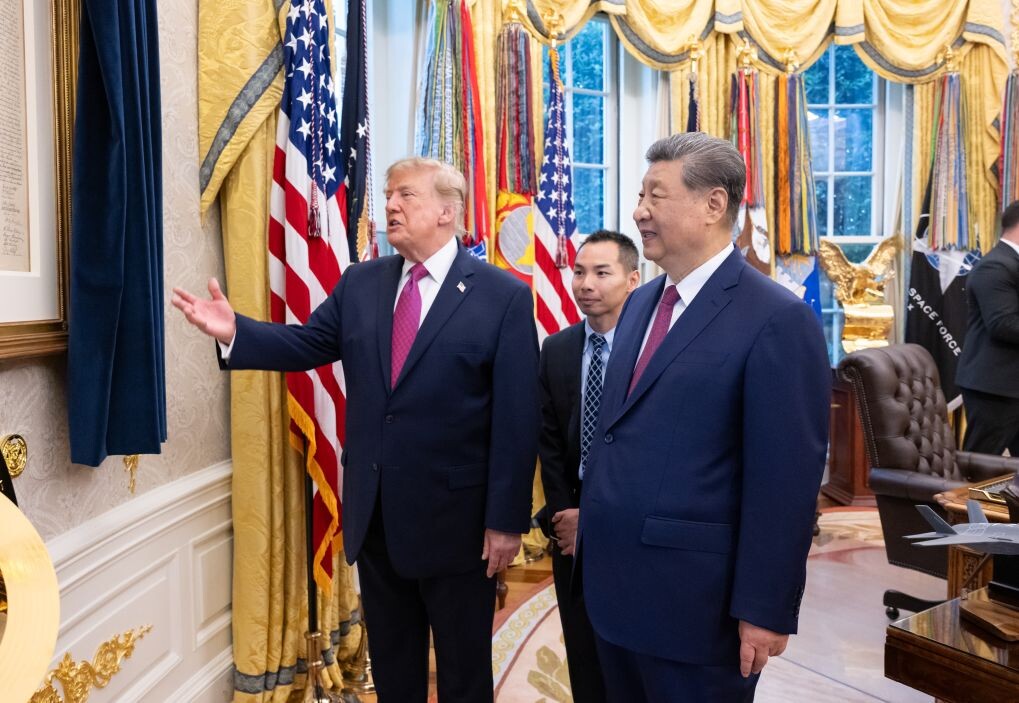
THE HIGH-STAKES state visit between Chinese President Xi Jinping and U.S. President Donald Trump at the White House highlights a stark industrial contrast between the two global powers. Beneath the diplomatic pageantry and White House state dinners lies a sobering reality: the world’s two largest economies are sprinting in opposite directions on global energy strategy. During the bilateral White House summit between the two world leaders, clean energy transformation was largely sidelined as discussions prioritized immediate macroeconomic, technological, and security concerns. This according to reports from Chinese news agencies like Xinhua, CGTN. The leaders focused on securing US access to China’s dominant critical mineral and rare earth supply chains, while negotiating agricultural purchase agreements, aircraft sales, and tariff truces within traditional trade frameworks. Beyond trade, the agenda centered on frontier artificial intelligence, semiconductor supply chains, and cybersecurity, underscored by a state dinner with top technology and defense executives. Ultimately, both nations framed their relationship through a lens of strategic competition and geopolitical stability, placing guardrails around military conflict and economic friction rather than advancing joint climate or energy goals. While Beijing executes a centralized industrial policy designed to lock in dominance over global clean energy supply chains, Washington is engaged in a policy reversal. The resulting chasm in capital deployment, technological leadership, and manufacturing scale threatens to redefine economic power across four core clean technology sectors: solar, onshore wind, offshore wind, and geothermal energy. Sector-by-Sector Technology Comparison China’s 15th Five-Year Plan for Renewable Energy Development (2026–2030) establishes explicit capacity targets, while current U.S. federal policy rollbacks create market friction and investment delays across all four key technology verticals. 1. Solar Photovoltaics (PV) & Concentrated Solar Power (CSP) China’s Roadmap: Solar serves as the primary engine of China’s growth strategy. As part of its binding 2.8 TW combined wind and solar target by 2030, China is deploying 370 GW across seven massive mega-bases located in desert and Gobi regions (including Xinjiang and the Yellow River Bend). China is also integrating advanced perovskite tandem cells and utility-scale Concentrated Solar Power (CSP) for thermal storage to maintain base supply. U.S. Reality & Policy Shift: The cancellation of residential clean energy tax credits, rescission of unobligated Inflation Reduction Act grants, and heightened trade tariffs have created supply chain bottlenecks. Domestic wafer and ingot manufacturing projects face capital freezes, delaying cost parity with Chinese producers by an estimated 10 to 15 years. 2. Onshore Wind China’s Roadmap: Onshore wind is being scaled alongside desert solar to form integrated mega-clusters that feed ultra-high-voltage (UHV) cross-provincial transmission lines. To overcome grid variability, China’s 15th Five-Year Plan introduces firm capacity standards, requiring onshore wind to maintain an 11% minimum capacity credit to ensure peak-period grid stability. U.S. Reality & Policy Shift: Onshore wind development in the U.S. faces extended permitting delays, federal land leasing slowdowns, and the expiration of production tax credits. Grid interconnection backlogs continue to stall new installations in wind-rich corridors across the Midwest. 3. Offshore Wind China’s Roadmap: The National Energy Administration has mandated the launch of 100 GW in new offshore wind projects between 2026 and 2030. Coastal provinces are building deep-water floating wind farms supported by localized supply chains, lowering balance-of-plant installation costs. U.S. Reality & Policy Shift: U.S. offshore wind has hit severe headwinds. Federal leasing freezes, legal challenges to existing offshore permits, and rising capital costs have led developers to cancel major commercial contracts along the Atlantic coastline. 4. Geothermal Energy China’s Roadmap: China is scaling medium-depth and shallow geothermal energy to replace natural gas for urban district heating. Through simplified pre-approval procedures, long-distance heat piping, and the conversion of depleted oilfields into geothermal wells, China aims to expand thermal direct-use beyond its current baseline of 1.65 billion square meters. U.S. Reality & Policy Shift: While Western states hold significant enhanced geothermal system (EGS) potential, federal research funding cuts and relaxed fossil fuel regulation have slowed commercial EGS pilot deployments, leaving domestic developers dependent on private venture capital. Comparative Sector Summary Technology Sector China 15th Five-Year Plan Target (2026–2030) U.S. Policy Status & Market Impact Estimated U.S. Recovery Lag Solar PV & CSP Core component of 2.8 TW combined solar/wind target; 370 GW across desert bases Rescinded federal grants, revoked residential credits, and tariff friction 10 to 15 years to reach manufacturing scale Onshore Wind Integrated with UHV transmission; mandated 11% minimum firm capacity credit Permitting slowdowns, federal land restrictions, and grid backlogs 5 to 10 years in project pipeline delivery Offshore Wind 100 GW of new offshore project starts by 2030 Federal lease freezes, litigation, and canceled commercial contracts 10+ years due to supply chain stagnation Geothermal Large-scale direct-use urban district heating to displace natural gas Reduced federal R&D grants for Next-Gen EGS systems 5 to 8 years in commercial-scale rollouts Expert Analysis on Overall Recovery Timelines Rigorous modeling from institutions like Princeton University’s REPEAT Project and independent energy market researchers provides clear data on the long-term impact of these policy shifts: Impact Category Estimated Recovery and Lag Timeline Key Industry Structural Drivers Decarbonization Goal Lag 5 to 10 years behind original zero-emissions trajectory Immediate loss of federal incentives, stalled utility-scale permitting, and relaxed power plant emissions mandates. Manufacturing Supply Chain 10 to 15 years to reach global cost parity High capital requirements for domestic battery gigafactories, processing plants, and solar wafer facilities requiring long-term investment stability. Global Market Position Decades or potentially irreversible Chinese state-backed competitors achieving compounding economies of scale across export markets in Europe, Latin America, and Southeast Asia. Restoring competitive parity in advanced manufacturing presents deep structural challenges. While policy changes can occur overnight through executive orders, building physical supply chains requires sustained capital commitment. Interrupting this funding cycle forces private capital overseas, leaving domestic supply chains fragmented and giving Chinese manufacturers an enduring lead across solar, wind, and geothermal technologies. This reporting breaks down the joint National Energy Administration and NDRC policy document detailing China’s 3.5 TW renewable capacity target and grid integration targets for the 2026–2030 period. Comments? Feedback? Email me: tribstribdino@gmail.com