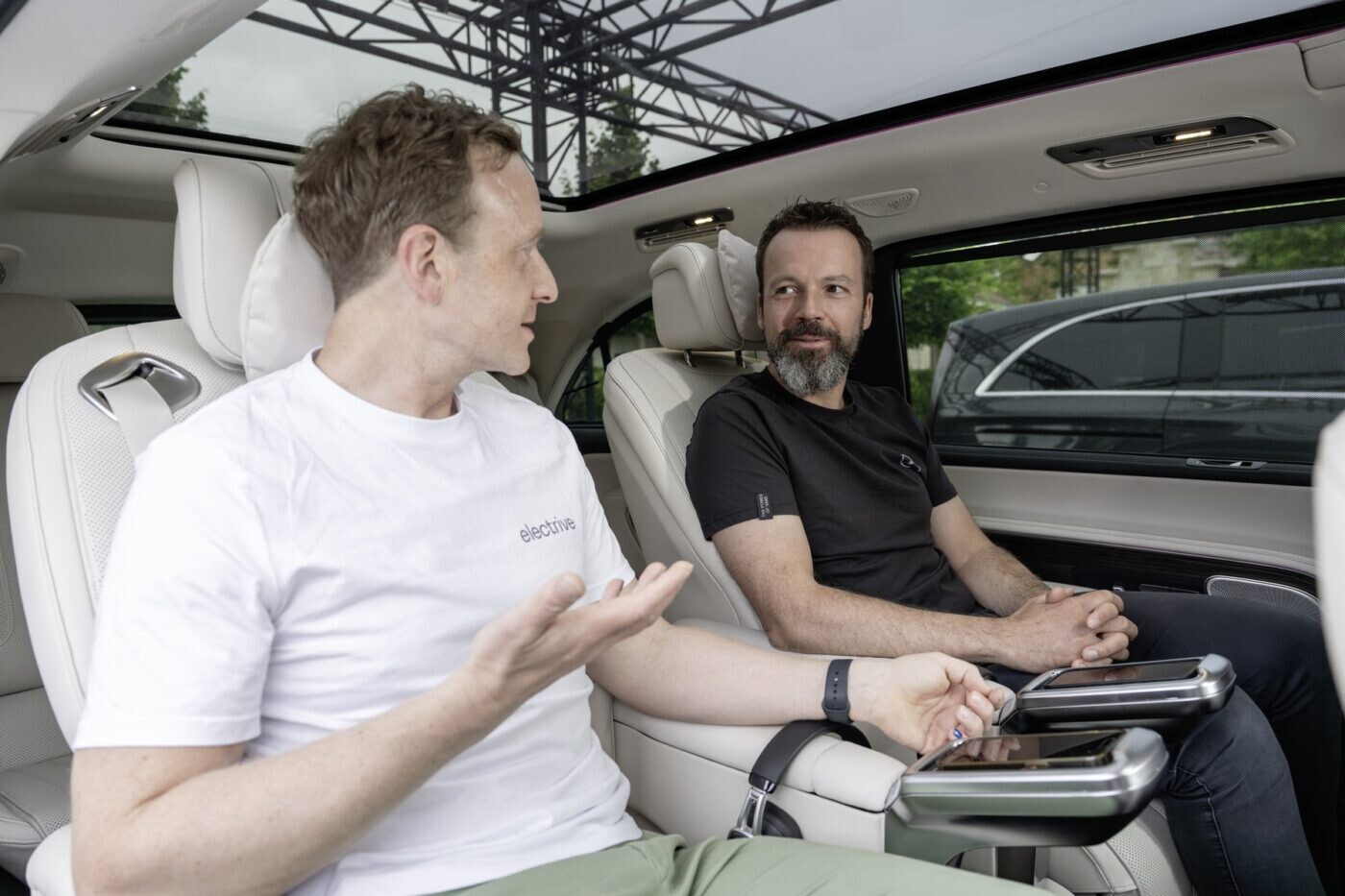
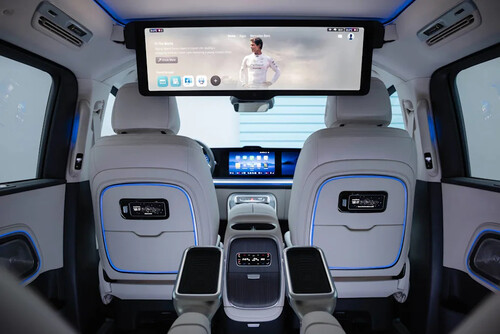
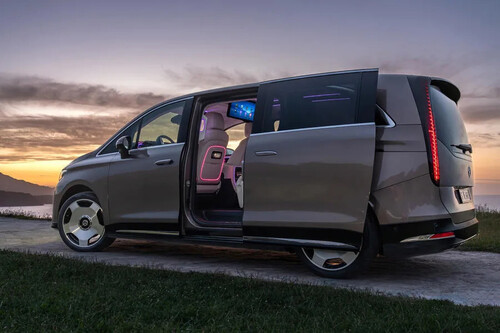
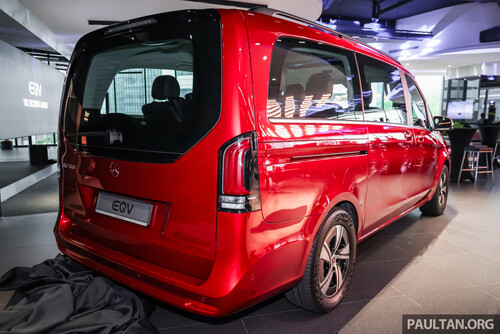
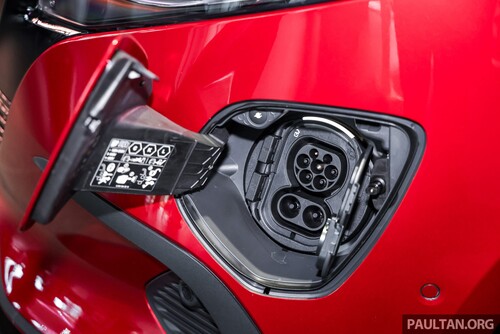
The sun shines over Bilbao, the industrial and port city in northern Spain surrounded by green mountains, as Benjamin Kaehler welcomes his guests. Journalists from around the world have gathered to meet his latest creation – Mercedes’ first 800-volt van.“There is no better place to experience the VLE for the first time than here in the Basque Country, where its story begins,” says the chief engineer of Mercedes-Benz Vans. He can barely contain his enthusiasm: the new VAN.EA electric platform is ‘a real game changer,’ while its positioning as a Grand Limousine ‘creates a completely new segment of its own.’Up to eight seats, a WLTP range of more than 700 kilometres and energy consumption of just 18.4 kWh/100 km. “That is equivalent to around two litres of diesel per 100 kilometres. Over the next two days, we invite you to beat that figure.”It is clear that Benjamin Kaehler is not delivering his own words as he opens the driving event. The marketing and communications team has once again done its job. That is why, after our first drive, we want to hear his personal perspective on the development of the platform and the vehicle. We meet him for a conversation in the comfortable seats of the luxury version of the VLE.Mr Kaehler, what makes the Mercedes VLE so special to you as the engineer responsible for its development?The opportunity to start completely from scratch – with a blank sheet of paper – naturally opens up an incredible number of possibilities. We were able to implement everything that mattered to us in one vehicle: from the drivetrain and efficiency right through to the vehicle we are sitting in now. Simply being allowed to do that and now seeing the result is, for me personally, the biggest highlight.The VLE is the first model to be based on the new VAN.EA architecture. Which is more important to you – the new platform or the vehicle built on top of it?Of course, you need both. But from my perspective, the drivetrain is no longer the differentiating factor today. The platform is the foundation. It has to be right, robust and solid, and it has to do its job – no question about that. The differentiation then comes from the vehicle built on top of it.In other words: what does the vehicle look like? How comfortable is it? How good is the NVH? What additional functions do I offer customers? I believe that today’s electric vehicles have reached a very good level when it comes to their electric characteristics. Now traditional automotive engineering is becoming important again.That is an interesting development. A few years ago, things were different: 800 volts was the big topic, everyone wanted it and hardly anyone had it. Has what is now technically implemented in the drivetrain become a commodity?I think so – certainly for us, now that Mercedes is rolling out its new vehicles. You mentioned 800 volts: it enables charging performance at a level where a charging stop is just long enough for a coffee. To put it bluntly, even a visit to Burger King would take too long.The same applies to efficiency, performance and everything that comes with it. From my perspective, that is no longer a differentiating factor and has not been a problem for a long time. I believe there is now really no reason left to say that you are not switching to electric mobility because something is missing. Image: Peter SchwierzWhat aspect of the technical development are you particularly proud of? Is there one highlight from the work of the past few years?If we look again at the platform and the drivetrain, I am proud that we are starting with the VLE, but that this platform will eventually underpin all of our vans. That includes larger vehicles, commercial vehicles, vehicles with a gross vehicle weight of more than five tonnes, 2.5 tonnes of towing capacity, all-wheel drive and so on.Creating that foundation is a major achievement. And then turning it into a Grand Limousine in the VLE – a vehicle that no longer has anything of a commercial vehicle about it, but can genuinely compete in the passenger car segment – is something special for me.Does the platform – or electric drive in general – give you more freedom than combustion-engine vehicles did in the past? The VLE’s climate functions, for example, are only possible because of the electric system, aren’t they?I am a passionate advocate of electric mobility and I genuinely believe there are only advantages. One example is the climate function you just mentioned. You can reach the desired temperature within a very short time – virtually from the moment you start driving or even while charging.In this vehicle, for example, we have two rear climate-control units. That allows passengers in the rear to set an individual climate zone and reach the desired temperature very quickly when setting off, regardless of whether it is hot or cold outside. A combustion-engine vehicle cannot really achieve that, because the required output is not available immediately.Then there is the flat design enabled by this skateboard platform and the highly integrated electric motor. It allows for a flat load floor. We can move the seats around, install them or remove them – all of that was important when developing the platform.What was the key consideration when packaging the drivetrain? You use a drive unit from ZF and a battery from CATL. How should we understand your strategy for bringing these components together?The first question was whether we wanted a predominantly front-wheel-drive or rear-wheel-drive vehicle. The decision in favour of front-wheel drive came relatively quickly because it allows us to achieve this flat load floor.At the same time, we wanted to offer all-wheel drive as an option. That meant we needed a package in which the rear electric drive unit was as flat as possible, so that it would not push the load floor back up again. At the same time, we wanted to integrate a rear axle that could compete at passenger-car level. We are talking about a multi-link rear axle that also has to be steerable, among other things.That required a package that is just as flat as the battery and the rear electric drive unit. Those were the biggest challenges when developing the platform.That also includes the inclined damper arrangement. I have never seen anything quite like it, and it was developed specifically for this vehicle. Did that not make the solution particularly expensive?Not necessarily particularly expensive. But you are right: it is unusual in conventional passenger-car design because it is generally not required. Most passenger cars have a three-seat rear bench and sufficient space behind it, for example in the boot. You are more likely to see such horizontally mounted dampers in Formula 1 – that was one of our inspirations as well.The solution does not make the vehicle expensive. It was a prerequisite. In the body structure, we use aluminium die-cast components where the dampers are mounted. In fact, that allows us to achieve the opposite: rather than increasing costs, it enables us to transfer the high suspension loads into the body structure as efficiently as possible while using a minimum amount of material.Looking back, what was the biggest challenge in developing the platform and drivetrain?Without a doubt, it was the breadth of applications we had to cover. We need to support everything from the VLE 300 with a 115 kWh battery and front-wheel drive through to future commercial vehicles with a gross vehicle weight of 5.5 tonnes, 2.5 tonnes of towing capacity and therefore a combined vehicle weight of up to eight tonnes, including all-wheel drive and a completely different rear axle.At the same time, we wanted to maximise commonality across the range, so that we would not have to develop everything from scratch for every vehicle and every variant. Achieving that breadth of capability was the biggest challenge.What about the software side? You have introduced many new features there as well.That was naturally a challenge too: creating a software architecture capable of supporting all derivatives. In that sense, the VLE is the snowplough clearing the path for this development. All vehicles that follow, including the commercial models, will benefit from it.You said that the platform and the technical foundations – including 800-volt technology and similar features – have, to some extent, become a commodity or are simply expected. So what will differentiate this vehicle? What will customers like about it?I believe these technical aspects are the prerequisite. They will not be the differentiating factor; they are the foundation. What will excite customers is, for example, the interior.We will stand out with outstanding NVH (noise, vibration and harshness). In the vehicle we are sitting in now, customers can deploy a huge, fully integrated screen from the headliner. We have seats with massage functions and many new features that we have not previously offered, and that can be configured in new ways.Building on that, we are reaching an entirely new level. The exterior design will also appeal to many customers. Then there are the retractable windows in the sliding doors – something familiar from passenger cars, but not offered by anyone else in this segment. Passengers in the second row no longer feel like second-class travellers. Quite the opposite: for rear-seat passengers, that is where the music quite literally plays.We have an excellent sound system, have taken safety to a new level and offer eleven airbags on board. This vehicle is a true Grand Limousine in terms of its materials, interior quality and comfort. That is exactly what our customers will appreciate.What impressed me most yesterday was the rear-wheel steering. It makes this large vehicle remarkably agile, even in narrow streets like those here in Bilbao. Isn’t that also a major differentiating feature?Absolutely. We achieve a turning circle of 10.9 metres in a vehicle that is just over 5.30 metres long. That is comparable to the figure of today’s CLA.We have tested it extensively over the past few days. You can turn this vehicle around within the space of a tennis court. In city centres, car parks and similar situations, it is a tremendous advantage. Everyone who tries it is impressed and surprised.When sitting in the rear, you almost get the feeling that the vehicle is rotating around you – that is how tight the turning circle is.There is one aspect that has not entirely convinced me yet: the charging port location on the rear right-hand side. In a vehicle of this size, that could prove challenging with some charging park layouts in Germany.First of all, we wanted to position the vehicle as a passenger car. In the passenger-car segment, different manufacturers take different approaches, but for Mercedes, the standard location is at the rear right. Every Mercedes customer should feel at home.Of course, the sliding doors create an additional challenge. We solved that by ensuring that the sliding door on the right-hand side does not open quite as far when the charging port is in use.And you are right: not all charging parks are designed the same way. There are now sites in France that allow vehicles to drive through and where even charging with a trailer is straightforward. Other layouts may be more convenient if the charging port is located at the front. There is no single perfect solution that satisfies everyone. That is why we decided to remain with the familiar rear-right position within the Mercedes-Benz ecosystem. Image: Deniz CalaganOn some trucks and passenger cars, charging ports are available on both sides as an option. From a user perspective, that would also be attractive here. I assume it would simply be too expensive?Very expensive. If we are talking about charging parks, you would really have to duplicate the DC charging port. That would be significantly more complex and costly because those are the heavy and expensive components. In my view, a twin-port solution for AC charging only would not go far enough.Speaking of DC charging: how did you approach fast charging and, in particular, the charging curve for the large battery?Our goal was to get as much energy into the vehicle as possible within 15 minutes – not simply to achieve a peak charging figure. Experience shows that if I charge the battery at a very high rate during the first five minutes, it becomes difficult to manage the temperature afterwards in a way that is suitable for longer charging sessions.That is why we focused on a different question: how much energy can we get into the vehicle within 15 minutes? We then optimised the charging performance accordingly. You will still see charging rates well above 300 kW. However, we do not want a sharp drop afterwards. Instead, we aim to remain in the region of around 300 kW for as long as possible.That was the objective – not a peak figure that looks good in communications but is only achieved for a few minutes in practice.What does a typical charging stop look like in real-world use, for example from ten to 80 per cent?That takes around 20 to 25 minutes. Within the 15 minutes we mentioned, we can add approximately 350 to 355 kilometres of range. That is highly practical for everyday use.Production started this week at the Vitoria plant just a short distance from here. What comes next for you? The VLE is now on the road and further models based on the platform are already in the pipeline. Your team will not be short of work, will it?Not at all. As you mentioned, more models are already on the way. Following the VLE comes the VLS, an even more luxurious vehicle. After that, the commercial vehicles will follow.You are one of the pioneers of electric mobility. We spoke many years ago about predecessors such as the eSprinter and the EQV. Looking back on the development since then, what has been particularly exciting – and what developments did you perhaps not expect?The most exciting development has certainly been charging infrastructure. But in reality, everything has improved. Compared with the EQV, this vehicle offers roughly double the range and double the charging performance – and at certain operating points perhaps even three times the charging performance.That means journeys which previously required two charging stops can now be completed without stopping at all. And when you do need to charge, it may take ten minutes instead of 30. I would not have expected that.Certain problems have simply disappeared. Topics that used to be discussed at length with potential customers, or indeed with colleagues such as yourself, are no longer relevant today. I would not have expected that either.Unfortunately, this progress is not happening everywhere. What we see in Germany or, for example, in France is excellent. But that is not yet the case worldwide. I would like to see charging infrastructure expand even faster.Thank you for the interview, Mr Kaehler!