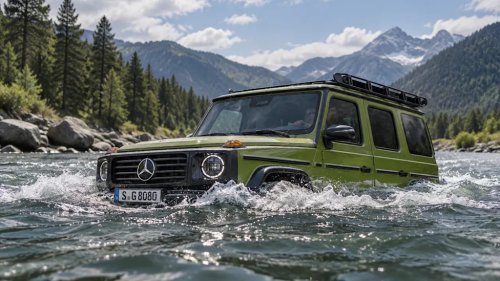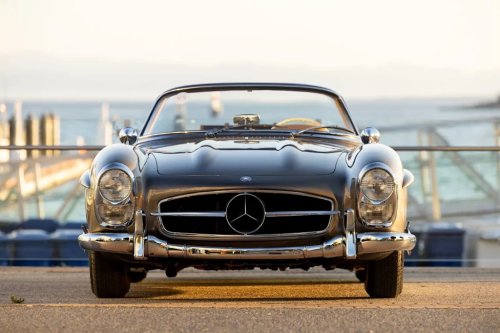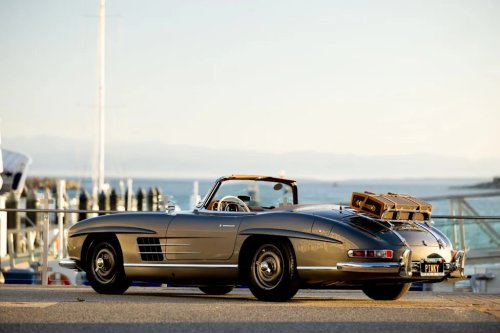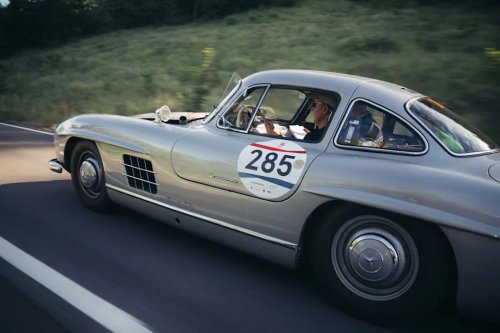
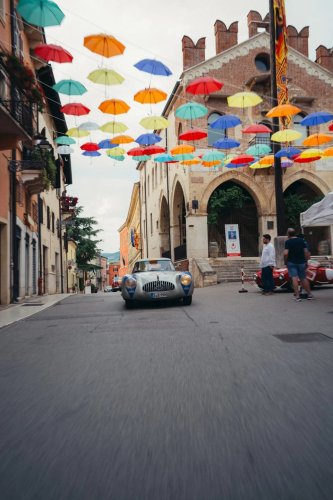
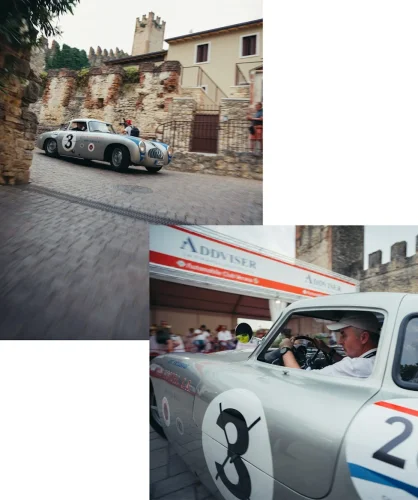
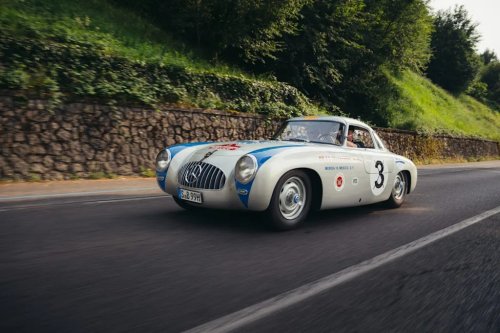
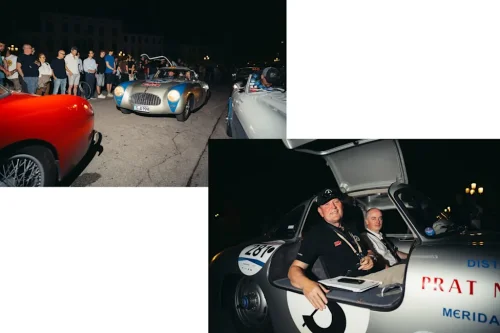
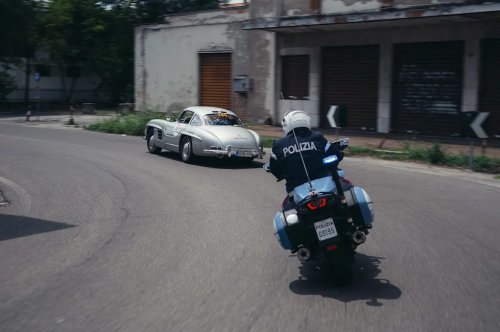
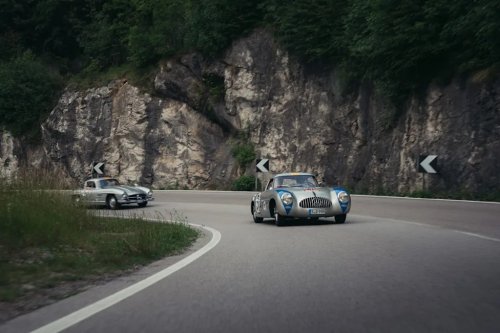
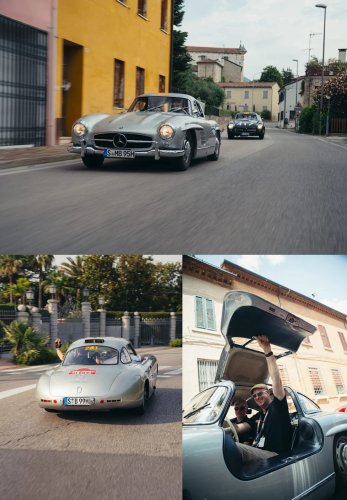
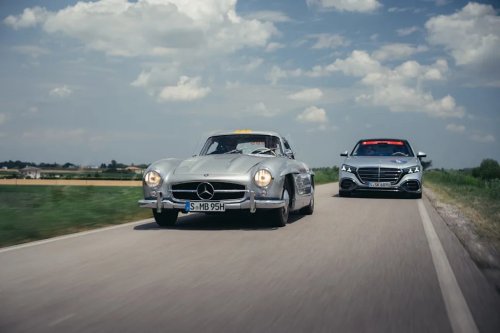
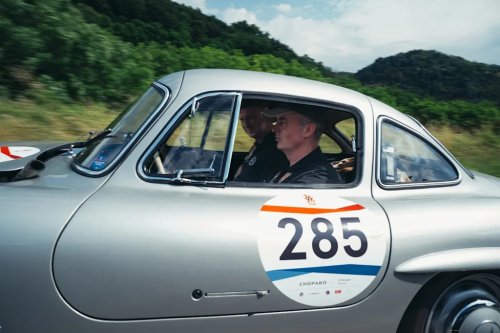
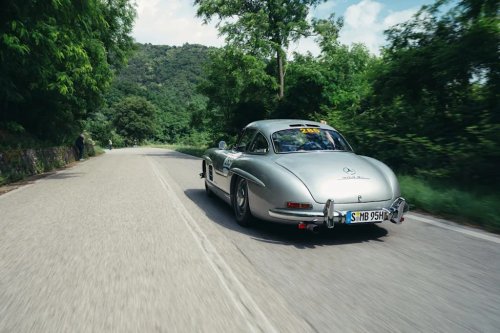
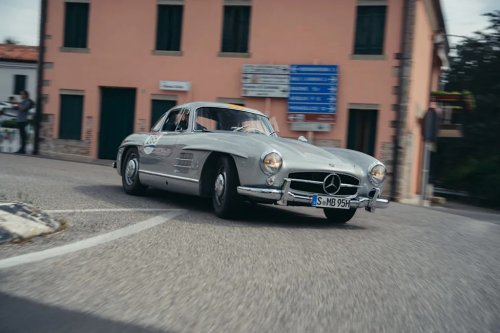


















Driving the Mille Miglia Is SpectacularMercedes ClassicMy ears are ringing from the sound of an unsilenced exhaust, my backside aches from sitting for hours in a barely cushioned seat. My arms are throbbing from the exertion of unassisted steering around hundreds of tight bends, and my right leg has endured a similar gym session with the heavy, wooden brakes. With air temperatures in the mid-90s, and massive heat soak from the mighty engine up front, I also feel like I've done all this sitting in a sauna.Also, my face hurts—from grinning so much.The Mille Miglia is not regular motorsport. Although there are rules and control checkpoints and timecards and marshals, for most of its competitors the Mille is more of a parade than a competition. And for the vast crowds that flock to watch, it is essentially a thousand-mile-long party held over five days on a figure-of-eight route that cuts across much of northern Italy, from Brescia to Rome and then back again. Watched by an estimated 5 million spectators every year, it can claim to be the most popular car event on the planet.Mercedes ClassicI arrive in Brescia as a complete newcomer and unaware of what to expect. For me the Mille name was an invocation of the race's peaks of risk and excitement, when the best European race drivers went flat out over public roads. That was the era that brought Stirling Moss's famous victory and never-beaten 98-mph average speed over 992 miles in 1955, aided by British auto journalist Denis Jenkinson delivering rudimentary pace notes. And also the infamous race that ended the original Mille Miglia two years later when Ferrari works driver Alfonso de Portago, co-driver Edmund Nelson, and at least nine spectators died in a horrendous high-speed crash.AdvertisementAdvertisementTwenty years later, the Mille Miglia was reborn as a classic event—speeds carefully regulated and with the competitive element involving accurately hitting target times. Eligibility is restricted to cars of types that competed in the original event and, unusual for historic motorsport, anachronistic modifications to cars are pretty much banned. This allows some of the most valuable and gorgeous sports cars to compete, but also more everyday machinery from the era. At the scrutineering hall before the start, multimillion-dollar Ferraris and prewar Bugattis rub shoulders with Fiats and Citroens.W194 race car wears the livery in which it won the 1952 Carrera PanamericanaMercedes ClassicAlso Mercedes. Lots of Mercedes. I'm here thanks to Mercedes-Benz Heritage, the division charged with looking after the automaker's history with more than 1200 cars in the corporate collection. Another part of Heritage's brief is to ensure these get seen and celebrated in appropriate settings, none more so than the Mille Miglia. For 2026 two 300 SL Gullwing coupes owned by Mercedes were entered, plus another belonging to Mercedes Italy, and another six run by the team on behalf of owners. There was also an even-rarer W194 race car from 1952, essentially a prototype of what became the Gullwing and the very car in which Rudolf Caracciola finished fourth in that year's Mille Miglia. I'm going to be taking turns in both the W194 and one of the production Gullwings over the two-day section from Brescia to Rome, both as driver and co-driver of each, before another crew of journalists swaps in for the return leg.The start in Brescia is pure street theater. The Mercedes Heritage convoy is escorted into the city center by a pack of motorcycle cops who block traffic at every intersection: Except for sections within some towns and the timed regularity stages, the entire route is on open public highway. I start out riding shotgun in the W194 next to Marcus Breitschwerdt, Mercedes-Benz Heritage's CEO and a Mille veteran who has done the event multiple times, including in prewar cars. Compared to those, he assures me, the W194 will feel modern. "Although I should mention that we have no suspension," he adds. This turns out to be only a slight exaggeration.Mercedes ClassicAfter passing over the start ramp, I soon discover that navigation is easy. A thick "road book" gives turn-by-turn directions, but this is rarely necessary with Mille Miglia arrows pointing the way at every intersection and the roads leaving Brescia lined with spectators. Many of the fans are expecting an interactive experience, holding out hands for high-speed high-fives. Mercedes has also provided a box of Gullwing toy cars, with one of my duties being to pass or throw these to children.AdvertisementAdvertisementEven without the coincidence of his initials, it's easy to see Breitschwerdt as the personification of Mercedes. A lifetime executive for the brand, with previous roles including heading up Mercedes's van division and being in charge of passenger cars in Europe, he took control of Heritage four years ago and led its transformation into a profit-making part of the business. Despite being 65, in what will likely be his last major role before retirement, Breitschwerdt is definitely a hands-on leader, talking to other competitors, organizers and spectators every time we stop. "You've got to be doing things, you've got to be meeting people," he says. "That is what this job is all about."MB Heritage CEO Marcus Breitschwerdt looks happy to have reached the end of day one in PaduaMercedes ClassicOne of the key decisions Breitschwerdt made early was that of selling a 300 SL "Uhlenhaut" coupe from the collection for 135 million euros ($142 million) in 2022; three years later a Fangio/Moss W196 R that had been on long-term display at the Indianapolis Motor Speedway Museum was sold for a further $53.9 million. They were controversial decisions at the time, especially in Germany, but have helped secure Heritage's financial independence."On that basis, I'm the best used car salesman in the world," he says, deadpan.While it's probably frightfully déclassé to talk about the value of cars at the Mille, there's no doubting the W194 would be one of the priciest here. Just nine original coupes were built, with three belonging to Mercedes, three privately owned, one scrapped, and the fate of the other two unknown. As a small-volume model with an elite competition history, including the Carrera Panamericana where the car at the Mille won and earned the livery it still wears, the estimated range of values for an example hitting the market range from 20 million euros to 30 million euros ($22 million to $34 million)—or so I was told when I asked Heritage employees to nominate a figure. Which, when Breitschwerdt said it was time to swap seats, makes it the most valuable car I've driven by some margin.Police motorcycle outriders help clear the wayMercedes ClassicWith a Mercedes-Benz board member next to me, and no seatbelts, the risk of infamy if something goes wrong is high.AdvertisementAdvertisementThe W194's seating position is low enough to make me want a booster cushion to improve my view over the long bonnet and also to add to the minimal padding. Ride is indeed brutally hard, and every imperfection is passed straight into my backside. With no air vents, and no blower fan, the cabin becomes incredibly hot whenever the car is stationary, the only cooling coming from airflow through the removed side windows. But the basics are all easy: the clutch bites progressively, the engine has good low-down torque, and the shift action for the four-speed gearbox is accurate despite a long and awkward throw. Steering is heavy—of a vein-popping nature at maneuvering speeds—but the race car tracks straight and true with minimal wander at speed. It clearly wants to go fast.Mercedes ClassicBefore setting off I've been warned about the need to adapt to Fifties brakes. Predating the introduction of the disc brake, the W194 uses drums at all four corners—as does the production Gullwing. But against low expectations, I'm pleasantly surprised: There's more top-end bite than I was expecting, and although heavy to operate the pedal is well positioned for heel-and-toe rev matching. I clearly grew up on cars with equally minimal brakes. Only pressing harder makes it apparent there isn't much retardation in reserve, and Breitschwerdt cautions me that there's also a much greater risk of fade than with discs.With all that in mind, I start at a respectful pace. The minimum times between control points mean that there isn't any need to travel especially quickly unless something has gone wrong, although many competitors seem determined to go as fast as possible. There's more than enough time to stop for the occasional espresso.MB Classic's Peter Becker proves his six-foot-four frame can fit in the Gullwing's driver's seatMercedes ClassicClearer sections of road also give the chance to push harder, extending the spectacular-sounding engine to the delight of spectators, with no excuse needed for rev matching and throttle blipping in towns and villages. The W194's side-exit exhaust is loud from idle upwards, and within the cabin it is overlaid by the mechanical symphony from the engine up front; there is no soundproofing at all. I probably shouldn't say this about such a highly bred powerplant, but at lower revs there's something definitely diesel-ish about it—like the dirtiest, most guttural Cummins you can imagine.AdvertisementAdvertisementBut as the revolutions rise, the W194 finds a purer voice, a hard-edged note that is utterly addictive. Lifting the gas pedal produces a fusillade of 100 percent organic pops and bangs as well, as unburned fuel passes through the engine. On a short stretch of divided highway the urge to push harder became irresistible. With the long-travel accelerator on its stop, the mechanical tachometer twitched its way to its marked 6000-rpm redline in third before I shifted to fourth. Hindsight may ultimately prove this to be the point at which my life peaked, but it also brought the sudden realization that the speedometer needle was now pointing at a figure well inside "hard time" territory under Italy's penal code. The race car still felt stable and composed—as did my co-driver—with this being just a small glimpse at the way the entire race was driven during the Mille's flat-out heyday.Duff's lack of sartorial elegance partially excused by 100-degree heat in the cockpitMercedes ClassicYet even a lower-tenths pace was still physically exhausting, especially with the need to wrestle the steering around numerous tight turns as the route winds through narrow streets and piazzas. Even as evening drew on, the crowds stayed sizable, with thousands coming to watch the finish in Padua. I've only driven half of the first day's 195-mile route, at an average speed of under 30 mph, but I'm completely wiped out. So it's unsurprising to learn from contemporary reports of the original Mille Miglia that many drivers used "keepy-up" pills to keep going—most likely methamphetamine.The next morning I'm fortified by nothing more than strong Italian coffee when it's time to shift to a new car and a new companion. Today I will be in an immaculate 1955 "W198" 300 SL Gullwing coupe from the Mercedes collection, sharing driving with Peter Becker, Mercedes Classic's affable PR manager, who somehow makes squeezing his six-foot-four frame through the narrow door aperture look easy.Mercedes ClassicBreitschwerdt assures me the production Gullwing will feel like a limousine after the race car. The coupe was one of the fastest cars in the world when it was launched and must have seemed like an alien visitor to 1955, but it was aimed at affluent buyers who were not going to sacrifice luxury for performance. The cabin is much better finished than that of the W194, with generously padded seats and smooth-working latches to hold the doors closed where the race car had awkward bolts. It's still going to be hugely hot—air temperatures are in the 80s before we even get started. But at least the Gullwing has quarter-windows to help direct air into the cabin when moving.AdvertisementAdvertisementWaiting to take the restart in Padua gives the chance to soak up some Mille magic in the staging area, where cars line up in approximate order, and fans get close to take pictures and ask questions. The Mille is a traveling circus that, it turns out, brings its own team of police officers from Brescia with it—our police escort and motorcycle outriders are the same guys throughout. There is also a historic police team that actually drives the route in cars from the Polizia di Stato museum; the police officers crewing them are wearing modern uniforms (and weapons) and seem to have been chosen for their photogenic looks. Vintage Americana is lacking, but there are a pair of Fifties Lincoln Capris running close to us in the order.Police officers are driving the entire Mille Miglia route in this car from the Italian State Police MuseumMike DuffEvery car has a story. Talking to Matthias Bonczkowitz, owner of one of the other Gullwings being looked after by Mercedes Classic, reveals it was an original "recce car" used by Moss and Jenkinson when they were learning the Mille route in 1955. Risking damage to a car with such rich history is brave, but, as Bonczkowitz puts it: "I can't think of anything more appropriate to do with it."The chance of harm is real. The world's most beautiful race suffers from some truly ugly driving. With the minimum time within sections set for a law-abiding average, rushing ahead normally means just having to wait for long periods to enter the next time control. But this doesn't stop much of the field driving as if they're in the Wacky Races, forcing their way past regular traffic from the off—much of which is unaware it is caught up in a historic race—but also, less forgivably, running stop signs and red lights. Many spectators seem delighted by this and warmly encourage faster progress, and at most major intersections volunteer Mille marshals help competitors to roll through safely without stopping. But there were still plenty of Mario Kart moments, including an Alfa Romeo Giulietta Sprint that drove into one of the motorcycle escort cops on the first day and immediately became an unwitting star of social media. Fortunately the rider was not badly hurt.Italy loves the Mille Miglia, nowhere more than in the Tuscan city of Sienna (right), reached on day threeMike DuffBecker and I witnessed our own near-miss soon after leaving Padua. I'm driving and stop for a woman using a pedestrian crossing in an area with a 50 km/h speed limit (31 mph). My act of timidity earns a horn blast of admonishment from behind, and the German-registered Austin-Healey then sweeps past on the inside at what is probably twice the limit, narrowly avoiding wiping out the pedestrian crossing in front of us. Participants at the Mille are necessarily rich, tend to skew old, and in many cases seem to have limited fast driving experience. There is no requirement for any kind of race license. Some drivers should definitely not be here.AdvertisementAdvertisementAlso, there are actual competitive sections to decide the order. There are two types of these: regularity trials—in which the object is to travel at precise speeds over short distances—and also longer average-speed sections, where the challenge is to maintain the same velocity throughout. Both were fun in a gentle way, with the need to hit the intermediate timing points on a regularity section with perfect accuracy: One of these short sections might require an average of 19 km/h over 220 meters, then the next—entered immediately—requires 22 km/h over 450 meters before another different speed and distance. Front-running cars use complex trip computers and even cameras showing front wheels to help hit these with split-second accuracy, and a complex coefficient index that favors older cars means that the ultimate winner is practically guaranteed to be a prewar car. In the Gullwing, they were just a gentle change of pace.The Gullwing is closer in time to the original 1886 Benz Patent Motorwagen than it is to the 2026 S-Class support carMercedes ClassicAmusingly, the second day's route ran right through Maranello and right past both Ferrari's Fiorano test track and the company's factory on Via Abetone Inferiore—with the rate at which the toy Gullwings were being given out to spectators increasing significantly as we passed through what should have been enemy territory, although the success of Bologna-born Kimi Antonelli in Formula 1 is being reflected in surprising amounts of Mercedes team gear in this part of the world.The Gullwing's softer suspension, plusher seats, and quieter exhaust made it a much more comfortable place to spend time than the W196, although it is definitely less intense as an experience. It's even easier to drive, with lighter steering, the fuel-injected straight-six being more tractable than the racer's carbureted engine, and a more precise gearshift. The only real challenge was remembering to turn on the second fuel pump as underhood temperatures rose, this being necessary to keep the engine supplied as gasoline starts to boil.Rubber hose in the trailing edge of the hood was a period-appropriate cooling enhancement from the FiftiesMercedes ClassicDespite the heat, the Gullwing didn't miss a beat, and Mercedes Classic's support mechanics—traveling in incongruous modern G-classes—didn't have anything to do for us other than check-overs and topping off fluids. One of the other Classic-run Gullwings did suffer a differential failure, and the mechanics who swarmed around to fix it by the side of the road probably enjoyed the rare chance to show off their skills.AdvertisementAdvertisementAfter lunch in the baking heat of Modena, the Mille route moved into the cooler Apennine Mountains in Tuscany, with the climb over the Passo dell'Abetone—4550 feet above sea level—the definite highlight. Stopping for photography (and coffee) had dropped the Gullwing well behind most of the pack of scrapping competitors, meaning I got to enjoy driving the spectacular road pretty much undisturbed, although a few spectators had stayed out to watch the stragglers.One of the most beautiful cars in the world on one of the finest roads in the hills of TuscanyMercedes ClassicOn fast, flowing asphalt, the Gullwing felt almighty: composed, stable and rich in feedback, the engine enjoying the cooler air and relishing any chance to head into the top quarter of its rev range. The tighter roads on the long descent from the summit suited it less well but gave the chance to run with another car that had dropped behind the pack—a tiny Lotus Eleven powered by an equally diminutive 1.1-liter Coventry Climax four-cylinder. The British lightweight had less than half the power and half the mass of the Gullwing, but the pair proved almost perfectly matched: the Mercedes faster on the short straights, the nimble Lotus quicker in corners and braking zones—especially as the smell of overheating friction material started to waft into the cabin from the SL's front drums.It was the last section of Mille route I drove, but also the most special memory from what is—despite the poor driving of some of its competitors—a truly magical event. No wonder the 450-plus entry slots were all filled despite entry fees that begin at 13,000 euros ($14,900) before taxes, with the cost of buying, preparing, and running an eligible car on top of that.The modern Mille Miglia is more party than race, but it's one hell of a party.Mercedes ClassicYou Might Also LikeIf You Can Only Own One Car, Make It One of TheseThese Are the Most Popular Cars by State