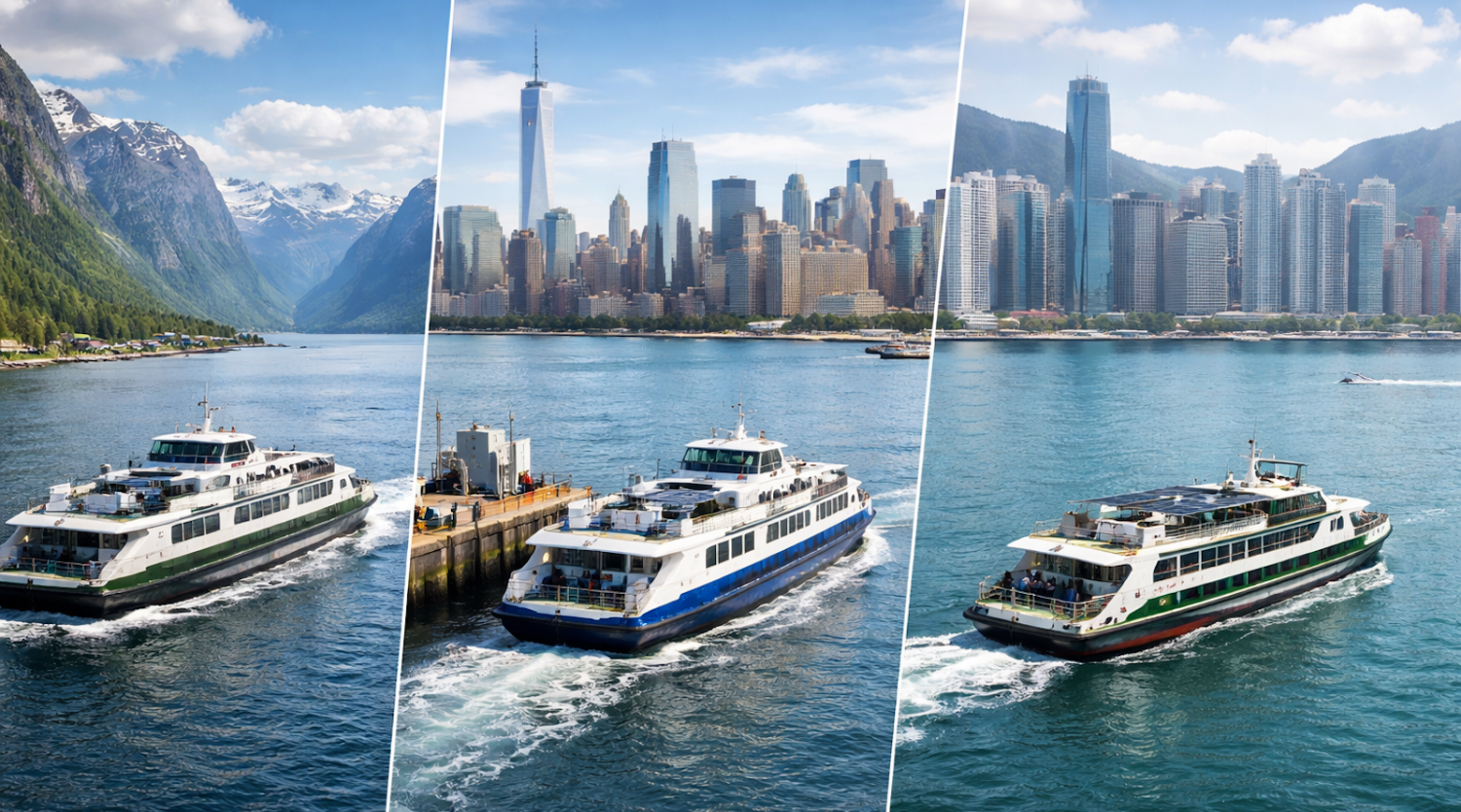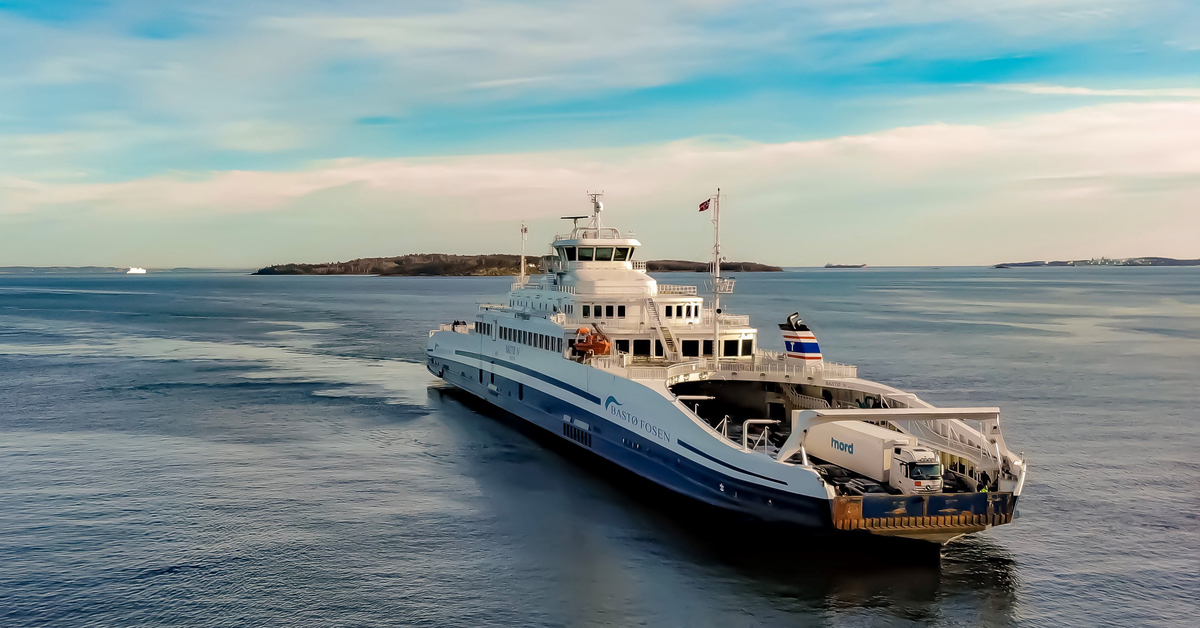



















AMSTERDAM, The Netherlands — WHEN Bastø Electric entered service in Norway in March 2021, it was hard to miss the significance of the ferry. At 139.2 meters long, with room for 600 passengers and 200 cars and a 4.3-MWh battery, it was the world’s largest all-electric ferry at the time. I picked up the story on the trip home from Hannover through Amsterdam, then Singapore. At the Schipol Airport group of Filipino and Indonesian crewmen were on their way back to their headquarters around the Moss-Horten crossing after a week of rest and recreation. It was an odd way to start thinking about an electric ferry, but watching crews come and go on a route that runs all day says something about the scale of the operation. Bastø Electric was never supposed to be a demonstration boat that went out when the weather was good and journalists were around. It was put into the Moss-Horten service to do the same work as the diesel ferries, carrying people and vehicles across the Oslofjord, over and over again. Five years later, that is still what it does. It is no longer the world’s largest electric ferry. Much larger battery vessels have appeared, including Incat’s China Zorrilla with more than 40 MWh of battery capacity. Bastø Electric’s 4.3 MWh ferry has something the newer vessels don’t have yet, though. Five years of doing the job. A busy route The Moss-Horten connection is one of Norway’s busiest ferry routes. Earlier figures from Bastø Fosen put annual traffic at about 3.7 million passengers and 1.8 million vehicles on roughly 36,000 departures. Current operator information puts the route at close to 2 million vehicles and around 4 million passengers a year. The crossing is only about 10 kilometers and takes around half an hour. That is a useful distance for battery propulsion because the ferry knows where it is going and, more importantly, where it will be charged next. Bastø Electric can take up to 9 MW from the shore charging system while it is alongside. There is no need to carry enough energy to cross the North Sea or make a long coastal voyage. It needs enough for the crossing, with enough reserve to get back into the charging cycle. That simple operating pattern is one reason ferries became one of the early places where battery propulsion started making sense. The original electrification program was bigger than Bastø Electric. Bastø Fosen also converted Bastø IV and Bastø VI from diesel to electric propulsion. When the three ferries are operating electrically, the company expected them to handle about 75 percent of the route’s departures and cut diesel consumption by roughly 6 million liters a year. The route had previously been using about 8.5 million liters of diesel annually. That 6 million liters is the useful number here. It works out to roughly 16,000 metric tons of CO2 a year using the standard emissions factor for diesel. The actual savings depend on how the vessels are operated and how much electricity is being used, so I would leave the figure as an estimate rather than present it as a measured five-year total. The transition did not happen overnight. Bastø Electric entered service in 2021, while the charging system and the conversions of Bastø IV and Bastø VI were still being completed. The vessels initially had to operate with hybrid capability while the shore infrastructure caught up. By 2023, charging was available at both ends of the route and the three ferries could operate fully on electricity. That part of the story is easy to overlook because it isn’t very photogenic. The ferry gets launched and everybody talks about the battery. The charging equipment at the terminal is what allows the battery to be useful. The same route, different boat Bastø IV and Bastø VI are perhaps as important to the story as Bastø Electric itself. They were not new electric ferries. They were existing ships that were converted. Bastø IV completed its conversion in 2021, and Bastø VI followed with sea trials in March 2022. Both can carry about 600 passengers and 200 cars. So the Moss-Horten operation became a mixture of new construction, conversion and new charging infrastructure rather than a fleet replacement program. That is probably closer to how electrification will happen on many other ferry routes. Operators have ships they already own, contracts they have to fulfill and terminals that were designed around diesel vessels. Some ships can be replaced, others can be converted and the infrastructure has to be built around both. Kongsberg Maritime has installed Auto Docking and Auto Crossing on the three electric ferries. Auto Docking uses sensors and thruster controls to handle the approach to the terminal, while Auto Crossing uses data from previous trips to create and follow a route intended to optimize propulsion and power use. Bastø Electric’s captain, Svein Erik Waskass, told Kongsberg that a crossing from Horten to Moss can essentially be reduced to three pushes on the screen. That is a very different story from simply replacing a diesel engine with batteries. The ferry’s electric propulsion makes precise control easier, particularly during docking and low-speed maneuvering. The vessel’s power demand can be adjusted directly rather than managing a conventional engine and drivetrain. The automation does not mean there is nobody aboard or that Bastø Electric is an autonomous ship. There are still people operating the ferry. It means some of the repetitive parts of a route that the crew performs hundreds or thousands of times can be handled by the system. A ferry making the same short crossing several times a day is almost an ideal place for this kind of system. The route is known. The terminals are known. The charging points are known. The vessel has made the crossing before, many times. That is probably the more interesting five-year update than the size of the battery, that looked enormous in 2021 but is now relatively small by the standards of new electric ferries. The ship that was once described as the world’s largest has been overtaken by larger vessels. My own computations There is no clean public tally of exactly how many crossings the individual ferry has made, because it works as part of a fleet and the operator’s traffic numbers cover the route rather than individual vessels. What we do know is that the Moss-Horten route has been making around 36,000 departures a year, and Bastø Electric has been part of that operation since March 2021. It also means the original fuel-saving estimate can be put into some perspective. The electrification program was expected to eliminate around 6 million liters of diesel consumption each year once the three ferries were fully electric. Five years on, the number is no longer a prediction about what might happen if the technology works. The qualification is that the three-ferry system did not operate fully electrically for all five years, so I would not claim 30 million liters of diesel has actually been saved. The infrastructure was completed later, and the vessels entered the program at different times. Still, the scale is clear. The ferry route is carrying millions of people and vehicles. Three large ferries are running on batteries. The charging infrastructure is in place. And now the same vessels are being fitted with systems that can automate parts of their regular operation.