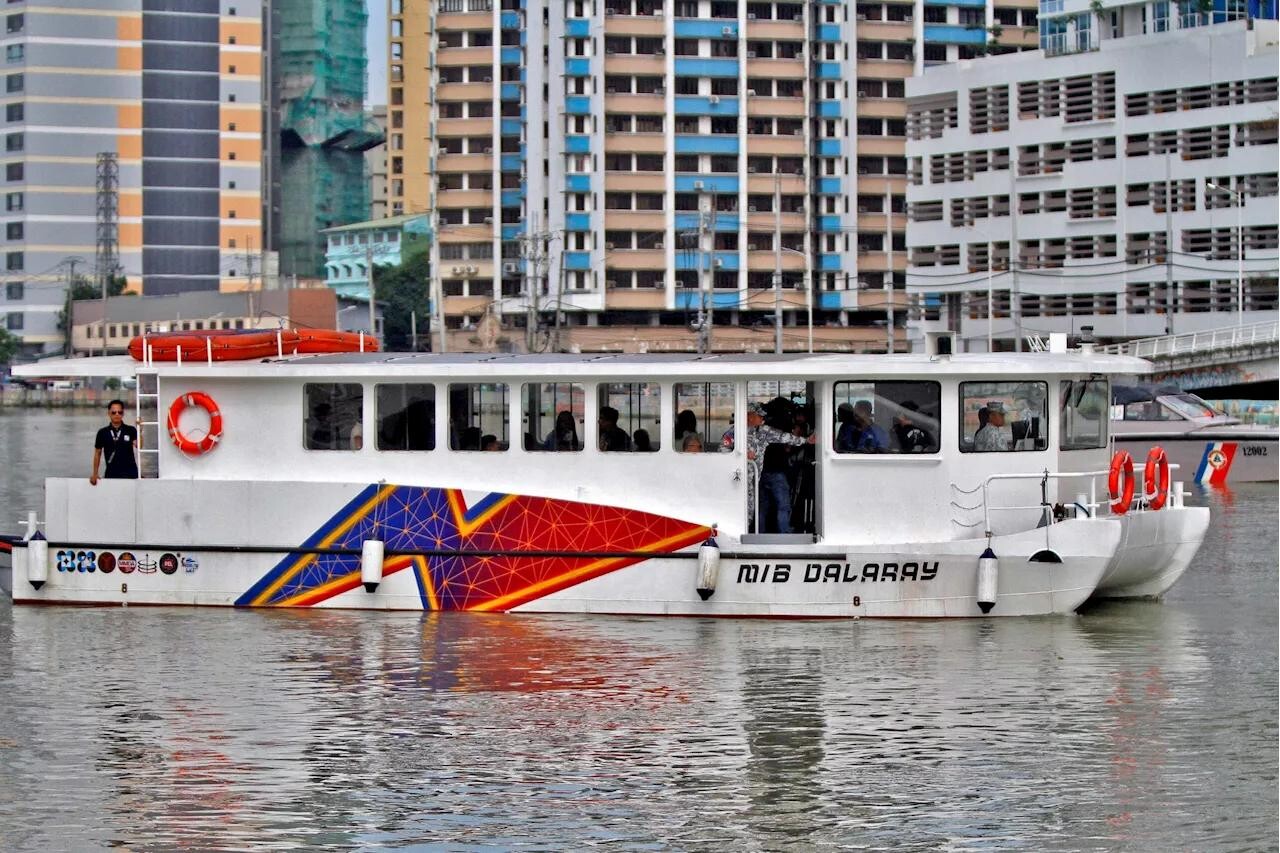
SAN PABLO CITY–Philippines. The Philippines’ first locally designed and built electric passenger ferry is no longer just a demonstration project. It is now carrying passengers on the Pasig River in Metro Manila. The M/B Dalaray was developed by engineers at the University of the Philippines Diliman with funding from the Philippine Department of Science and Technology. The ferry was launched in October 2025 and was expected to enter passenger service the following month. By March 2026, the Department of Science and Technology’s Philippine Council for Industry, Energy and Emerging Technology Research and Development reported that Dalaray was serving passengers on the Pasig River, with scheduled trips between the Guadalupe and Escolta ferry stations on Mondays through Saturdays. It is a modest operation, but it marks an important step for a country that has been trying to move electric transportation beyond imported cars, motorcycles and buses. Dalaray was designed specifically for inland water transport. The 13-meter (43-foot) aluminum catamaran was built at a shipyard in Navotas, a city in metropolitan Manila. It can carry up to 40 passengers and three crew members. The boat has a 160-kilowatt-hour lithium-ion battery and two 50-kilowatt electric motors. According to the University of the Philippines Diliman, it can travel more than 45 kilometers (28 miles) at a cruising speed of 8 knots. A full charge takes approximately two to three hours. Solar panels are also installed on the ferry, although Dalaray is fundamentally a battery-electric vessel rather than a solar-powered boat. The solar system supplies some of the vessel’s auxiliary electrical loads, including lighting and air conditioning, rather than providing its main propulsion. That distinction matters. Dalaray does not need hundreds of miles of range because it operates on a predictable urban route. It can return to established terminals and recharge rather than carrying a much larger battery simply to provide range it does not need. Charging stations were installed at Escolta in Manila, Guadalupe in Makati and Napindan in Pasig. The three locations give the ferry access to shore-based charging along the river. The project began in 2024 through the University of the Philippines Diliman’s Electrical and Electronics Engineering Institute. Researchers were tasked with developing, prototyping and deploying an electric passenger ferry for Philippine inland waterways. The project brought together the university, the Department of Science and Technology, the Metropolitan Manila Development Authority and the Maritime Industry Authority. The vessel itself was fabricated in the Philippines rather than imported as a finished electric boat. There is a straightforward economic reason for trying this. At the ferry’s launch, the project team reported energy operating costs of approximately 45 Philippine pesos per kilometer, compared with about 130 to 135 pesos per kilometer for a conventional diesel ferry. At current exchange rates, those figures are roughly 80 cents and $2.25 to $2.40 per mile, respectively, although the comparison is only for energy costs and should not be confused with a complete cost-of-ownership calculation. The savings could be particularly meaningful for a ferry that makes repeated short trips every day. Electric propulsion also changes the experience on the river. There are no direct exhaust emissions from the boat while it is operating, and the electric drivetrain is considerably quieter than a conventional diesel engine. The Pasig River is an unusual place to test the technology. It runs through one of the most densely populated parts of the Philippines’ capital region, where road congestion is a daily problem. The ferry offers another way to move people through the city without putting another vehicle on its already crowded roads. The river could also become important during emergencies. Philippine Department of Science and Technology Secretary Renato Solidum has argued that the Pasig River could provide an alternative transportation corridor after a major earthquake or other disaster that disrupts road travel. Earlier earthquake-resilience planning for Metro Manila has considered the river and nearby Laguna Lake as potential alternative transportation routes. That gives an electric ferry a purpose beyond replacing diesel fuel. Still, the technology has not yet proved that it can be scaled economically. Dalaray was a research and development project, and a prototype can absorb engineering and development costs that would be difficult to justify for a production vessel. The next challenge is determining whether the lessons from the first boat can produce a cheaper and more standardized design. That is where the ferry’s 2026 operation becomes more important than its 2025 launch. The Philippine government now has an opportunity to measure what the vessel actually does in daily service. How much electricity does it consume on a typical trip? How often does it need to recharge? What does the charging infrastructure cost to operate? How much maintenance does the electric drivetrain require? How is the battery performing after repeated charging cycles? Those numbers will tell more about the future of electric ferries in the Philippines than a launch ceremony ever could. The country has plenty of potential applications. The Philippines is an archipelago of more than 7,000 islands, and boats provide transportation in communities where roads either do not exist or are impractical. Urban ferry systems, island connections and tourism routes could all potentially use electric propulsion where distances are short and charging can be planned around regular schedules. But the economics have to work. An electric ferry does not become a viable transport solution simply because its motor uses less energy than a diesel engine. Operators have to pay for the vessel, batteries, charging equipment, maintenance and eventual battery replacement. They also need the boat available when passengers expect it, which makes charging time and reliability just as important as energy consumption. Dalaray is therefore a useful experiment precisely because it is operating in the real world. The Philippines has demonstrated that its engineers can design and build a battery-electric passenger ferry locally. The ferry is now carrying passengers on a real route with dedicated charging infrastructure. The next stage is less dramatic but more important: collect the operating data, reduce the cost and determine whether the design can be replicated. For electric water transport, one working ferry is proof of concept. A fleet would be proof that the concept works.