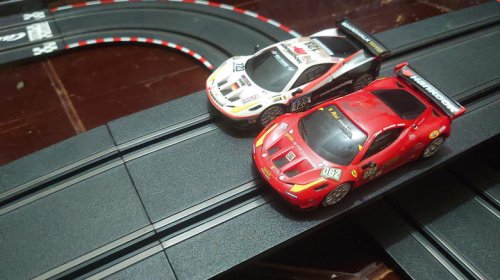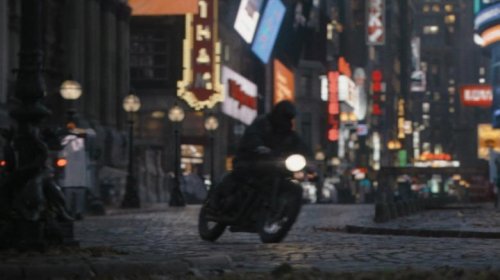















Rob Larson and the elaborate slot car track he created in his Ridgefield garage. (Bud Wilkinson/For Hearst Connecticut Media) A visitor can spot chic seaside boutiques on the French Riviera that display the names of Cartier, Chanel and Hermès. There's an eatery named after his granddaughter called Ristorante Frankie that's set in a city in Italy. There's a highway sign showing the way to Abu Dhabi in the United Arab Emirates. There's even an early McDonald's restaurant with golden arches from the United States. These elements and locales are all part of an elaborate slot car racetrack of Larson's design. He built it by hand and it's where he races the 200 cars in his collection. It fills a noticeable portion of a garage bay where he keeps his low-mileage 2008 Porsche Boxster sports car - that is, when he's not piling up laps with the slot cars. Larson calls his creation Titus Hill Raceway, the name being "kind of a combination of some of the streets that are nearby," he said recently during a trackside interview with My Ride. The layout even has a detailed replica of the Skip Barber Tower at Lime Rock Park racetrack in Lakeville. The track also has grandstands filled with spectators, TV cameras in key spots, a beverage stand and more. The New York skyline at night provides a backdrop for the center portion of the track. "You're really only limited by your imagination," said Larson of his clever setup. The origin of Titus Hill Raceway can be traced back to the COVID-19 pandemic of six years ago that caused an upheaval in Larson's life both in terms of work and awareness. Before its arrival, he was hard working, with little free time and no knowledge of slot cars or of social media. "I didn't know any of that existed because I'm just a guy who's working 50 hours a week, and I'm in the car (commuting) and I'm trying to work out. I play some golf and I had no time for any of this," he said. Stuck at home during the pandemic, Larson began an online exploration. "So I saw some things that kinda tweaked me. I saw some cars that were racing at Nürburgring and a few other places. An algorithm leads you from one to another. I'm watching these guys doing these Matchbox races with commentary and they're getting 500,000 views," Larson said. "I didn't know anything about the scale or the slot cars. You don't really have this too much in in the United States. We all played with HO, small cars, as kids, so we're familiar with those but I'd never seen this." Amazed by what he saw on YouTube, and what he learned from the videos, Larson began by building a couple of structures - a grandstand and a clubhouse. "There's all kinds of tutorials. Anything you want to do. Fix your car. Build a model like this," he said, pointing to the track. "You can get all the basics. Of course you have to work it out yourself." With buildings underway, he turned to acquiring segments of track and cars before expanding his vision. Many of the necessary parts came from hobby outlets and home improvement stores, adapted to fit a racetrack setting. "Virtually everything you see is made by these two hands. You had to learn the craft. You buy the track, the plastic track. You buy the cars. Those are made. You can buy them from kits but for the most part what I have is purchased, but everything else is just Styrofoam, a little bit of plastic and some straws. You can see some plastic straws for the guard rails. Plastic straws to make it look like an aluminum roof," he said, referring to the roof of the Lime Rock Park tower. The creation process wasn't always easy. "The attraction for me was really in the design. You think about something. You know what you want to build. The challenge can be in actually making the materials work. Working with foam, it can be difficult to paint, it can be difficult to glue. Any of these materials can react with glue and just melt on you." The McDonald's was particularly difficult. "It was a challenge. The angles in that. There's virtually no right angles in it," Larson said, reporting that the arches are made of foam with EL wire. As the track grew, so did Larson's car collection. He has open car models, sports cars and stock cars, both vintage and modern. "They're a bit of an addiction. It's kind of like jewelry for boys," he said. "You can get them used on eBay. The prices have gone up since I've started. I used to be able to get them for 29, 39 bucks. The high-end cars are upwards to 250 bucks. They're collector cars." Along the way, Titus Hill Raceway gained a social media presence with a Instagram account that currently has more than 7,000 followers. The track "was fun for me to build. The social media aspect came afterwards. It wasn't really a thought when I started with this. I just wanted to clean up the garage but it's a way to share what you've done and connect with other people. This is a hobby that's really popular in Europe where racing is really popular." Larson isn't done. He's still brimming with ideas for the track and it's a never-ending process. He now wants to build a Fotomat kiosk and a old phone booth. "It's fun," he said. "The racing is actually a bonus. I had no idea. The racing's addictive." Harwinton native Bud Wilkinson writes about classic cars and motorcycles for Hearst Connecticut Media. He previously reported for The Columbus Dispatch in Ohio and was columnist for The Arizona Republic in Phoenix before reporting for KSAZ-TV in Phoenix where he won a Scripps Howard National Journalism Award and an Emmy Award for commentary. He may be reached by email at budw@ride-ct.com. Related Reading Sign up for the Connecticut Briefing from CT Insider. Get the biggest headlines of the day from our network of journalists around the state.