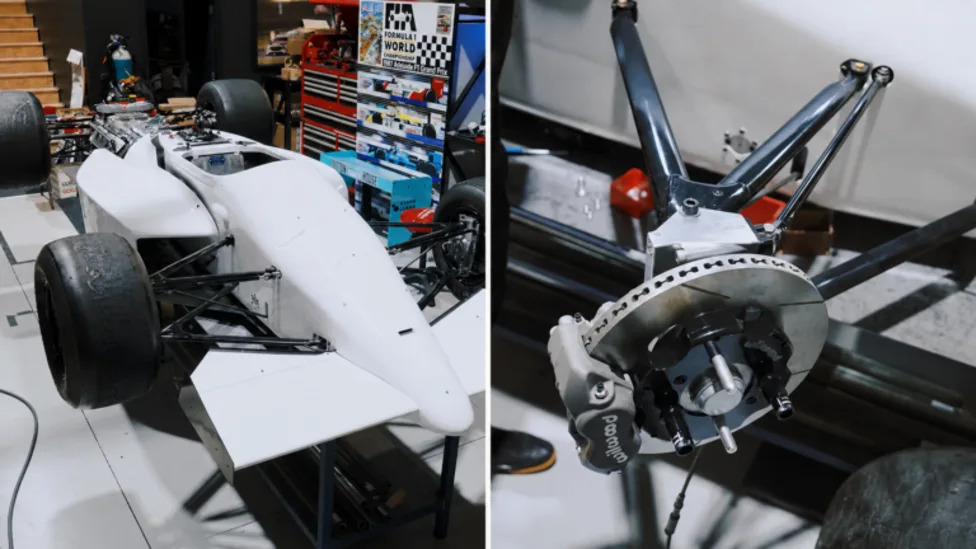
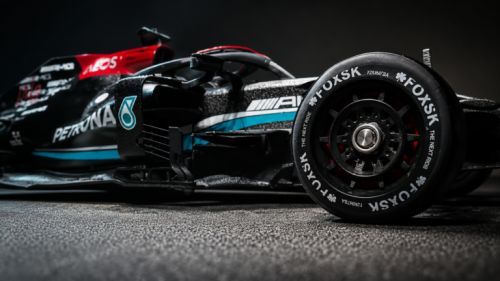
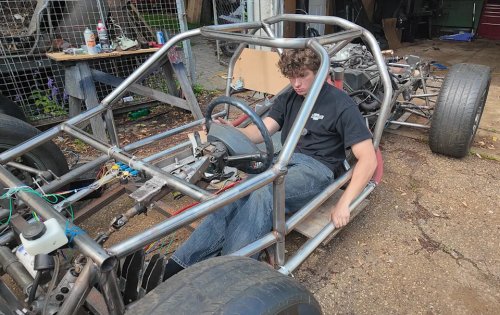
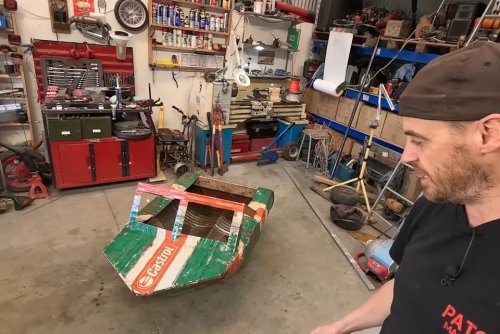
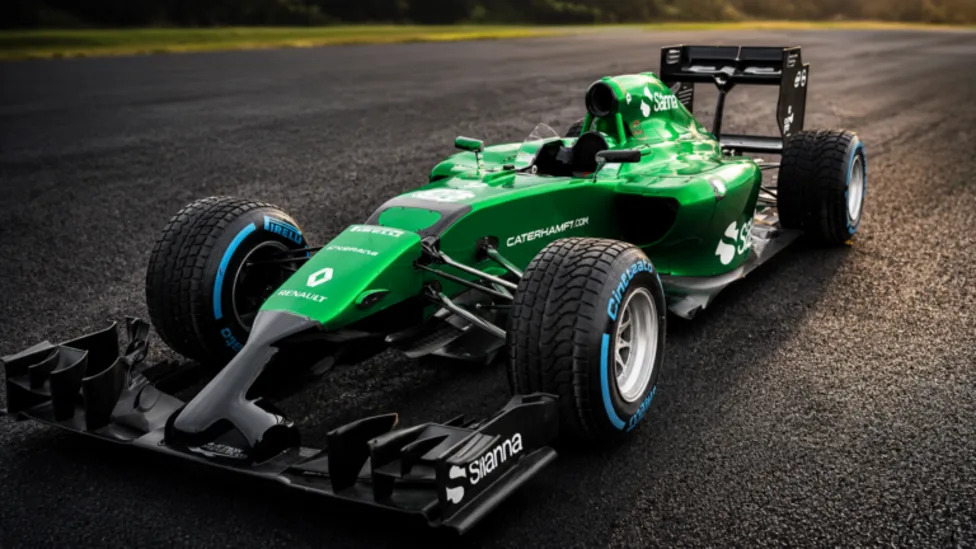
Electrician Builds Working F1 Car in His Garage After Buying the Wreck for Under £5,000Most people who fall deep into a Formula 1 obsession end up with a framed poster or a die-cast model. Kevin Thomas ended up with an actual Caterham F1 car in his driveway – and it runs.Thomas is an electrician from Burgess Hill, a town in the UK around 40 miles south of London.He's been following F1 since childhood, and what began as collecting memorabilia – a suspension component here, a steering wheel there – eventually escalated into something far more serious.AdvertisementAdvertisementA visit to a Renault dealership in 2008, where he encountered an F1 car in person, really set the spark to actually own one.The jump from wanting one to having one, though, took the better part of a decade and a borderline reckless amount of determination. The origin of the car itself is rooted in disaster.Marcus Ericsson's race at the 2014 Hungarian Grand Prix ended after he spun off at turn four, with the Caterham hitting the wall at a force of 20G. The driver walked away unhurt. The car did not.Due to Caterham F1 falling into administration on 21 October 2014, neither team driver was able to compete at the United States Grand Prix and the wrecked monocoque from Hungary was eventually seized by debt collectors along with the rest of the factory's assets.AdvertisementAdvertisementFollowing Caterham's bankruptcy, the destroyed tub was auctioned off for the surprisingly low sum of £5,000.The listing was poorly photographed, vaguely described, and detailed none of the damage specifics – which, for a bargain hunter like Thomas, was exactly the kind of thing that keeps other bidders away. After a two-hour bidding war, he won it. "I was over the moon to win it," Thomas said. "But there was an area of doubt until I got it, picked it up, got it home, then I knew it was mine."Getting a Renault Engine Costs More Than You ThinkWith the monocoque secured, the real complexity began. An F1 car isn't assembled like a road car. The engine is a structural component, and without it the chassis splits in half. Thomas's first instinct was to go straight to the source. He contacted Renault about acquiring a compatible power unit.They were happy to oblige.AdvertisementAdvertisement"We're happy to rent you one, for €2 million a quarter," Thomas recounted. "But we then need to give you a set of our Renault technicians that have to come over, that you have to pay for, to rebuild it after a quarter." Red Bull quoted a similar figure for a matching gearbox. The total rental bill for a genuine drivetrain package would have landed somewhere around €5 million per quarter. Thomas passed.He would source his engine from a Formula Renault car – still a Renault, just a wee bit smaller.Slower than the original, obviously, but more than sufficient for what he actually intended to do with the car. The gearbox, suspension uprights, and brakes followed the same logic: Formula Renault components adapted to fit the Caterham tub, with custom brackets and a 3D-printed rear wing support fabricated to bridge the gaps.The steering wheel alone cost him twice as much as the chassis at £10,000.AdvertisementAdvertisementOnly three were made for the car that season, and Thomas tracked one down to a private collector in Australia. Getting the contact required pestering an auctioneer day after day until the man finally relented. "I only phoned him once or twice after that," Thomas said. The nose turned up hanging in a CEO's office in Las Vegas. A rear wing came from a Williams. The project circled the globe before it was done.The Car Actually Runs — and Thomas Plans to Drive It Properly This YearAfter discovering the mangled carbon fiber tub at auction, Thomas dedicated ten years to an ambitious reconstruction project, a process that was documented by YouTuber Driver61.When the build reached the point where the last 10% of engineering work was beyond his skill set, Thomas brought in John Da – specialists in restoring and running competition cars – to complete the commissioning work. That meant sorting the wiring loom, getting the pedal layout right, and working through the kind of mundane but critical checks that determine whether a car starts or just sits there looking expensive.In late 2024, it started. Thomas stalled it roughly 25 times and covered about 50 yards. He described it as being over the moon. A few months later, he took it to an old airfield in Suffolk and, by his own account, frightened himself for a couple of hours. "When I first drove the car, in my head, I was doing 240 km an hour, but I was probably doing about 80 or 90," he said. "It scared the bejeezus out of me, to be honest."AdvertisementAdvertisementIn late 2024 Kevin took the car for a spin for the first time, and now, in 2026, the car is track-ready. In total, it cost him between £150,000 and £200,000.By comparison, that is definitely a lot less expensive than buying a used F1 car on the open market, where comparable examples trade for north of $800,000. Thomas's isn't 100% original, and it's not as fast as it was in Ericsson's hands at the Hungaroring. But it moves under its own power, it has the right chassis, it has the right steering wheel, and, "This year, 2026, is when I'll drive it on a track for the first time" – he's not finished yet.For someone whose professional toolkit involves wiring domestic circuits, that's a fairly extraordinary place to end up.



















 +51 others