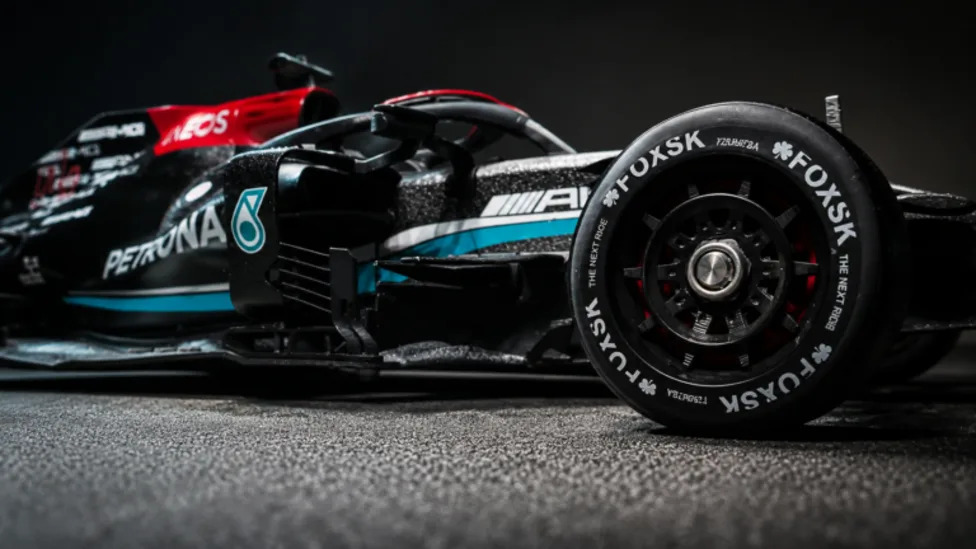
Someone Built a $7,000 RC Mercedes F1 Car With a Real Gearbox and Working DRS From ScratchBuilding a radio-controlled car from scratch is one thing. Building one with a custom six-speed sequential gearbox, a laser-cut aerodynamic floor, lathe-turned tires, and a functional Drag Reduction System is something else entirely. That's exactly what YouTube builder September pulled off, and the $7,000 price tag might be the least surprising part of the whole thing.The project focusses on a highly detailed, fully running replica of a Mercedes AMG Formula 1 single-seater from the hybrid era. Everything visible on a real car shows up here: the safety halo, sidepods, Petronas sponsor graphics, and the number 44 – a nod to Lewis Hamilton's championship years with the team. None of it is purely cosmetic. The bodywork was precision-cut with a laser cutter for the lower sections, while 3D-printed molds shaped the upper shell, and the finished panels were dressed with authentic Mercedes and Petronas decals.But despite the extraordinary level of detail, September admitted the car is still far from perfect.AdvertisementAdvertisement"The improvements to this car are still unsatisfactory," he said. "The main reason is that the vehicle's weight does not match its power."The Engineering Goes Surprisingly DeepThe transmission alone makes this build worth paying attention to. September machined a custom steel unit with six sequential gears and five usable speeds – purpose-built to handle the mechanical punishment of a small-displacement engine at high revs.The original plan called for a scratch-built miniaturized four-cylinder boxer engine, complete with hand-soldered intake tubes, calibrated pistons, and functional spark plugs. However, that original plan did not work as intended."After all, when it was first designed, it was for a four-cylinder engine. But that didn't work out," September explained. "What's currently being used is a class-21 single-cylinder methanol engine."AdvertisementAdvertisementThat change had a major knock-on effect. September said the car's gearing and power delivery still do not properly match the final package."So no matter how I adjust the gear ratio, it is still as seen in the video," he added. "All roar and no run."He continued: "It can't even shift up gears; once it shifts up, it can't move."The chassis began in 3D modeling software before any metal was cut. Suspension uses miniature pistons, a central steel spine, and a set of stability bars to keep the car planted at speed. The rims were machined from solid stock, and the tires were shaped on a lathe to match the profile and proportions of genuine F1 rubber. Stopping power comes from an independent cable-actuated braking setup, not a placeholder, but a properly engineered system tested through the build.AdvertisementAdvertisementHowever, the gearbox remains one of the biggest areas requiring further development. September revealed that the transmission had already failed during earlier testing."The current strategy is still weight reduction. First of all, this gearbox broke during previous tests," he said.He explained that the problem comes from the nature of the sequential transmission itself."In the previous video, I mentioned that this is a sequential gearbox, and its power is transmitted through the engagement of dog clutches," September said. "So the impact force is particularly large. If the materials are not up to standard, the dog teeth area will wear out very easily.AdvertisementAdvertisement"So based on my current manufacturing skill level, this gearbox is not suitable for high-speed operation scenarios."That has already pushed September toward a possible rethink for future versions of the car. He said he has been studying automatic transmissions as a way of reducing the shock loads on tiny components."Therefore, I have been looking for a way to avoid this impact," he explained. "Until I learned about the AT (automatic transmission) commonly used in cars today, which we often call an automatic gearbox."This type of gearbox achieves gear shifting through the coordination of multiple planetary gear sets. And the power is transmitted through friction clutches, so there is no impact."AdvertisementAdvertisementSeptember added that the potential solution could also help with packaging and weight."This is very friendly for the small parts on a model," he said. "Moreover, the volume can be made smaller, and the weight will be lighter."The disadvantage is that the structure is more complex and the manufacturing difficulty is higher."The rear wing's DRS flap is functional, which gives the car a period-correct detail that real F1 has already moved past.After 15 seasons, F1's drag reduction system was retired ahead of 2026, with the 2025 Abu Dhabi Grand Prix serving as its final race.The 2026 regulations replaced it with active aerodynamics – movable front and rear wings capable of switching between a high-downforce cornering mode and a low-drag straight-line configuration.AdvertisementAdvertisementSeptember's car immortalizes the old system in miniature right as the real sport moves on from it.There is also another unexpectedly important issue: the tires. September revealed that the current tires were made from skateboard wheels, which turned out to be far heavier than ideal."Another issue is the tires," he said. "Friends who have watched my previous videos should know that these are tires modified from four skateboard wheels."They were also the most appropriately sized tires I could find, and they feel very heavy in the hand."He admitted that viewers had already spotted the problem before he fully accepted it himself.AdvertisementAdvertisement"At the time, some friends reminded me via bullet comments that the unsprung mass was too high, but I didn't take it seriously," September said. "Now the facts prove that you were right."That means the next stage of the Mercedes AMG RC F1 project may involve either sourcing better tires or building them from scratch."So now I urgently need to find the tires I need, or spend some time making them myself," he said.And if the combustion-powered version continues to fight him, September has not ruled out an even more radical solution."If none of the above methods work, I won't rule out converting it into a new energy (electric) vehicle," he said.AdvertisementAdvertisementThe finished car makes its run on an open road at the end of the video, but the creator's own comments make the project more interesting than a simple success story. Seven thousand dollars for a ground-up, mechanically complete F1 replica with a working transmission, real suspension, functional DRS, and a genuine fuel system is already an extreme undertaking. The fact it still needs weight reduction, new tires, and possibly an entirely different gearbox only makes the build feel closer to real motorsport engineering than a normal hobby project.



















 +24 others