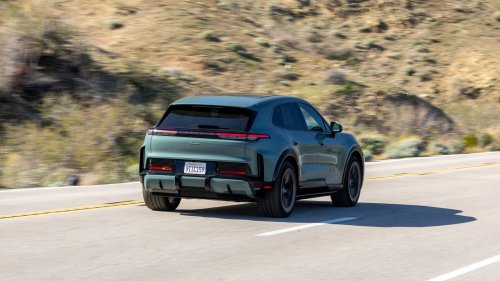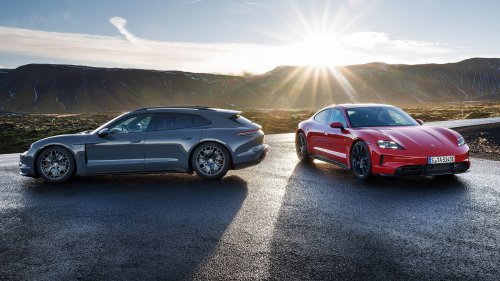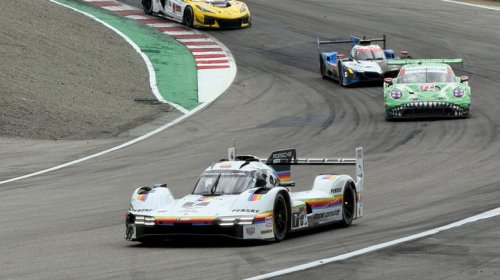
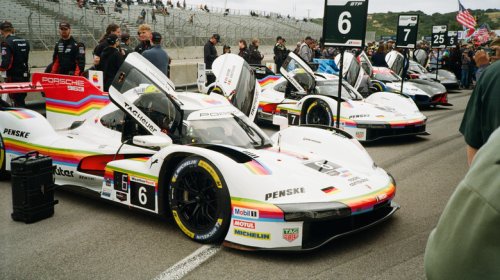
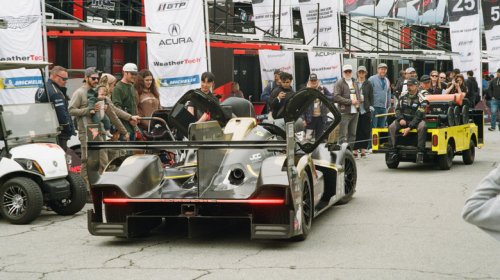
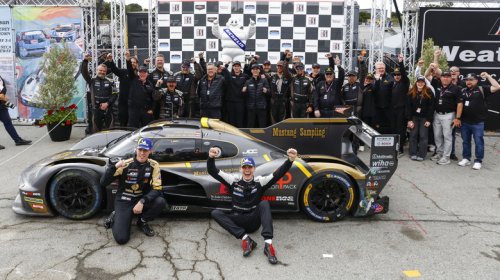















Daniel Golson/Jalopnik There are a lot of legendary and beloved race tracks in the United States, from Daytona and Indianapolis speedways to Lime Rock Park and Road Atlanta. But probably none are as known and revered worldwide as Laguna Seca, even if you discount the impact its presence in video games has had on enthusiasts for the past few decades. Though Laguna Seca has only been in operation since 1957, decades fewer than many other tracks, it has been host to all sorts of different racing series from MotoGP bikes to IMSA sports cars and Le Mans prototypes, and basically everything else in between. And that's not to mention all the historic racing that happens there. The track itself is special, from the layout to the location, and no company knows that better than Porsche. The automaker is obviously proud of the fact that it is the most successful manufacturer at Laguna Seca, with 32 victories (including both chassis and engine) against second-place Chevrolet's mere 12. At the IMSA Monterey SportsCar Championship race a few weekends ago, Porsche fielded five cars across three of the four classes, three of which were 963 protoypes in the top GTP class, and the company brought back its 1980s Apple Computer livery on the Porsche Penske Motorsport cars. With both Porsche Motorsport and Team Penske celebrating anniversaries this year (75 years and 60 years, respectively, and 50 years for Apple too), there was a lot riding on Porsche to do well at WeatherTech Raceway. A day before the race, I sat down with Urs Kuratle, head of Porsche's LMDh program, and Laurin Heinrich, one of two drivers in the JDC-Miller 963, the only customer car on the GTP grid. My questions must have been especially good, because the next day Heinrich and his teammate Tijmen van der Helm took the overall victory after a riveting final ten minutes of battling Jack Aitken in the Cadillac, and not only was it Heinrich's third class win at Laguna Seca in a row, but it was the 963's third overall victory there in a row, as well. Not a bad way to celebrate an anniversary. Full disclosure: Porsche invited me up to Monterey to attend the IMSA race and then its Track Experience driving school. They gave me a Taycan GTS to drive up to Monterey, bought me a plane ticket back home, and fed me. It's a team effort in more ways than one Daniel Golson/Jalopnik 2026 marks the Porsche 963's fourth year of racing in the North American IMSA series, but following the 2025 season, the car is no longer raced in the European FIA World Endurance Championship. Kuratle has been at Porsche since 2013 and has overseen the 963 program since its inception in 2022, and he knows a thing or two about racing — the start of his career was with the Mercedes Sauber team when it won Le Mans in 1989. "It's developed great," Kuratle said of how the car has evolved over the past four years. "The first year was difficult because it was new for everybody, we had a lot of issues with components with the cars, the team was brand new, our situation having customers in the field was brand new." But in the years since, Porsche has kept the same people on its team, which Kuratle said is a big advantage now, as lots of their competitors have changed partners and teams. But ever since we kept the group together, the whole operation, which is a big advantage now." Kuratle called Laguna Seca one of the best tracks in the world. "I love the track, the corkscrew, the whole environment, the fans and everything — it's great to be here, it's a great track to come to." As for challenges racing there? "I mean, it's a lot of traffic. It's the same for everybody, but it's a lot of traffic around these corners. You can overtake, but still for the drivers it's very challenging," Kuratle said. "The main key would be to keep the car on track, make less mistakes than the others or no mistakes at all." Easier said than done, for sure. Daniel Golson/Jalopnik "We're the only OEM with customer [teams] running here, and when we first started that was a big step to have two new teams. So there's two new factory teams — one in Europe, one here in the U.S. — and then at the same time have some customers in Europe and the U.S. as well." But, Kuratle said, it's "great" to have the customer teams. "With JDC, you can see they are ahead of the factory team this session," he said very presciently, "and they're doing a really great job. You have Laurin Heinrich as a driver over there. It's great to work with these guys." I asked Kuratle how the 963 program stands out from other race cars that he's worked on, particularly its 919 predecessor, and the word "competition" was the first thing that came to his mind. "We have much bigger competition, more different brands we are competing with than the 919 program. The challenges for me personally here are different; the integration of all these different partners into the one Porsche Penske Motorsport team." That wasn't the case with the 919, where most of the team and development was all in-house based in Weissach, and the car was more technically advanced and challenging. Is it annoying to have more competition on the track? "No, that's what we really love. A victory or a good position on track is much nicer with many people behind you. Competition is a very good thing, it's boring to be alone like that," Kuratle said. "The fans also appreciate it. It's great to have so many brands, good brands and big OEMs in the paddock." When it comes to being at Porsche, he said the only downside is the expectation that you have to win. "We cannot come just to compete, we have to win. But that's what we're all here for. The second is the first loser." The driver's perspective Daniel Golson/Jalopnik A few minutes later, about four hours before qualifying at Laguna Seca, I sat down with 26-year-old Heinrich, who had already placed first at the 24 Hours of Daytona, first at the 12 Hours of Sebring, and sixth at the Grand Prix of Long Beach this season. This year is his debut in the 963, having competed in 911 GT3 Rs in the previous two years (he was top of the GTD Pro class in 2024 and came fifth in 2025), though he did participate in some test days last year and one race in the WEC series. "I felt quite well prepared heading into Daytona," Heinrich said, "the good thing is I've raced in IMSA so I know already all the tracks and circuits we race on, so for me I could really put all my focus on just adapting to the car and not learning new tracks, which is obviously quite difficult." His first two races this season were with the Porsche Penske factory team before moving to JDC-Miller, and he said that was "great because the team is so experienced and they really helped me with both hands to bring me up to speed and teach me as much as possible in the short amount of time because the cars are so complicated, so complex. For the driver there's so many tools and so much stuff to learn and to work with, and you really want to make use of that, so the more adaptive you are, the better." Jumping from a lowly GT3 sports car to the 963 prototype is a big leap in terms of performance and speed, but also car size, which means Heinrich has to drive differently than he has in the past. "It's a prototype, so generally you can take much less curves, which is also a big topic here at Laguna," he said, "I try to prepare myself pretty well before the weekends to know what to expect, because in the end, in a race weekend like this you only get as many laps as you do, there is not much time to try out stuff. I really focus on learning from onboards from previous years, seeing what works and what not, trying to understand the dynamic of the race." The prototype is lighter and has much more power, so it'll arrive quicker to the corners, which means Heinrich has to adapt his braking and turn-in points. Daniel Golson/Jalopnik "I knew Laguna Seca already from the simulator before coming here in 2024 for the first time, and I knew I liked the track and I liked the layout. But coming here in real life, first of all you experience California, racing on the west coast, which is already a great atmosphere here with all the nature around. This, obviously, I didn't know from the simulator," he said with a laugh. "Once you hit the track for the first time, experience all these elevation changes, going down the corkscrew, what it does to your stomach, the feeling and impressions you get driving a race car around here — that made me really fall in love." The cherry on top of the cake, he said, was to win at Laguna twice, with one of those wins being both his first IMSA victory and Rexy's first. "I would be lying if I said this wasn't my favorite place on the IMSA calendar. I don't like generic tracks that are quite repetitive, which we have some in Europe unfortunately, but a track like Laguna, I mean, there's nothing to compare to that layout. I think that's why IMSA racing is so special, because all the tracks have their own character and corners they're known for." We spoke about Laguna Seca's elevation changes and off-kilter corners, how it's way more intense in person than it even seems in video games or on TV. "It's certainly a track that you need experience on. You need to understand the corners, where you can push harder than others, and also how the track changes — having all this sand around the track, this weekend especially being quite windy, it's similar to what I know from Zandvoort in Europe, racing on the beach. The longer you drive, the more dusty it gets off line, and the tighter the lines get," Heinrich said. "Experience really pays off around a place like here, and in these prototypes we're already quite busy with just handling the car. There's no proper straight, you're always turning and you need to make a lot of adjustments on the steering wheel." "There's a lot of sports car racing fans around here, there's so much history, and the people really embrace it. IMSA having a throwback weekend I think really suits this place," Heinrich said." He mentioned watching the Porsche owner's parade lap, and how every car he saw was different. "It's amazing for us drivers to see how people appreciate the brand and the history of the track." But one particular Porsche is directly tied to Laguna Seca in Heinrich's memories. "If you think of Laguna Seca, the first picture that comes to my mind is the RS Spyder going down the corkscrew," he said. "Now driving a prototype for me, for the first time, is also something special — even if it's not an RS Spyder, but it's a nice experience." I said Porsche does enough historic events at Laguna Seca that maybe he'll be able to do that one day, to which Heinrich replied, "I would love to, I wouldn't say no." Get on that, Porsche! What's next in IMSA? Porsche Next up on the IMSA calendar is this weekend's Detroit Grand Prix, which Heinrich is looking forward to racing in the 963. "I think it will be a tough challenge. In terms of the sensation you get while driving, you cannot compare it to Laguna Seca, but I think it will be very unique. And then going to Road America and all the high-speed tracks, we can really make use of the aero that we have on the car and the straight line speed, I think this will be a pretty special sensation," he said. "And obviously coming back to Petit Le Mans, the place where I drove the car for the first time and where I also did my first race in the U.S., will be special." As Porsche's already won this year's first two endurance races, he's hoping to do the same again at Petit, and having already driven the car on that track will help given how demanding the track is. "I'm happy to be with JDC because I'm still very fresh to the car and to prototype racing, so the more experience I can make the better. Because as I said the car is so complex, you just need laps. You need race experience, race mileage, and I'm so happy and thankful to get this opportunity," Heinrich said. He's also doing some GT racing in Europe and Asia this year. "It's important for me, with my career still being quite young, there's still many races I want to win, and you cannot win every race in a prototype. There's some races where you can only win it in GT, so I'm happy to still be on the grid there as well." While the endurance races are a totally different prospect than the couple-hours races like Laguna Seca, both are equally as important for the championship. "IMSA racing is made out of that dynamic. You have 24-hours, 12-hour races, but also 100-minute sprint races on the street circuit, and in the end it's a whole championship. You don't score more points at Daytona than you do at Detroit," he said, "and in the end you got to master all of these different scenarios to be the champion." With the first four races under his belt, the German driver is currently the front-runner for that title.