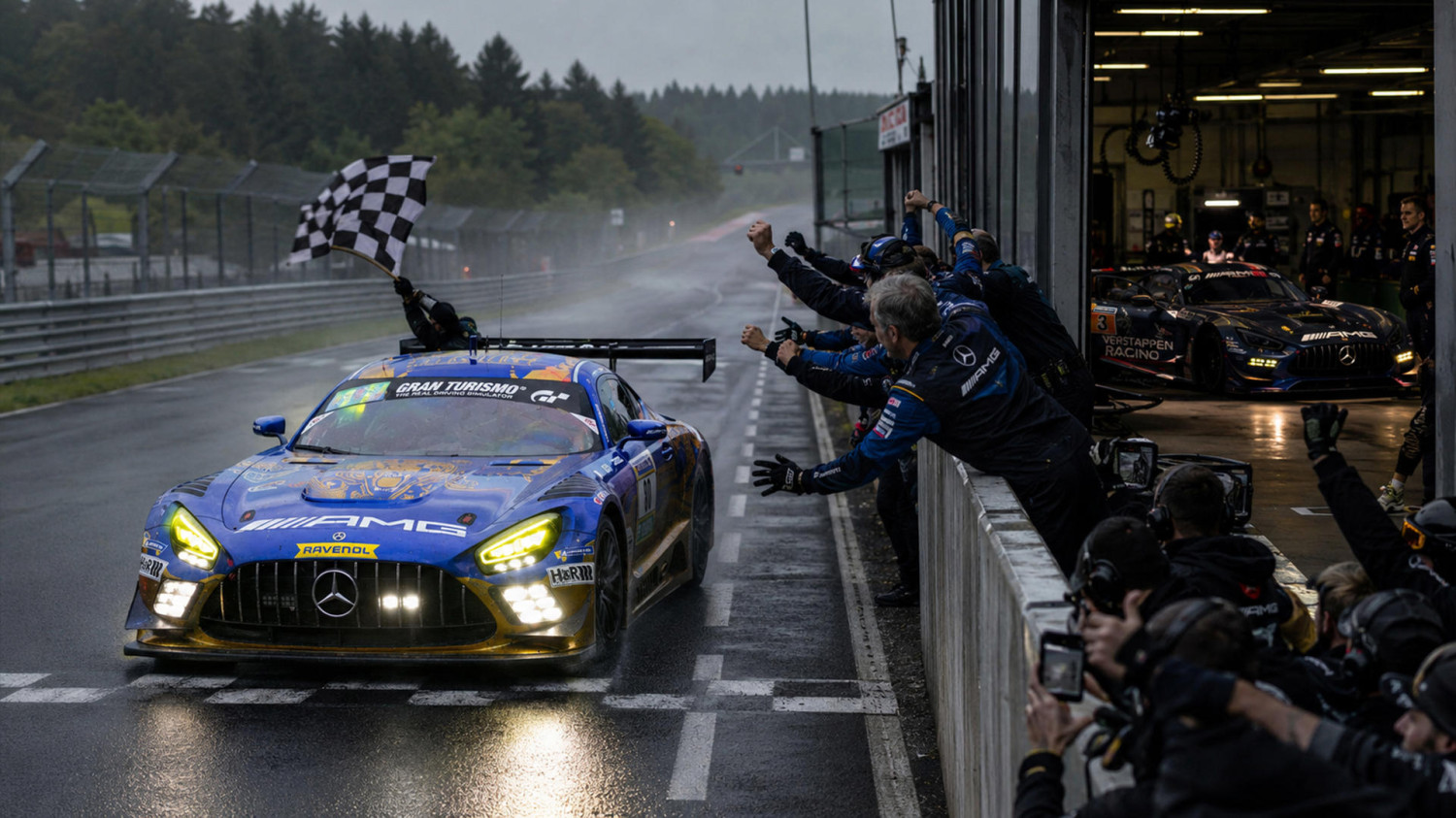


















Mercedes Claims First Nürburgring 24 Win Since 2016 After Verstappen’s Car Falls Out of LeadMercedes Won, But the Story Was Also About What Slipped AwayThe Nürburgring 24 Hours rarely gives anyone a simple victory.Mercedes-AMG finally returned to the top step of the race for the first time since 2016, with the #80 Mercedes-AMG Team RAVENOL entry surviving a tense final phase to take the win. But the result came with a sharp twist: the sister #3 Mercedes-AMG Team Verstappen Racing car, which had led for hours with Max Verstappen among its drivers, lost its chance after late technical trouble.For Mercedes, it was a landmark victory. For Verstappen’s crew, it was a reminder that endurance racing does not reward only pace. It rewards survival.The #3 car had looked capable of delivering a sensational debut victory for Verstappen at one of the toughest races in GT competition. Instead, the race became a Mercedes triumph with a painful internal contrast.The Two Mercedes Cars Had Controlled the RaceFor much of the closing stage, the picture at the front was clear.The two factory-supported Mercedes-AMG GT3s ran first and second, with the #3 Verstappen Racing car ahead of the #80 RAVENOL entry. With just over three hours remaining, the pair had a lead of more than five minutes over the #34 Aston Martin in third place, making it look as if Mercedes simply needed to avoid mistakes and mechanical drama.That is often the most dangerous moment in a 24-hour race.The hard work appears done. The lead looks safe. The team starts thinking about risk management rather than attack. But the Nürburgring has a long history of punishing exactly that kind of comfort.The #3 Mercedes was still leading when the race turned.Verstappen’s Car Lost the Lead With an ABS IssueDani Juncadella was behind the wheel of the #3 Mercedes when the first signs of trouble appeared.He encountered an ABS problem but initially continued. After two laps, the team called him into the pits. The car was pushed into the garage, where mechanics discovered a broken driveshaft, turning what had looked like a controlled run to victory into a long repair job.That ended Verstappen’s chance of winning on debut.The car would later return for two laps so it could be classified as a finisher, but the race was already gone. In endurance racing, that detail matters emotionally but not competitively. The team avoided a complete retirement, yet the victory that had seemed within reach had disappeared.For Verstappen and his team-mates, the difference between a debut win and a footnote was one mechanical failure.The #80 Mercedes Inherited the Lead and Finished the JobOnce the #3 car was delayed, the #80 Mercedes moved into the lead.Mercedes did not expect the #80 car to suffer the same problem, and with a large advantage over the cars behind, the team could afford to manage the final hours more carefully. But the race still did not end quietly. Rain returned to the circuit, creating slippery conditions and putting pressure back on the leaders.Maro Engel handled the final stint without major errors and brought the car home.The victory carried extra meaning for Mercedes. It was the brand’s first Nürburgring 24 Hours win in ten years, and it came exactly a decade after Engel’s previous victory in the race for Mercedes.That gave the result a sense of symmetry: Mercedes returned to the winner’s circle with one of the drivers from its last winning era still playing a central role.Lamborghini Held Second After a Late Penalty ScareBehind the winning Mercedes, the fight for the podium remained tense.The #84 Lamborghini crossed the line second, but it had to absorb an 82-second penalty for speeding in a Code 60 zone. That meant its margin over the #34 Aston Martin became critical in the final moments.Mirko Bortolotti pushed hard on the final lap to preserve the gap.The Lamborghini had started from pole but suffered a puncture on the opening lap, making its recovery to second place impressive in its own right. It was also helped late on by a yellow flag on the Döttinger Höhe, caused by a stranded backmarker, which affected the Aston Martin more than the Lamborghini.The final podium therefore told three different stories: Mercedes execution, Lamborghini recovery, and Aston Martin pressure that came close but not close enough.The BMW Touring Project Became One of the Race’s SurprisesThe top five also included one of the more unusual entries of the race.The #99 BMW finished fourth, while the #81 BMW M3 Touring 24H took fifth. The M3 Touring project had reportedly begun as an April Fools’ joke before being turned into a real GT3-style race effort, and a top-five finish gave it a surprisingly strong result.That is part of the Nürburgring’s appeal.The race can produce a high-level manufacturer victory at the front while still making room for strange, memorable projects deeper in the order. The Nordschleife rewards serious engineering, but it also keeps a sense of character that many modern races lack.A wagon finishing fifth in the Nürburgring 24 Hours is exactly the kind of detail that gives the event its personality.Verstappen’s Debut Still Changed the Race’s ProfileEven without the victory, Verstappen’s participation was one of the defining stories of the event.His presence brought wider attention to the Nürburgring 24 Hours and helped turn the #3 Mercedes into the car many casual observers were watching. But on track, the story was not just celebrity appeal. The car had the pace and execution to lead deep into the final hours.That matters because Verstappen did not appear as a gimmick. He was part of a serious front-running effort.The failure does not erase that. It changes the ending, not the evidence. The #3 Mercedes was fast enough to win, and Verstappen’s debut showed that his interest in GT racing and the Nordschleife was backed by real competitive quality.Endurance Racing Does Not Care About MomentumThe brutal lesson of the race is familiar but always harsh.A 24-hour race is not won when a car builds a five-minute cushion, survives the night, or reaches the final three hours in control. It is won only when the car crosses the finish line first. Until then, every component is still under stress.That is what caught the #3 Mercedes.The team had survived the traffic, darkness, weather, and strategic pressure. It had reached the point where victory looked close. Then the mechanical problem arrived and made all of that work secondary.This is why the Nürburgring 24 Hours carries such weight. It does not simply identify the fastest car. It tests the entire system: drivers, mechanics, strategy, durability, discipline, and luck.Mercedes Took the Prize, Verstappen Took the Unfinished StoryThe final result gave Mercedes-AMG a long-awaited Nürburgring victory.The #80 car earned it by staying intact, staying calm, and surviving the late rain. But the #3 car left the race with unfinished business. Verstappen’s debut could have become an immediate triumph. Instead, it became a near-miss that will likely make any future return even more compelling.That is not a consolation prize, but it is part of the race’s meaning.The Nürburgring 24 Hours did what it often does. It produced glory and heartbreak inside the same garage, for the same manufacturer, in the same final stretch of one exhausting race.Mercedes won the day.Verstappen’s car showed how close victory can be before the Nordschleife takes it back.