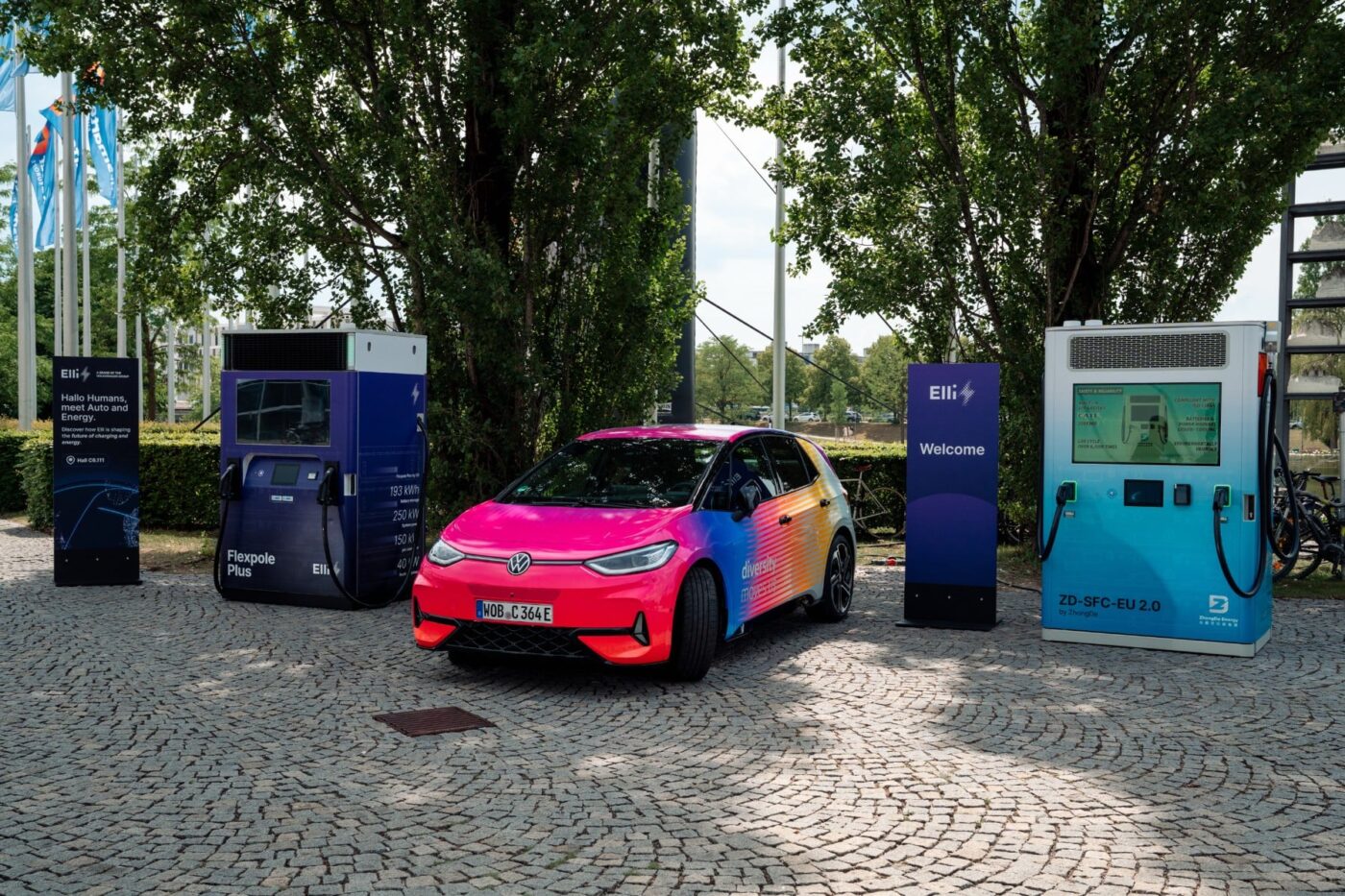


















Image: ElliFor several years, Volkswagen Group charging subsidiary Elli has marketed battery-buffered fast charging stations under the Flexpole name, with final assembly taking place at Volkswagen’s Hanover plant. In an interview with electrive, however, Elli Chief Technology Officer Mark Möller said the company will exit the hardware business by the end of the year. Its former Chinese partner, ZhongDe Energy, will continue the business independently.The Flexpole is a battery-buffered fast charging station offering up to 250 kW of total charging power via two charging points, each capable of delivering up to 150 kW when used individually. Unlike conventional DC chargers, the Flexpole is available exclusively with an integrated buffer battery. At Power2Drive 2025 in Munich, Volkswagen Group’s charging subsidiary Elli unveiled the next-generation Flexpole Plus. One year later, CTO Mark Möller told electrive that Elli will withdraw from the hardware business.“The market is evolving: from basic charging towards smart charging,” Möller said in the interview. “We want to seize this opportunity and focus even more intensively on the interface with the energy market. That is where we will concentrate our efforts. Consequently, in this new market phase, we no longer necessarily need to manufacture hardware ourselves. This is why we have decided to end the final assembly of the Flexpole in Hanover by the end of 2026.”Elli to focus on the energy marketElli’s and Volkswagen’s value creation in Germany for the Flexpole has been limited. ZhongDe Energy already supplies the main components of the battery-buffered fast charger, while Volkswagen has focused on final assembly, including components required for German calibration law (Eichrecht) compliance and the CCS charging cables. This assembly work will end by the close of 2026. However, Möller said the decision will not result in job losses, as employees currently involved in Flexpole assembly will move to the adjacent battery system assembly line at the Hanover plant.Möller said Elli’s strategic shift reflects the changing needs of the charging infrastructure market. “The first phase for us was driven by the ambition to support Volkswagen and its brands’ customers with charging solutions. This included the launch of wall boxes and charging cards.” The company then expanded its focus to public charging as demand for fast-charging infrastructure increased. “At the time, we saw battery-buffered charging stations as a relevant niche—and quickly implemented the idea of offering such a station ourselves, in collaboration with our Chinese partner.”To date, the Flexpole has been rolled out in 14 European countries. Elli has sold nearly 1,000 units over time, with around 700 currently in operation. Möller emphasised that Elli’s management still considers the charging station a relevant product but acknowledged that the company has ‘reached the end of this initial phase.’ Elli now aims to fully divest from hardware production and instead focus on hardware-agnostic opportunities at the intersection of the increasingly intertwined mobility and energy markets. “We are concentrating on digital use cases in energy trading,” Möller stated.This strategic shift was already evident at this week’s Power2Drive in Munich, where Elli showcased both its existing product and a further development that its Chinese partner will offer independently.Partner ZhongDe unveils new charging station versionMeanwhile, Elli will continue to support customers who already have the Flexpole in their portfolio. The brand will also honour its warranty obligations. Möller stressed that his employer is committed to ensuring ‘the product continues to thrive.’ To this end, Elli has signed a letter of intent with its Chinese partner to transfer its share of the business—particularly the end-of-line testing relevant to calibration law—to ZhongDe.ZhongDe Energy plans to continue manufacturing battery-buffered charging stations at a 2,000-square-metre facility in Dreieich near Frankfurt. The production concept will remain unchanged, with most components—including CATL battery cells—sourced from China and final assembly carried out in Germany.At Power2Drive in Munich, ZhongDe also unveiled an updated version of the battery-buffered charging station. The installed battery capacity with four modules has increased from 193 to 219 kWh, while the maximum charging power per connector has doubled from 150 to 300 kW. Total system output, however, rises only from 250 to 330 kW. The required grid connection has been increased from 40 to 80 kW, enabling the integrated battery to recharge more quickly. ZhongDe has also added a powder-based fire suppression system, while the thermal management system continues to be integrated into the station’s head unit.