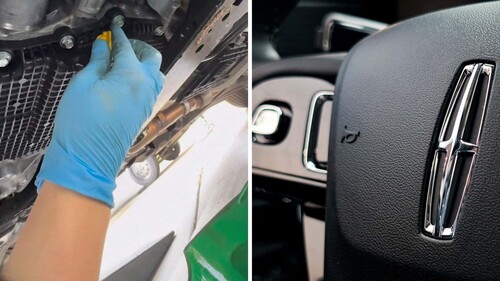
Mechanics hear strange complaints all the time. But when one customer asked to have "the red LED light under my truck" removed, the inspection revealed a discovery even seasoned techs found unsettling. A viral TikTok from Bratz Tire and Auto in Palestine, Texas, lets the unnamed mechanic have fun revealing to viewers that what was thought to be a rogue LED was actually a system in severe mechanical distress. "Start looking around and...Oh! There you are! Yeah, I don't think that's an LED," he said in the clip that’s been viewed more than 240,000 times. What the mechanic uncovered underneath the Nissan truck was not cosmetic at all. The red glow was coming from a section of the exhaust system that had become so hot it was visibly incandescent, an unmistakable sign that something was seriously wrong. While many viewers casually referred to the glowing component as the muffler, the intense red light is more likely coming from the catalytic converter or nearby exhaust piping. Catalytic converters are designed to operate at very high temperatures, burning off harmful emissions before exhaust gases exit the tailpipe. Under normal conditions, however, they should never glow visibly red. According to the US Environmental Protection Agency, catalytic converters typically operate between 800 and 1,200 degrees Fahrenheit during everyday driving. When temperatures exceed roughly 1,500 degrees, the metal casing can begin to glow, especially in low-light conditions. That kind of heat usually points to a deeper mechanical problem rather than a standalone exhaust failure. The National Highway Traffic Safety Administration also warns that excessively hot exhaust components can pose fire risks, particularly when vehicles are parked over dry grass or debris. In extreme cases, overheated catalytic converters have been linked to vehicle fires and damage to surrounding underbody components. Why Exhaust Components Glow Red The most common reason a catalytic converter overheats is the presence of unburned fuel in the exhaust system. When fuel that should have been burned in the engine reaches the converter, it ignites there instead, dramatically increasing temperatures. This can happen for several reasons. Misfiring spark plugs, failing ignition coils, or malfunctioning fuel injectors can all cause incomplete combustion. Faulty oxygen sensors may also confuse the engine computer, leading to an overly rich fuel mixture that overwhelms the converter. Oil consumption is another frequent culprit. Engines that burn oil, often due to worn piston rings or valve seals, can coat the catalyst material inside the converter, reducing its efficiency and trapping heat. Over time, this can cause internal blockage, forcing exhaust gases to fight their way out and raising temperatures even further. In some cases, the converter itself is simply failing or clogged, especially on high-mileage vehicles. When exhaust flow is restricted, heat builds rapidly, and glowing metal becomes the visible symptom of that restriction. A handful of commenters on the viral clip suggested that glowing exhaust components can be "normal" under certain conditions. While it’s true that metals will glow at sufficiently high temperatures, most automotive experts agree that visible incandescence is not a normal operating condition for passenger vehicles. Engineering guidelines generally assume that exhaust systems will be shielded, insulated, and positioned to prevent surrounding components from reaching ignition temperatures. When parts begin glowing, it means those safeguards are being exceeded. The Automotive Service Association notes that persistent converter overheating often leads to secondary failures, including damaged sensors, melted wiring, degraded exhaust hangers, and, in some cases, engine damage caused by excessive backpressure. Even if the vehicle continues to run, performance often suffers, with drivers reporting reduced power, sluggish acceleration, or difficulty reaching higher engine speeds. Fire Risk and Repair Costs Beyond driveability concerns, overheating exhaust components can create real safety risks. Fire departments across the US have documented cases of catalytic converters igniting dry vegetation beneath parked vehicles, particularly in rural or off-road settings. Consumer safety advisories from organizations like AAA recommend avoiding parking over tall grass if a vehicle shows signs of excessive heat from the exhaust. From a financial standpoint, the discovery can also be sobering. Repair costs vary widely depending on the underlying cause, but catalytic converter replacements alone often range from $1,500 to $3,500 on gasoline vehicles. Importantly, replacing the converter without addressing the root cause, such as ignition or fuel delivery issues, often leads to repeat failures. That’s why mechanics typically diagnose upstream problems before recommending exhaust replacement. The comments section of the clip leaned heavily into gallows humor. Viewers dubbed the glowing part a "Light Emitting Disaster," an "analog LED," and a "red ring of death." Others joked that it was "factory underglow" or proof the truck had "just been paid off." The humor reflects the jarring nature of the visuals. Most drivers never look under their vehicles, and few realize how hot exhaust components can get when something goes wrong. If there’s a clear takeaway from the video, it’s that unexpected lights under a vehicle aren’t always electrical, and they’re never something to ignore. A red glow underneath a car or truck, especially one that appears after driving, warrants immediate inspection. As the mechanic’s understated reaction in the video suggests, the moment is less about surprise than recognition. And as one commenter unintentionally summed it up: if your vehicle has underglow and you didn’t install it, something is very wrong. Motor1 has reached out to the creator via email and direct message. We’ll update this if they respond. We want your opinion! What would you like to see on Motor1.com? Take our 3 minute survey. - The Motor1.com Team