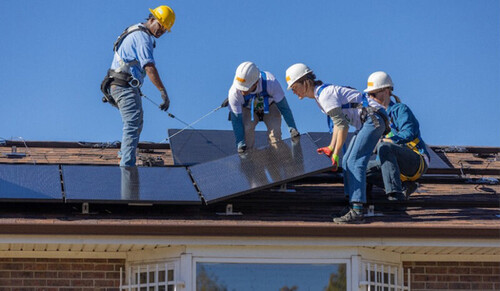
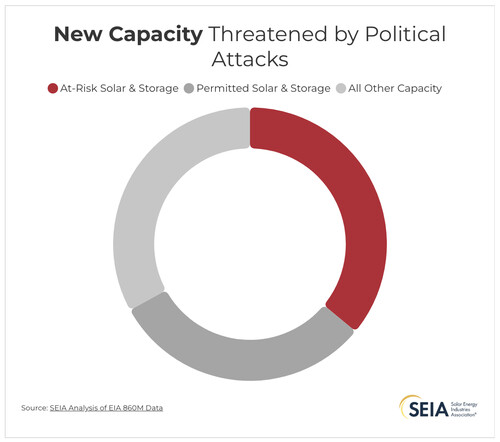
True or false? Most large scale solar energy projects in the US encounter relatively few permitting conflicts. Many media stories that spread the perception that opposition to solar development is common. A new study led by University of Massachusetts Amherst researchers says the correct answer to the question is…. True. It turns out that institutional arrangements and project scale, rather than partisan composition, appear to shape conflict and attention in solar permitting. Lead study author, Juniper Katz, assistant professor of public policy at UMass Amherst, says that the project grew out of a disconnect between public perception and the available evidence on solar siting disputes. Katz adds that understanding the drivers of renewable energy conflict will become increasingly important as governments seek to expand energy generation capacity. Land Use at the Root of Solar Permitting Conflicts Communities have many choices about how to handle controversial land use decisions. In the US, over 25,000 local and regional governments play a role in making land use decisions. Conflict has implications for policy — these decisions affect the built environment, the landscape, and the economy for decades or even centuries. Calling solar “the workhorse of US clean-energy growth with developers,” the solar siting researchers sought to operationalize what conflict means. It’s well-known that changes in land use can spur policy conflict, especially in rural areas where residents prize natural landscapes and productive land. Rapid growth in large-scale solar has intensified attention to land use conflict. Local disputes are generally site-specific and influence residential, commercial, and industrial neighbors. If citizens and government acknowledge that the existing process can be adversarial and stifle creativity, they are more likely to seek out and participate in more constructive approaches. The researchers looked at solar permitting conflicts on a national scale to understand if the appearance of conflict was as prevalent as it seemed. With high stakes in permitting reform, there are significant “implications for the speed of the energy transition, democratic participation in energy siting, changes to environmental review processes, and the range of consequences of removing local control over siting decisions,” the researchers state. The data points to a much less fraught attitude toward solar installations than is generally recognized. The state-level makes way for solar more quickly: Projects approved under state-level permitting systems were associated with lower levels of observed conflict compared with projects reviewed under local or hybrid permitting structures. “Practically speaking,” the researchers note, “low conflict cases may emerge from different contexts and yield different outcomes than high-conflict cases.” The bigger the solar installation, the greater the pattern of permitting conflicts: Larger projects were more likely to involve more conflict. Large-scale solar, also called utility-scale solar, is characterized by its capacity to generate large amounts of electricity and its purpose to feed electricity to the grid. Very little NIMBY for Democrats: The share of Democratic voters in the area surrounding development sites showed no statistically significant relationship to opposition levels. Unlike studies of wind projects, the researchers did not find that wealthier, whiter, or more Democratic communities were consistently associated with higher levels of solar opposition. Methodology: The study analyzed 686 large-scale solar facilities that went online between January 2022 and November 2023. Researchers found that 56% of projects fell into “no” or “low” conflict categories, while 19% saw high levels of conflict. They gauged conflict by analyzing news coverage and social media posts that used terms associated with public disputes, such as “protest,” “lawsuit,” and “opposition.” The Positive Results of Solar Installations The public is starting to get it: renewable energy brings in far more than it costs. Wind and solar account for less than 5% of the increase in electricity bills over the past decade. They help drive down wholesale energy prices, exerting a moderating effect on long-term costs. The real question is how to electrify our heating, mobility, and industry to move away from fossil fuels. Meaningful clean energy progress has taken place across red, blue, and purple states, and, occasionally, innovations occur across the political aisle. Renewable energy sources are continuing to grow their share of the electrical generation makeup in the US, growing more than 11% in Q1 2026 when compared to the previous year. The US Energy Information Administration’s (EIA) latest “Electric Power Monthly” shows that the first quarter growth was led by utility-scale solar (up 23.9%), hydropower (up 21.9%), small-scale solar (up 11.9%) and wind (up 2.1%). In addition, utility-scale battery energy storage capacity increased by 8.5%. Solar’s rising prominence is due to a major supply glut, technology advances, and falling prices, according to BloombergNEF. Solar is expected to become the world’s largest generator of electricity by 2032, driven by massive overcapacity and falling prices. Battery storage is now a core element of contemporary grids across the world. Battery storage technology is not novel or new to the energy scene. Together, solar and storage are a special kind of battery. It’s possible that part of the disconnect that leads to misunderstanding about permitting conflicts comes from the marketplace. The growing market for renewable technologies decreases energy costs, makes energy consumption more efficient, and creates energy independence. Even as renewable technologies become more competitive, though, the marketplace is slowing the transition to clean energy. The bottom line (pun intended) is that affordable clean energy technologies aren’t experiencing a linear translation into adequate investment. What, ultimately, drives private investment decisions is not the marginal cost of energy but expected profitability. Solar power’s share alone will be almost one-fifth (19.9%) of total US energy capacity. Battery storage increased by 17,301.8 MW in the past 12 months, and EIA foresees another 23,523.8 MW being added by April 1, 2027, bringing the total up to 69,971.1 MW — an increase of over 50%. Thus, the combination of utility-scale renewable energy sources and battery energy storage will provide 80,604.4 MW of new clean energy capacity by early spring 2027. With the inclusion of small-scale solar, that figure could rise to close to 87,000 MW. Distributed energy resources (DERs) refer to small-scale, local sources of energy, including energy storage. In terms of renewable energy, solar panels suit the tasks of DER well due to their ease of scalability and widespread siting opportunities. Microgrids, virtual power plants, small wind turbines, and distributed wind projects are examples of the DER model, which are becoming increasingly popular. These technologies often include demand response capability that reduces demand for non-essential items like hot water heaters, air conditioners, and EV chargers for a few minutes to a few hours. As you can tell, we are very interested in clean energy, especially solar, here at CleanTechnica. In fact, over the last year we asked readers to answer a series of survey questions; their responses became the foundation for a newly released report, which is now available for purchase. Click through and learn more about solar and consumer perceptions about living with this valuable renewable energy source. Resources “Despite headlines, America’s solar boom isn’t sparking constant backlash.” Aaron Kupec. University of Massachusetts Amherst. May 26, 2026. “NEF’s New Energy Outlook 2026: Transition to newer technologies, expanded electrification to strengthen nations’ energy security.” BloombergNEF. May 19, 2026. “Renewable energy sees double-digit growth in Trump’s second term.” Kelly Pickerel. Solar Power World. May 26, 2026. “Sunburned? Conflict prevalence in 686 United States solar projects.” Juniper Katz, et al. Energy Research and Social Science. June 2026.