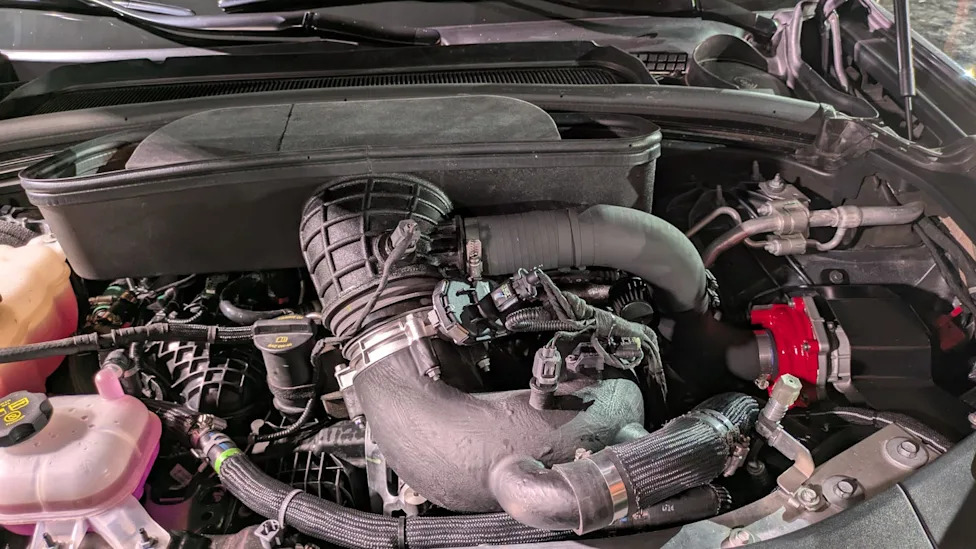
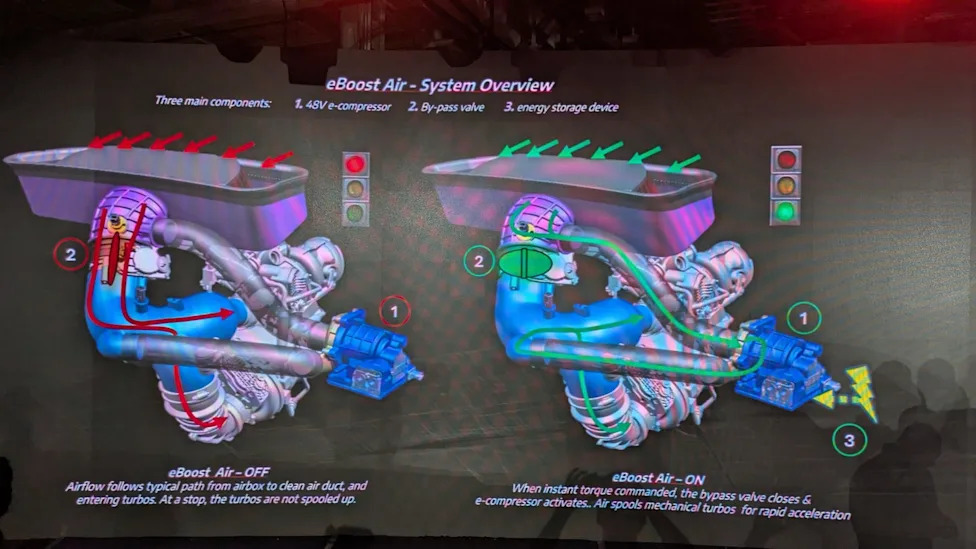
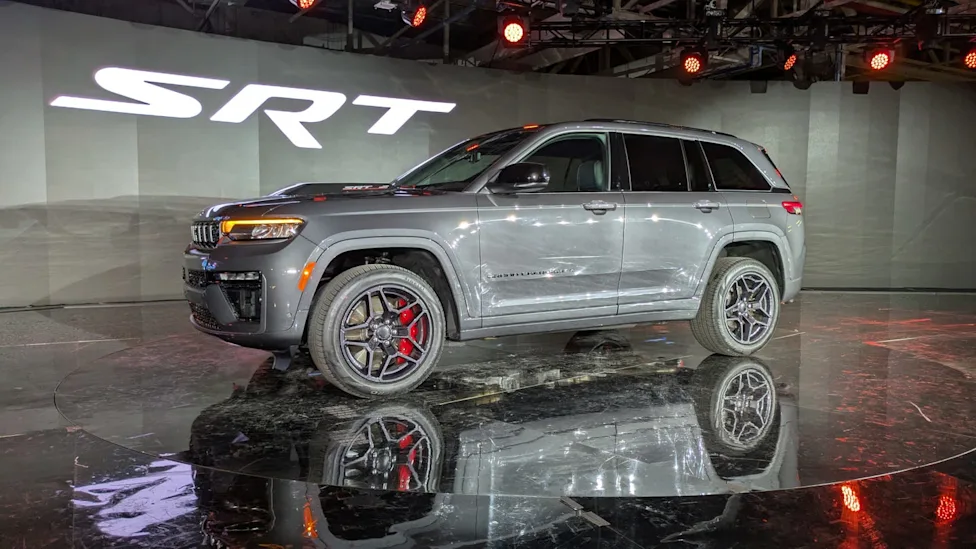
SRT Tech Makes a Turbo I-6 Drive Like a Blown V-8MotorTrendStellantis' SRT performance division is working on a powertrain technology that could make a twin-turbo inline-six drive with the fast-responding, linear feel of a Hellcat's supercharged V-8. The system, called eBoost Air, uses an electric supercharger to build boost pressure off the line and in passing maneuvers before the conventional turbochargers have spooled up.The electric supercharger itself doesn't increase an engine's power output, but by improving low-end responsiveness it would allow engineers to tune engines and size turbochargers for higher output. The prototype, a Hurricane 3.0-liter twin-turbo inline-six installed in a Jeep Grand Cherokee, uses the stock turbos and yet output has climbed from 550 horsepower and 531 lb-ft of torque to 620 horsepower and 600 lb-ft simply by recalibrating the engine and strengthening the driveline. The eBoost Air system minimizes turbo lag by delivering 10 psi to the intake manifold within 0.65 seconds of the driver stomping the accelerator. The conventional twin turbos need whole seconds to spin up to speed, at which point they take over providing boost pressure to the engine.SRT - MotorTrendSRT calls eBoost Air an electric turbocharger, but it's actually an electric supercharger, as the electrically driven compressor is entirely independent of the exhaust-driven turbos. Volvo and Mercedes have built production cars with electric superchargers, and Porsche and Mercedes have sold cars with electric turbos, which incorporate an electric motor into a conventional turbo.AdvertisementAdvertisementeBoost Air was developed from an idea into a working prototype in just seven weeks. Joel Baker, VP of propulsion engineering, says there's still a lot of work to be done to refine the technology. In the concept, the compressor gets power from a 1-aH, 48-volt battery recharged via DC-to-DC converter and an upsized 12-volt alternator. Baker's team is looking at alternatives, including non-battery energy storage solutions such as capacitors. Baker also says that a logical evolution would be to incorporate eBoost Air into the Hurricane 2.0-liter turbo inline-four engine.Eric Tingwall - MotorTrendStellantis says there are currently no plans to put eBoost Air into production, but the fact that the company is talking about a seven-week-old technology suggests it's not a pipe dream, either. If it does reach showrooms, we'd expect to see eBoost Air in a performance vehicle first, such as the Dodge Charger or a revival of the Jeep Grand Cherokee SRT Trackhawk.



















 +44 others