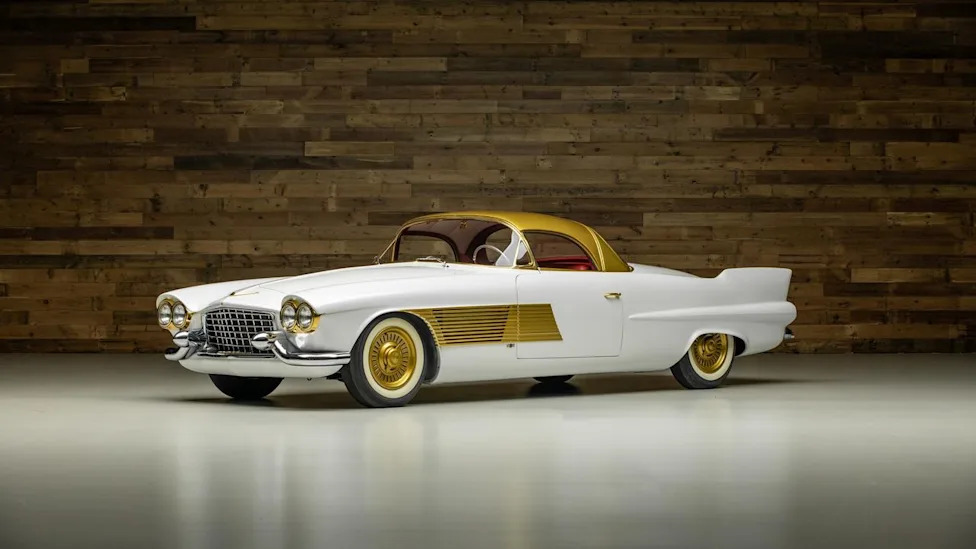
A Gold-Plated One-Off Cadillac Beat a Duesenberg at Auburn — and That Designer Credit Is Doing Less Work Than You’d ThinkBackfire NewsEL PuckettSat, September 19, 2026 at 8:00 PM UTCAdd us on GoogleA Gold-Plated One-Off Cadillac Beat a Duesenberg at Auburn — and That Designer Credit Is Doing Less Work Than You’d ThinkA one-off 1953 Cadillac wearing 24-karat gold over its brightwork sold for $1.4 million at Kruse Auctions' 56th Annual Auburn Auction on September 5, and in doing so it walked past a 1932 Duesenberg Model J dual-cowl phaeton that made $1,022,500 on the same docket. That is a genuinely strange result, and the reasons it happened are more interesting than the gold.What the car actually isThe Elegante, VIN 536262805, started as a 1953 Cadillac Series 62 convertible and kept the 331-cubic-inch V8 and four-speed Hydra-Matic underneath. Everything above the frame is hand-formed aluminum by Carrozzeria Rocco Motto in Turin. It has a hydraulically retractable hardtop, a Lucite steering wheel, and custom bronze castings for the headlamp rings, wheel covers, dashboard, door panels, door handles and windshield frame, all finished in 24-karat plate. It debuted at the 1955 New York International Automobile Show and took People's Choice at the 2014 Amelia Island Concours before the Birdsall family estate consigned it. This was its first public offering in 73 years.Worth noting for anyone searching later: this has nothing to do with the Elegante trim package Cadillac hung on Sevilles and Eldorado Biarritzes starting around 1980. Same word, unrelated cars.Read the designer line in the catalog, not the headlineThe shorthand traveling with this car is that it was designed by Albrecht von Goertz, the man behind the BMW 507. That is doing a lot of compression.AdvertisementAdvertisementKruse's own listing splits the credit into two lines. Initial design is attributed to Harry Birdsall, a New York commercial artist, with Joe Mascari involved on the build side. Goertz's contribution is listed separately as design studio work through Goertz Industrial Design. That is styling refinement at a studio, not authorship, and it is a meaningful distinction. The Elegante does not appear anywhere in BMW's own official biographical material on Goertz, which walks through the Raymond Loewy introduction, the Studebaker years, the Max Hoffman connection and the 503 and 507 that both landed at the 1955 Frankfurt show. A car he is supposed to have designed being absent from the definitive account of his career is the kind of thing a buyer should notice.Goertz attribution has been slippery before. Nissan sent him a letter in 1980 stating plainly that the 240Z was the product of its own design staff and that his work had been an influence, not the design. BMW's 2006 obituary release still lists the 240Z among his credits. Two official organizations, two different answers, one very marketable name.Why a one-off is so hard to priceHere is the practical lesson, and it applies to any singular car you see at auction.A BMW 507 has a floor and a ceiling because 254 of them exist. There is a registry, a chassis-by-chassis history, decades of sale records and a known top of the market, which is the John Surtees car at £3,809,500 at Bonhams in July 2018. When a 507 crosses the block, every bidder in the room already knows what one is worth within a range.AdvertisementAdvertisementThe Elegante has none of that. One car, no club, no comparable set, no second example to check the first against. Pricing it is not valuation, it is a negotiation between however many people in the room want it badly enough, which is exactly how a car with a contested design credit can outrun a Duesenberg with impeccable paperwork. The same dynamic is why asking prices on ultra-low-volume modern hypercars swing so wildly. Thin markets are loud markets.The gold is the smart partGold plating on cars is usually a punchline, but the execution here is technically sound in a way that matters for whoever owns it next. The plating sits on bronze castings rather than on steel stampings. Automotive gold plating is a stack: a copper strike, then a nickel barrier layer, then the gold itself, typically well under a micron for show work. The nickel is what actually holds the line against corrosion, and steel underneath gives that stack far more to fail against than bronze does.Gold also reflects roughly 95 percent of visible light against chrome's 65 to 70, which is why these cars photograph the way they do under show lighting and look almost soft in daylight. The material cost of the gold itself is trivial. The labor and surface prep are the entire bill, and bad prep is the single most common cause of plating failure. On a car where the castings are one-off and unreplaceable, a re-plate is a restoration decision with no safety net.What it says about the wider marketKruse's Auburn results had the Elegante at $1.4 million, the Duesenberg at $1,022,500, a 1929 Hispano-Suiza H6B cabriolet at $478,000 and a 1959 AC Bristol roadster at $442,250. Blue-chip prewar iron holding just over a million while a mid-century one-off show car clears well past it is a data point worth filing, and it lines up with a pattern that has been building for a few years: Cadillacs with a story attached keep outperforming Cadillacs with a spec sheet attached.AdvertisementAdvertisementOne caution on the arithmetic. Kruse published a single "sold for" figure of $1,400,000 and did not itemize hammer against buyer's premium, so treat that as the all-in number rather than a hammer price. And the superlative floating around this car, that it is the most expensive Cadillac ever sold at public auction, is not something Kruse itself claims anywhere on the listing.Photography: Kruse Auctions. Sale result and vehicle documentation via the Kruse Auctions 56th Annual Auburn Auction listing.Your Turn: Should auction houses credit a designer's original vision, or just the outcome on the block? Let us know your take.