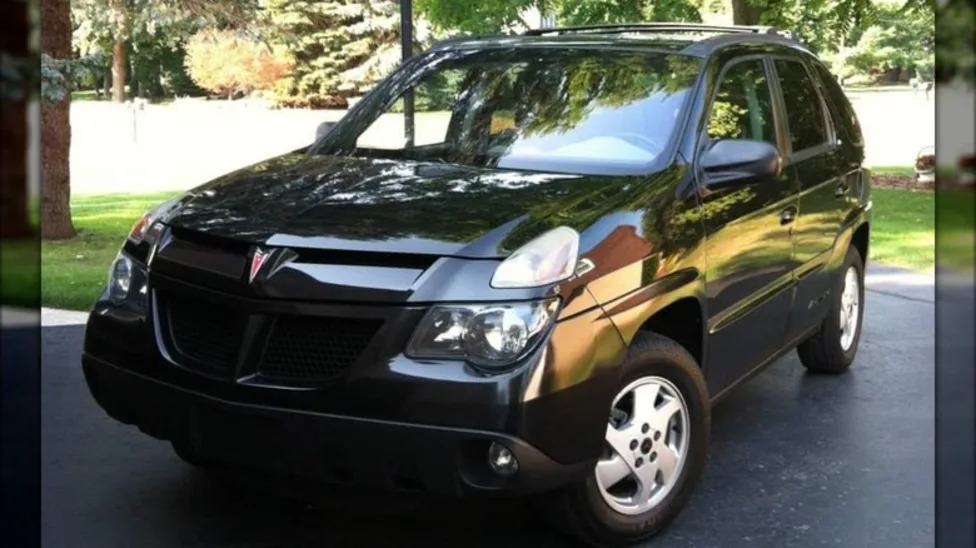
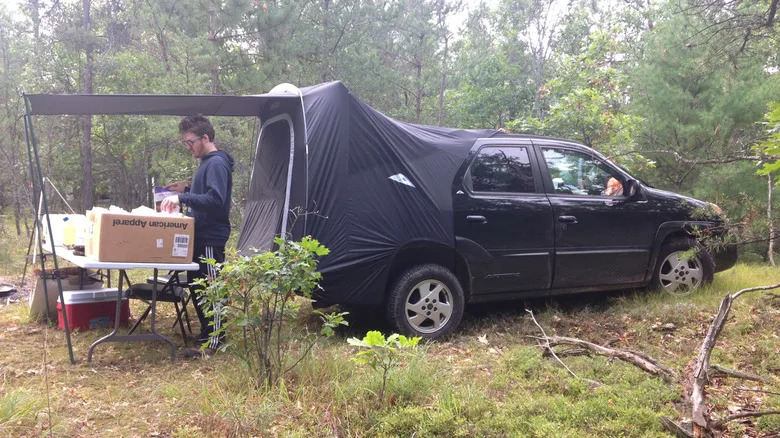


















Lalita Chemello / Jalopnik Add Jalopnik on Google: Google Discover Hi, my name is Lalita Chemello and I'm a proud former Pontiac Aztek owner. This is when you would likely tell me that the first step in recovery is admitting you have a problem, but there's no problem to admit to. I've spent years enduring the slander against the Aztek and I'm here to set the record straight: I am one of few who actually owned an Aztek. This was long before Walter White and "Breaking Bad" made it sorta cool. While the Aztekis still mocked to this day, I consider it one of the best vehicles I have ever owned. The Pontiac Aztek concept was actually well received. The sport recreation vehicle would be the first-ever crossover to hit the market, combining the best of worlds from the current vehicle market. It sat on the Pontiac Montana's minivan platform, albeit shortened, and wore a sportier, wider stance, like a sports car for "sporty" handling. The combination provided a decent-handling vehicle with room to haul stuff, and easy loading. What was unveiled was a sleek concept featuring a low roofline, perhaps slightly higher than a station wagon, but lower than a van, and a tasteful application of plastic cladding (a 2000s sporty vehicle necessity), including along the upper roofline. I first encountered the Pontiac Aztek at the 2000 North American International Auto Show. The production vehicle wasn't the sleeker, more stylish off-roading machine Pontiac had promised in its concept. What did transfer over from concept to production was the vehicle's diverse driving capabilities as well as outdoor-minded accessories. I immediately fell in love with the odd-shaped box, declaring I would someday own one. The roofline was a bit taller, the cargo area more squared off. The lines were more angular and not as soft as the concept. And the cladding was laid on real thick. As the Aztek's on-sale date inched closer, the reviews were mixed. Mostly on its exterior. Car And Driver found its appearance "...rather cartoonish, space-cadet styling," and in an earlier review left it at just being "unique." Forbes' impressions were less forgiving, calling it "a truly unattractive car that might have been the unfortunate offspring of a tryst between a Volkswagen Thing and a Honda CRX." Despite its mixed reception, at least everyone could agree on the success of its interior. You can't judge a book by its cover Lalita Chemello / Jalopnik The Aztek's interior was as spacious as the reviews described it to be. The front captain chairs were divided by a center console, or the cooler accessory — which was a literal cooler, and also cool. The rear seats folded down and were easy to remove for someone my size, which could then be classified kindly as thin and petite. With the seats removed, the rear was the ultimate moving machine. In the time I owned it, I moved six times to five different places (three of those were within one year). I discovered a full size mattress lay perfectly across the floor, which was vital knowledge for future adventures. The only downfall would be that this tailgating-friendly vehicle had radio controls on the rear panel. Great for tailgating, terrible for moving. When transporting large amounts of cargo, if you didn't protect the controls, a bump would knock your furniture into the buttons and turn up the volume or randomly skip a song or change the station. And if a cooler replacing your center armrest storage was impressive, the Pontiac also made a swanky tent kit specific to the Aztek. I had received one during my ownership as a gift from an ex for an anniversary. The full-size mattress (mentioned earlier) could be laid across the rear, and because the tent required the tailgate to be opened, it served as an entryway to the tent, ideal for shoe storage or to set your cooler in at night to avoid attracting bears in the Michigan wilderness. The cons were relatively easy to manage Lalita Chemello / Jalopnik This was the first car I truly cared about. I washed and waxed it like it was a sports car. The 3.4-liter V6 was easy to maintain, and the power was well suited for daily commuting to school. The commutes either-way were nearly 100 miles round-trip, and that didn't include mileage accrued for work. The engine did experience the same head gasket failure experienced by many GM vehicles built in that era, which would give out at around 75,000-100,000 miles. I spent a Thanksgiving weekend helping my father tear the top end of the engine down to put in a new one. Call it quality family bonding time. I never had a problem with the engine after that. The head gasket honestly wasn't the worst. It also had a problem with perpetually failing ball joints. And the dashboard gauges slowly gave out a little after about 140,000 miles — a common issue of that era of Pontiacs as well. My method to avoid getting stranded was resetting the tripometer and getting gas once it hit 250-300 miles, knowing I could squeeze 400 miles out of the tank on a good day. My ex at the time, however, did not and got us stranded one cold December Saturday night on the side of I-696. Thank god I had a space blanket in the glove box. Sentiment or pioneer of design? In the '90s and '00s, prior to the recession and bankruptcies, GM was really trying to do something different and try new. Bob Lutz, in an interview with Car and Driver, revealed the company's strategy was that "40 percent of all new GM products would be 'innovative.' ... Everything that looked reasonably radical got green-lit." Thus, the Aztek was born. It was created for the outdoor enthusiast, something you can tailgate and camp with — things we associate with trucks or Subarus today. Perhaps part of its downfall was the jutting odd angles which stood out in a decade where everything was of bubbled shapes. I tearfully bid adieu to my Aztek after a handful of years of ownership and over 170,000 miles on the clock. My one reminder of it is an Aztek cooler David Tracy found on one of his Michigan junkyard explorations that he gifted to me before he left Jalopnik. The Aztek was everything I hoped it would be from the first time I saw it. It was a solid vehicle to drive and frankly the problems it had were normal car problems. No car is perfect. Little things are going to fail, especially if you live in the Midwest or drive it almost 200,000 miles. As for the design, it was a vehicle presented way ahead of its time as the precursor or beginning to the crossover, and did it in a way where it wasn't egg shaped or boring, or like GM's other attempts via the Pontiac Torrent and Chevrolet Equinox. Remember those abominations? It didn't look like everything else, and honestly, not enough automakers have tried to do something so daring and polarizing with their crossover or SUV design since. I dare automakers to take a chance to make something outside of the literal box they have put themselves and their cars into like GM did with the Aztek. Maybe we wouldn't be surrounded by so many eggs on wheels or Land Rover look-alikes.