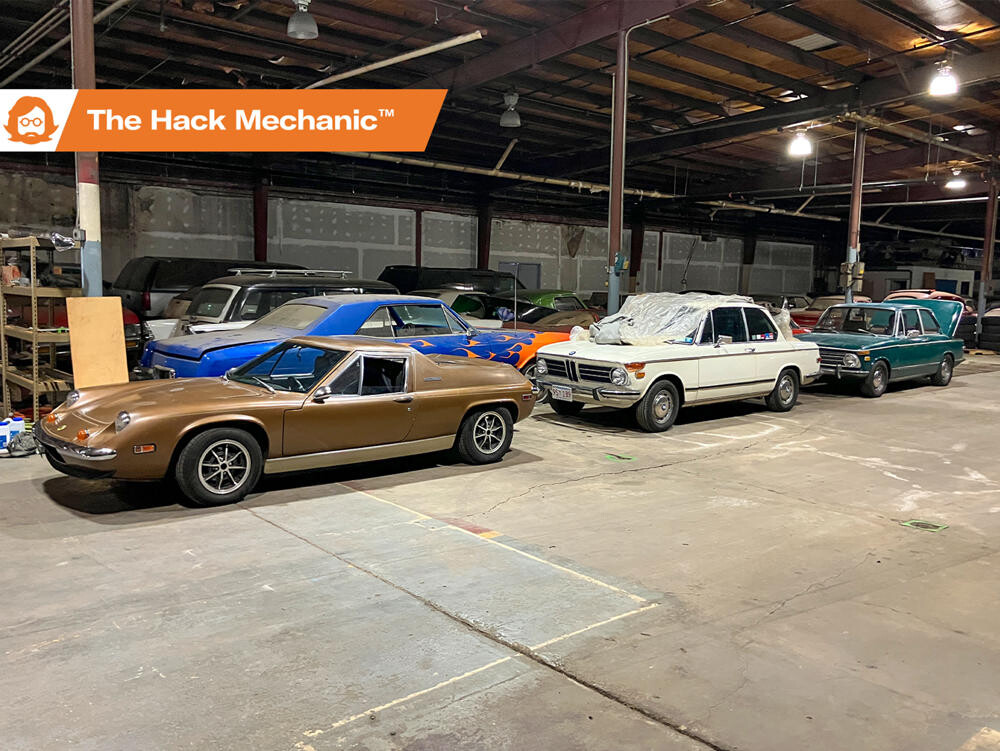
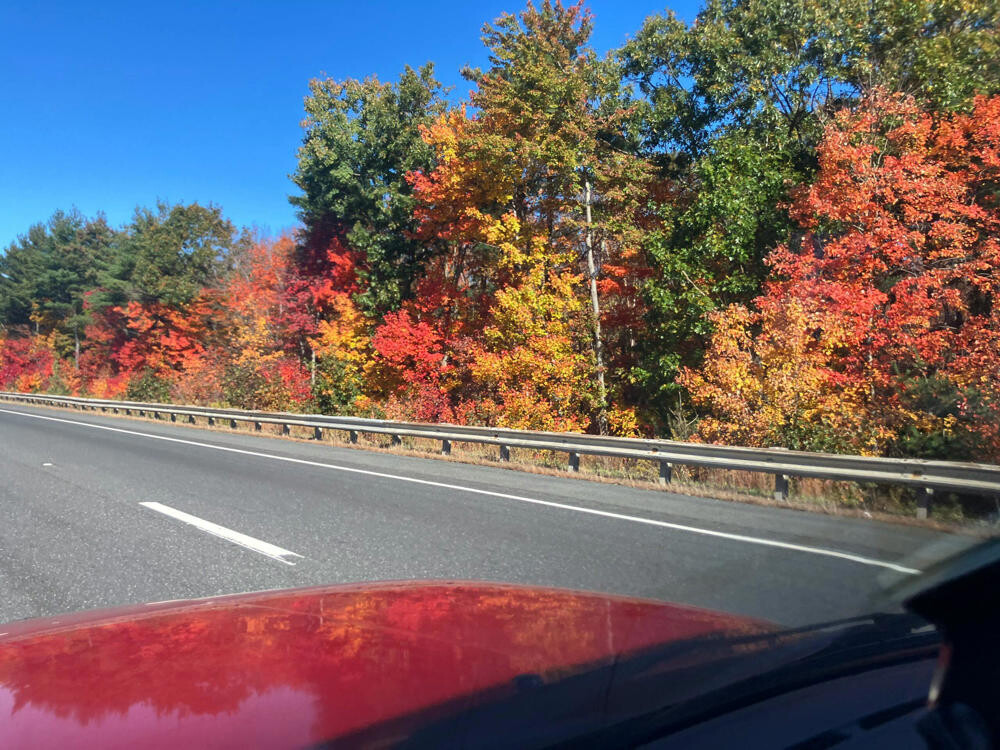
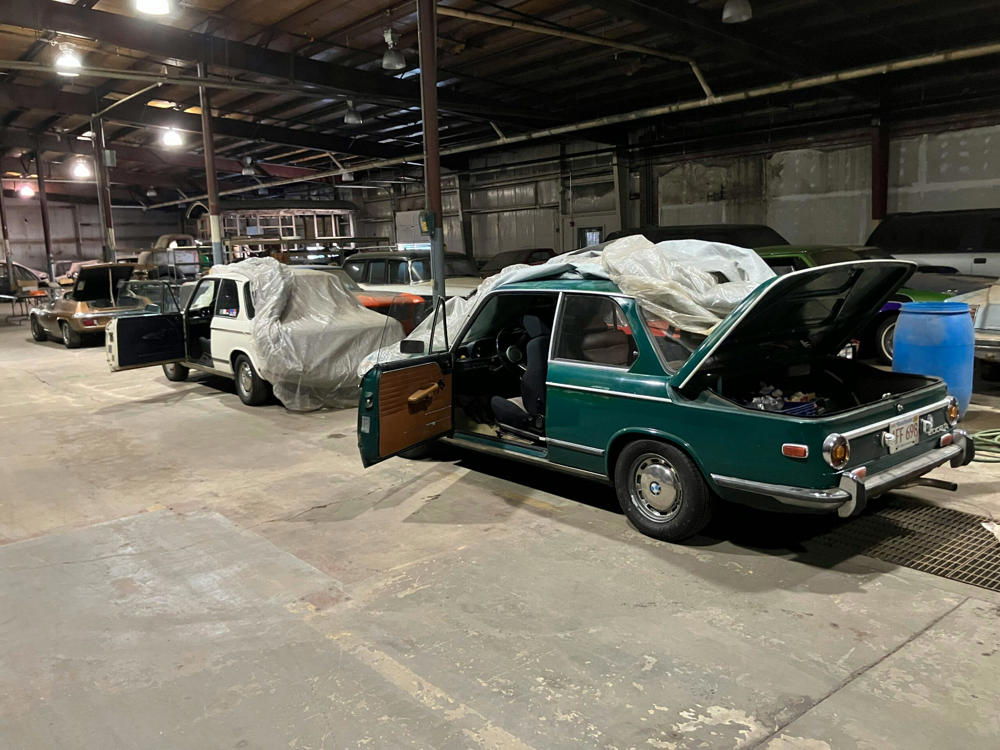
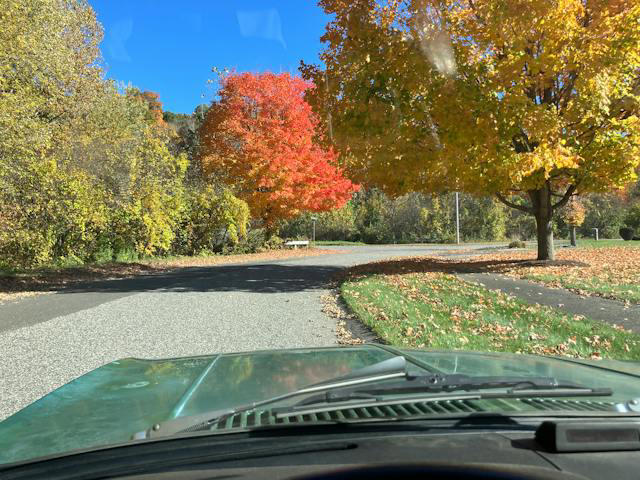
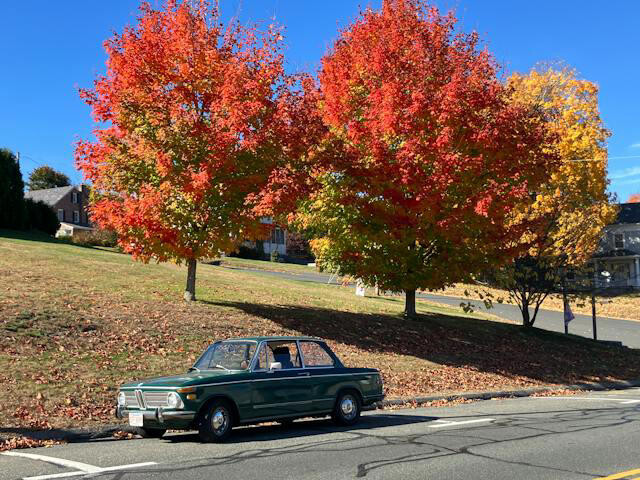
After my mini road trip with Maire Anne to Vermont in the FrankenThirty last month, I made it a priority to get out to the warehouse in Monson, Massachusetts, where I store cars. I hadn’t been out there since mid-July when I brought the FrankenThirty and the now-departed M Coupe home, dropping the number of cars out there from five to the more-manageable-sounding three. In addition to pleasure-driving them, there are good reasons why it’s important to exercise lightly-driven cars: It helps keep the tires from getting flat-spotted, the brakes and clutch from sticking, rust from forming on the cylinder walls, and the rubber seals lubricated. Unfortunately, as I’ve complained, with traffic and construction, this is typically about an hour and 20-minute drive each way. Plus, there is a humidity issue in the warehouse, so unlike when I used to have the cars in Fitchburg and would do a surgical strike and swap one fun car for another and be back home in two hours, Monson has turned into an all-day affair where I’m not out there as often, but when I am, I spend much of the day changing all the DampRid packs and exercising all the cars. So I shot out there in the FrankenThirty. Having enjoyed the car so thoroughly in Vermont, I hated to possibly put it away for the season, but as Cooper said in Interstellar, “To move forward, you have to leave something behind.” On the plus side, the foliage on the drive out to Monson was just as spectacular as it was in Vermont, so seeing it again against the red hood of the FrankenThirty was anything but a hardship. When I arrived at the warehouse and saw my three cars (the Lotus Europa and the two 2002s) in a line, it already looked like a shrunken hoard in comparison to the five that used to occupy two rows. Still, the drill was the same—pull the covers back, carefully remove the two DampRid containers from each car, bring them outside, empty and clean them, refill them, and place them back inside the cars in cardboard boxes so they don’t tip. It doesn’t sound like much, but what’s in the containers isn’t clean water—DampRid is calcium chloride salt, and the water feels like slimy brine. So you wear nitrile gloves, and you really don’t want to spill the captured water inside the cars, as it’s like subjecting the floor pans to a concentrated dose of winter road salt exposure. With the messy part out of the way, it’s on to the fun stuff—driving. Unfortunately, to get to “driving,” you have to pass through “starting,” and that’s often challenging with 50-year-old cars that have carburetors fed by mechanical fuel pumps and have been sitting for months, especially in an environment where there’s no electricity for trickle-charging. If they’re healthy and three-ish months have passed, reconnecting the battery and giving a blast or two of starting fluid usually awakens the engine and spins it long enough for the mechanical fuel pump to suck enough fuel into the float bowl to keep the engine running. I bring a battery jump pack as well as jumper cables in case the battery is weak or a hard-starting issue runs it down. Fortunately, the Europa—the first car in the line—woke up immediately. As soon as I got it out of the warehouse and into the crisp fall air, I was reminded how much I love this ratty, odd-looking little slot car. Although my Elan +2 is much prettier, the Europa continues to be the most smile-inducing car I’ve ever owned, and I immediately decided that this would be the car I’d swap for the FrankenThirty. Lotus Europa + foliage + dappled sunshine = happiness. Rob Siegel While I was out and about in the Europa, I had an epiphany—screw the self-imposed task of driving all three of the cars. Do the Ram Dass “Be here now” thing. You’re enjoying yourself driving the Europa? So keep driving it. Monson is located in the southern end of the Berkshires; the area is lovely, and the roads are fun. I drove down to the Connecticut border, headed back, and thought about making it a Europa day by driving out to my adopted hometown of Amherst, Massachusetts, where I first saw a Europa when I was 13, and making a big lazy loop up the Pioneer Valley and back down along Quabbin Reservoir. But, for better or worse, I did the responsible thing, stuck to the plan, and headed back to the warehouse. After all, the youngest of these three cars is 52 years old, and they don’t exactly grow more reliable like kids who have moved out, gotten real jobs, and put their life together (kids do that, right?). So part of going through this exercise is not just keeping them exercised, but staying abreast of their needs, which always increase unless you intervene. So I engaged Hampton, the 52,000-mile survivor BMW 2002. This car has a still-unsolved hard-starting problem that occasionally bursts out like the Alien from John Hurt’s belly. It’s a certainty that the float bowl of the Weber will be dry, and that cranking the starter doesn’t do enough to fill it to allow you to mash the accelerator a few times to get the little pump on the carb to squirt in fuel. So off with the air filter, hold the linkage down to open up the throttle plates, a good blast of starting fluid, crack the key to start, and it runs for a second then dies. Typically you repeat this two or three times and the fuel pump has pulled enough fuel into the float bowl to give the thing enough of its morning coffee to wake up. But this time, after doing the blast-and-crank thing half a dozen times, it was clear that something was wrong. Okay, time for actual diagnosis work. It’s always (well, almost always) just fuel and spark with these things. Since the car was firing up for a moment with starting fluid, it clearly had spark, so the problem was fuel. There was gas visible in the transparent fuel filter, but that didn’t mean that it was moving. I eyeballed the squirt nozzle while I moved the linkage, and nothing came out. This meant that the fuel pump wasn’t pulling in fuel, which either meant that it had died, or it was sucking air, or there was a blockage. Imagine my surprise when I put my hand on the fuel filter and it immediately disconnected from the fuel line that was supposed to be feeding it. Once reconnected, the car started on the second crank-and-squirt. Hampton and I had a lovely drive. I don’t think of Chamonix (white) as a pops-in-autumn color, but it was a great counterpoint and allowed the trees to do their thing. Last was Louie, the 1972 2002tii Ran When Parked car. Louie is my most road-tripped car, but other than running around Monson, it hasn’t seen use in a few years. I noted when I exercised it last spring that my retrofitted A/C had quit working, and the suspension I’d installed years back (stiffer progressive-rate springs, Bilstein HD shocks, beefier sway bars) felt way too stiff in the front and seemed to be clunking in the back. Unfortunately, with the Lotus Elan +2 still eating all my vintage-car attention, Louie was perpetually back-burnered. Louie is a car with mechanical Kugelfischer injection, which is a diesel-like system similar to the old Bosch injection in Mercedes and Porsches of that era. These typically don’t start instantly like an electronically-injected system does, but the injectors and the high-pressure electric fuel pump typically allow easier starting than a carbureted system, as long as the cold-start circuit is working. On a 2002tii, this circuit has a spray nozzle, sort of a fifth injector at the top of the throttle body, that sprays gas for an amount of time determined by temperature. The thermo-time relay that controls this typically dies, so folks like me replace it with a push-button under the steering column. Hold the button while the engine cranks, and the tii typically starts up without a lot of fuss. Only this time it didn’t. It took repeated cranking to get it started. But once it was alive, it ran like a 2002tii should, with that great wind-up when you open up the throttle. The degree to which the foliage was absolutely exploding around Monson cannot be overstated. In every car I drove, and on every road, around nearly every turn, there were oh-my-god-worthy colors. I saw these magnificent trees, parked Louie under them, and snapped the pic. Then, of course, the car wouldn’t start. Hitting or holding down the cold-start button didn’t help, and I was afraid I was flooding it. Continued cranking began taking its toll on the battery. I’d brought the jump-pack with me, connected it, and the car reluctantly came back to life. I returned to the warehouse and shut it back off. I began to put the cars back into line, cueing up the FrankenThirty to stay and the Europa to leave. I needed to move Louie into position, but again it wouldn’t start. In the past I would’ve just pushed it, but with my only-recently-healing back, I need to be really careful doing such things. As was the case with Hampton, I thought, okay, I need to diagnose why this thing won’t start, and again, it’s either spark or fuel. It definitely has fuel, so it’s got to be spark. Normally I’d run a wire directly from the battery to the hot (“+” or “15”) side of the coil, and I always have one with the connectors on it in my road-trip kit, but I didn’t have that with me. Damn. And then I looked down into the well below the windshield where the wiper motor lives, and there was a wire with a battery clamp on one end and a female quick-connector on the other end. In other words, I’d had this hard-start problem before, had stashed this wire there as the in-case-it-happens-again workaround, and had forgotten both the problem and the solution. I hot-wired the coil, and the car started instantly. This showed that the problem appeared to be that the coil had current when running, but didn’t have current (or enough current) when the starter was being cranked. This implicated either the ignition switch, the ballast resistor, the starting relay, or some combination. But no matter. I wasn’t going to drive Louie home anyway, just move it into position and drive off in the Europa. By this time, it was 3 p.m. I’d certainly hit rush-hour traffic on the drive home on I-90. This ran afoul of my goal of bringing the Europa home, for a number of reasons—visibility, a stiff clutch that engages in the last two inches of travel, a non-functional power brake servo—I try to keep it out of interstate stop-and-go traffic. But I didn’t really care. In fact, I realized I could still take a foliage drive—head home the long way and drive north along the edge of Quabbin Reservoir, then head east either on Rt 2 or whatever meandering small leafy roads I chose. This sounded great. I put the covers on all the cars, packed the Europa, and hopped in. And it wouldn’t start. One crank of the starter, then nothing. I don’t have battery cut-off switches in all the cars. On the Europa, I just leave the negative terminal loose, and twisting/pushing it down is enough to keep it secure. Until it doesn’t. And once it gets loose, the poor electrical contact becomes a reinforcing problem, because the increased resistance causes it to heat up, which creates pitting and corrosion. Using a battery post cleaner and tightening it almost always solves the problem. Except this time, it didn’t. Half a spin of the starter, then nothing. So, the positive terminal? It did have visual signs of corrosion. I pulled it off, cleaned it, and tried to seat it, but something wasn’t right. It took me a while to see that the positive clamp had a crack in it. Still, it was surprising that it wasn’t making good enough contact to start the car. Maybe the battery was at the end of its life. I thought back and remembered that I’d stolen it from one of the 2002tiis and dropped it in the Europa after I installed the rebuilt engine in 2019, so it was no spring chicken. I tried the jump-pack, and the car fired right up. So I could still drive the car home if I wanted to. Hell, if all it needed was a positive battery clamp, there was a NAPA about five miles away. And if it needed this small 2002tii-sized battery, there was a nearby Walmart that sold them for $70. So, what to do? Which car to drive home? Hampton was the least hobbled of the three. I love the car, but it’s not a winter project—I don’t see it coming back home until spring. Make a run for it in the Europa and just don’t shut it off? I was hesitant to do this, as sometimes, with the stiff short-travel clutch, I have been known to stall it. Plus, a truly intermittent battery connection can blow the diodes in the alternator. Should I run to NAPA and replace both the battery clamp and the battery? My back is better than it was a few months ago, but I’d need a better reason to lift a battery than this. A better plan was returning to the warehouse next week with a positive clamp and a battery tester. Calling it a day, not disturbing the new-improved-smaller herd, and heading home in the FrankenThirty had a lot of appeal. But I opted for Louie. Whatever was going on with the ignition had been happening long enough that I’d stationed and forgotten about a work-around. I again tested it, and it again worked flawlessly. So. Compared with 15 months ago, the number of cars is down from 14 to 10, and the number in Monson is down from five to three. But the number of issues seems to be about the same. I am big on these little numeric automotive aphorisms (e.g., “Siegel’s Seven-Car Rule,” “The Five Pillars of Attraction,” etc.), and need to model what’s going on. It’s got to be some combination of my age, the age of the cars, the distance between my house and the warehouse, and the length of time the cars sit. This is going to take… algebra. Rob’s newly expanded book, The Best of The Hack Mechanic: 40 years of hacks, kluges, and assorted automotive mayhem, is available on Amazon here. His other seven books are available here, or you can order personally inscribed copies from Rob’s website, Looking to purchase a car? Find your match on the MSN Autos Marketplace

 Liked by Lauren Hill, Evan Wilson
















 Liked by Lauren Hill, Evan Wilson