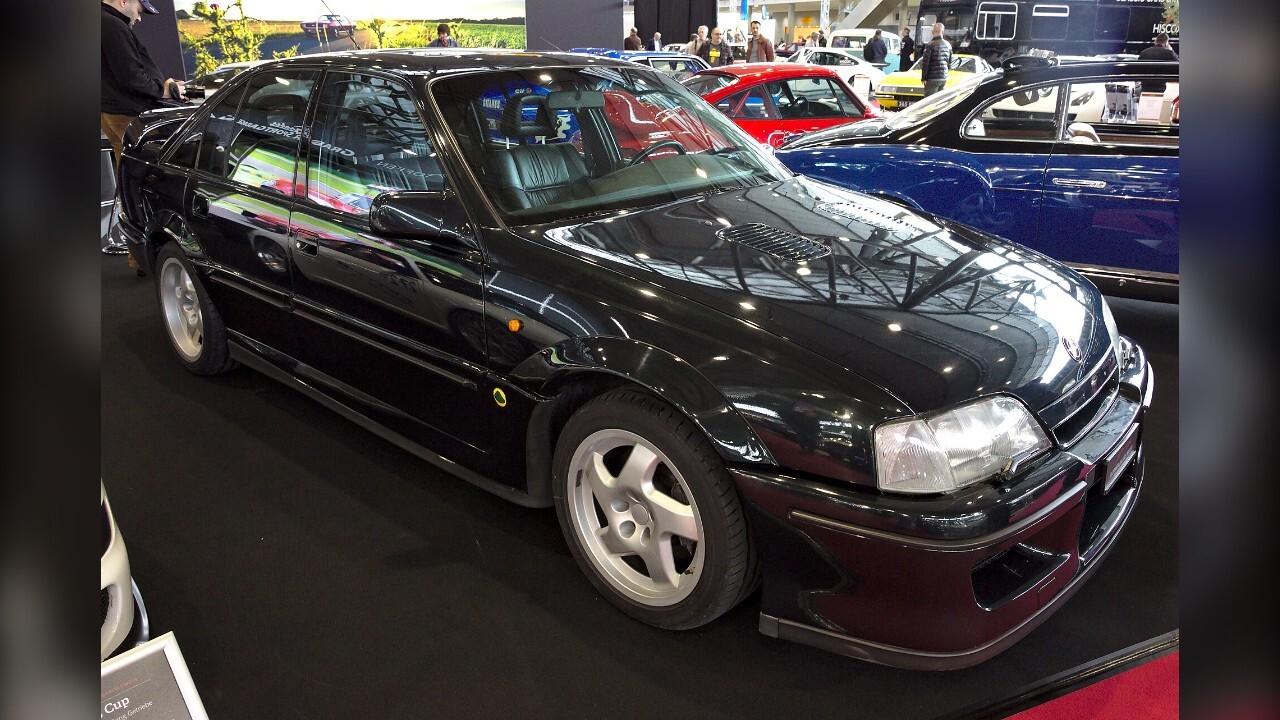
Lotus took an Opel family sedan, added two turbochargers and built the Lotus Omega, a four-door that topped 176 mph. Only 950 of these Lotus-tuned sedans left the line between 1990 and 1992. That is what a real sleeper looks like: ordinary on the outside, wild underneath. Sleepers have always had a special appeal. A loud muscle car announces itself from a block away. By contrast, a fast sedan or wagon in plain clothes lets its driver surprise people at every on-ramp. These are our picks: seven sleepers that, in our view, you’ve probably never seen in person. Some were built in tiny numbers, and others simply blended into traffic so well that nobody noticed them. The facts come from maker histories, period tests and enthusiast publications. 1. 1991 Dodge Spirit R/T Turbo III The Dodge Spirit was a plain midsize sedan, the sort of car a family bought for the school run. Then Dodge built the R/T. It used a 2.2-liter Turbo III four-cylinder with a 16-valve, dual-overhead-cam head engineered by Lotus. The engine made 224 horsepower and 217 lb-ft of torque. Soon, the numbers made people look twice. According to The Autopian’s history of the Spirit R/T, Car and Driver ran it from 0 to 60 mph in 5.8 seconds. That was nearly as quick as a 1991 BMW M5, yet the Dodge cost $17,820 new against $56,600 for the BMW. Chrysler advertised the R/T as “the fastest sedan made in America.” From the outside, though, only R/T badges, small spoilers and cast aluminum wheels set it apart from an everyday Spirit. Dodge built every R/T in Mexico. Our take: almost nobody noticed. Dodge built only 1,399 across the 1991 and 1992 model years, all with a manual gearbox. If you find one, check for torque-steer abuse and a tired clutch. Period reviewers already complained about wheelspin when the car was new. 2. 1991 Lotus Omega The Lotus Omega started as an Opel Omega, a sensible German executive sedan. Lotus, which knew it internally as the Type 104, fitted a 3.6-liter twin-turbocharged inline-six rated at 377 horsepower. The result could top 176 mph while carrying four adults and their luggage in comfort. Lotus built 950 cars between 1990 and December 1992. That total split into 630 Lotus Omegas and 320 Lotus Carltons, about 150 fewer than Opel’s original target of 1,100. In Britain, the car caused such a stir that its advertising drew condemnation in Parliament. A campaign by the Daily Mail and the Association of Chief Police Officers to ban it also failed. Lotus simply kept building the cars until production at its factory stopped in December 1992. In our view, the Lotus Omega is the definitive sleeper, because a four-door family sedan should never be this fast. With so few built, most enthusiasts will only ever know it from photos. If you ever do spot one, look for the Lotus badges, which are about the only clue to what sits under the hood. 3. 1992 Mercedes-Benz 500E W124 From the curb, the 500E looks like any W124 sedan with slightly puffy fenders. Underneath, however, sits a 5.0-liter V8 from the 500 SL. Mercedes-Benz could not fit those widened fenders on its own Sindelfingen line, so it turned to Porsche for help. According to Porsche’s history of the project, the car debuted at the 1990 Paris Motor Show and went on sale in spring 1991. Each body traveled between Sindelfingen and Porsche’s Zuffenhausen plant twice, and the whole process took 18 days per car. Porsche says the engine made up to 322 horsepower, with top speed limited to 155 mph. Only 10,479 left the factories by April 1995. For the 1994 model year, Mercedes renamed the car E 500 as part of a wider E-Class facelift. The last 120 cars came together at Porsche in early 1995. Our take: the 500E is the most refined sleeper here. It seats only four, because the big differential left no room for a middle passenger in back. If you shop for one, insist on full service records, and buy the best car rather than the cheapest. 4. 1993 Saab 9000 Aero 2.3 Turbo The Saab 9000 shared its basic platform with three Italian sedans: the Fiat Croma, the Lancia Thema and the Alfa Romeo 164. Saab, however, turned its version into a turbocharged hatchback with a serious streak. The Aero arrived on the CS body in 1993 after a Paris Motor Show debut in October 1992. The manual Aero used the B234R 2.3-liter turbo four, rated at 225 PS, or about 222 horsepower. Torque reached 342 Nm, roughly 252 lb-ft. That much midrange push in a roomy five-door made the Aero a fast, practical road car. Automatic versions, meanwhile, made do with 200 PS. The 9000 itself grew out of the success of Saab’s turbocharged 99 and 900. That gave the company years of boost experience behind it. That know-how shows in how smoothly the Aero delivers its power. In our view, the 9000 Aero hides better than almost any car on this list. It looks like a tidy Swedish family hatchback, and most people walk right past it. Production of the Aero ended in summer 1997. If you want one, hunt for the manual, since it carries the full-power engine. 5. 1994 Audi RS2 Avant The RS2 was a station wagon with a Porsche secret. Audi built it on the 80 Avant from March 1994 to July 1995, and Porsche assembled it at Zuffenhausen. The 2.2-liter turbocharged five-cylinder made 315 PS, or about 311 horsepower, with all-wheel drive. Porsche’s own RS2 anniversary release lists the parts it supplied: 17-inch wheels, mirrors, red high-performance brakes and Porsche lettering in the RS logo. Porsche estimates that about 20 percent of the car came from its side of the partnership. Top speed was electronically limited to 262 km/h, about 163 mph, even though the speedometer read to 300 km/h. Audi built 2,891, and only 180 had right-hand drive. That total beat the roughly 2,200 cars Audi had originally planned. Clearly, demand for a fast family wagon ran higher than Audi expected. Our take: the RS2 was Audi’s first RS model, and it taught the world that a family wagon could run with sports cars. With only 2,891 built, most enthusiasts have only seen one in photos. If you shop for one, verify the Porsche-specific parts, since replacement pieces are expensive. 6. 1997 Pontiac Grand Prix GTP coupe Pontiac sold the Grand Prix as a mainstream midsize car, and its GTP package hid real punch. The 3.8-liter 3800 Series II V6 gained an Eaton M90 supercharger, which raised output to 240 horsepower. By comparison, the naturally aspirated version in the SE made 195 horsepower. That 45-horsepower gap came with no dramatic body kit, so most people never knew which Grand Prix they were looking at. In short, the GTP badge did all the talking. The 1997 redesign also leaned hard on styling. Pontiac promoted its “wide track” look, with the wheels pushed out toward the corners. The coupe body made the GTP even more of a rarity, because Pontiac dropped the two-door after 2002 and sold only sedans for 2003. In our view, the GTP coupe is the sleeper you probably sat next to at a stoplight without a second thought. It looked like a stylish everyday Pontiac, so the supercharged coupe blended right in. That, after all, is the whole charm. If you want one, look for a coupe with service records. Most of these cars served as daily drivers rather than garage queens. 7. 2003 Mazdaspeed Protege Mazda’s compact Protegé was a sensible commuter sedan, but the 2003 Mazdaspeed version added a turbocharger. Mazdaspeed, the company’s in-house performance division, built it as its first model sold to everyday buyers. It went on sale in North America only. In Japan, Mazda sold a different hot version of the same car, the Mazdaspeed Familia, with its own 2.0-liter engine. The car started as a Protegé MP3 and gained a Garrett turbocharger with an intercooler. As a result, output rose from 140 to 170 horsepower. Mazda also gave it a new front air dam and a rear spoiler, though the changes stayed subtle enough to fool most onlookers. Inside and out, it looked a lot like the car your neighbor drove to work. Only a careful look at the bumper, the wing and the badges revealed the extra 30 horsepower hiding underneath. Our take: the Mazdaspeed Protegé is the hardest car on this list to spot, because it looks so much like the regular Protegé. Cars like this often attract owners who modify them, in our view. If you find an unmodified 2003 example, buy it, because stock survivors of tuner-era compacts are getting scarce.

 Liked by Sophie Rogers, Victoria Moreau
 Liked by Sophie Rogers, Victoria Moreau