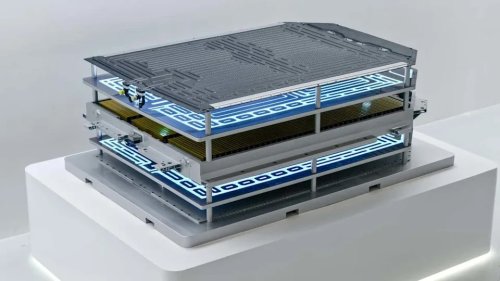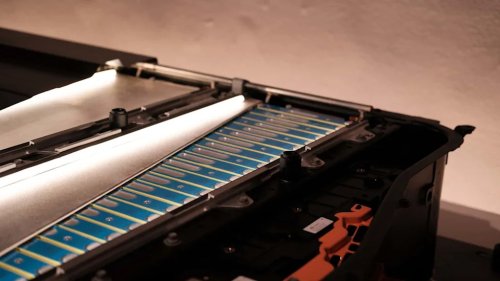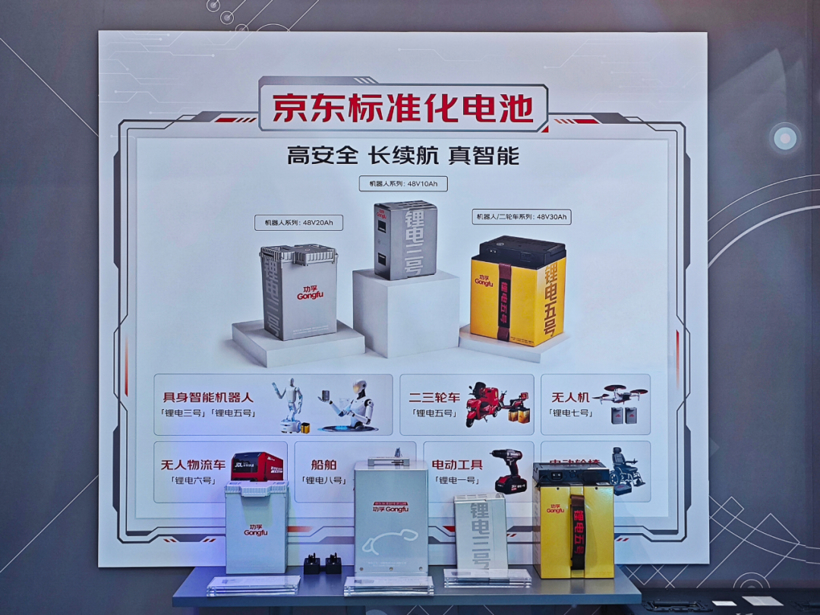



















Gasgoo Munich-JD officially unveiled its standardized battery series at the 2026 World Robot Conference, according to Gasgoo Embodied Intelligence. With BAK Battery serving as the core cell supplier, the two parties rolled out products featuring unified interfaces and dimensions — a move aimed at resolving the long-standing fragmentation that has plagued the robotics sector.The robotics battery sector has long been mired in fragmentation. A chaotic mix of dimensions, non-uniform hardware interfaces, and incompatible communication protocols has driven up production and maintenance costs for manufacturers, creating a hidden bottleneck to large-scale robot deployment.The standardized solution developed by JD and BAK enables "plug-and-play" functionality for robot batteries. By amortizing costs across the entire chain — from design and production to operations and maintenance — the system is widely adaptable to various robot forms, including humanoid, industrial, and wheeled units.Image source: BAK BatteryAs the cell provider for the entire solution, BAK Battery leveraged its high-consistency cells to bridge the full energy chain — from individual cells to modules and finally to the unified external interface — providing the underlying support for the universal battery system.Beyond general standardization, BAK has simultaneously introduced a differentiated cell strategy for humanoid robots dubbed "one chassis, three personalities." The "one chassis" concept relies on mature 21700 standardized cells to build a unified physical and electrical architecture. This approach capitalizes on high energy density, superior heat dissipation, and stable high-current output to achieve cost reductions in both the supply chain and production.The "three personalities" are tailored to specific application scenarios. The "burst" variant targets high-dynamic movements like running, jumping, and load-bearing climbing, offering ultra-high discharge rates. The "endurance" option caters to commercial service robots, prioritizing high energy density to extend single-charge operating time. The "balanced" model serves home or industrial collaborative scenarios, striking a trade-off between power and capacity to balance performance and cost.This design dispels the industry misconception that "standardization equals homogenization," preserving the flexibility for scenario adaptation atop a unified foundation.The robotics energy ecosystem is currently transitioning from a fragmented "Warring States" era to a new stage of scalable modularity and on-demand customization. Combining JD's channel and scenario integration capabilities with BAK's cell technology expertise, the partnership is poised to accelerate battery standardization — providing critical support for cost reduction, efficiency gains, and mass production in the humanoid robot sector.