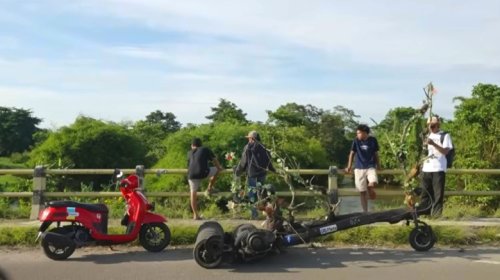
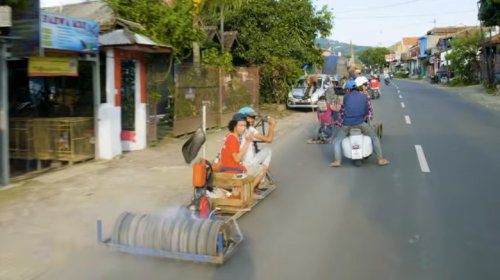
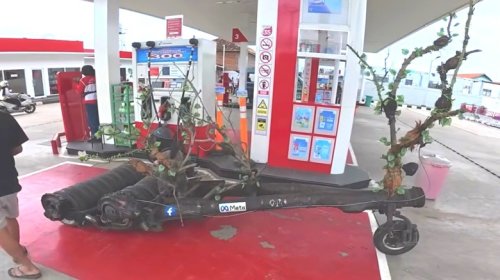
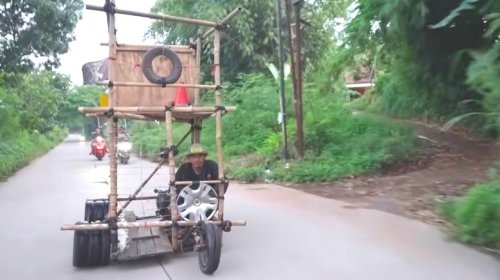
Sam/YouTube Modding is a fairly common practice for Vespa owners worldwide. You could say Vespa started the trend of thinking outside of the box, after spending its first decade building weird racing models for record-making runs. The company even built a tiny tactical war machine for the French army. For the common person, there is the famous British modding trend, with its overwhelming collective of lights or shiny add-ons placed artistically on the scooter's front fairing, as well as Vespas made to sail across the English Channel. Vespa owners take care to make these notorious two-wheeled steeds their own. In Indonesia, the same applies, except for a widespread network of owners known as Rebel Riders, who take their mods to the literal extreme. These Vespas don't look like Vespas at all. The riders who construct what can only be called creative forms of transport refer to them as "Extreme Vespas." They're imaginative – made from just about anything from sheet metal, bamboo, and rubber, to a literal tree branch. Some are built to be capable of transporting one or two riders, while others can carry upward of eight at a time. These Vespas are erected with questionable rigidity, and safety isn't really a priority. In several videos and photos of these creations, the tires are worn down to the treads or completely blown out, but there are dozens of others there to help. The only thing that makes them a Vespa is the 98 cc engine. Behind the second-largest Vespa enthusiast community in the world Great Big Story/YouTube The Italian scooter made a massive mark on the country when Piaggio opened a factory in Jakarta in the 1970s. The small two-wheeled vehicle became a massive mode of transport, inspiring roughly 85% of islanders to own a scooter, according to National Geographic. The Vespa enthusiast community there quickly grew to be one of the largest in the world — second only to the Vespa's home country, Italy. When the Asian financial crisis hit in 1997, prices skyrocketed, and islanders were unable to afford new Vespas. The factory ended Vespa production in 2001, and those still in search for affordable transportation found that they could just repair or repurpose old Vespas and their parts into machines of their own. As individuals became more creative and innovative with the repurposed parts, the Extreme community found there's a way to fit a 98 cc Vespa engine to just about anything. Extremely innovative Vespa fun Sam/YouTube One of the most well-known Extreme Vespas belongs to an Indonesian man named Neo (neovespapohon_87), who recently told YouTuber Sam that his Vespa was made from a log that he found fallen in the road. Neo's log Vespa shows up in several stories written on the culture over the years. Like many Extreme Vespa owners, Neo had to learn how to fabricate and fashion all of the cables and linkages to operate the Vespa engine and transmission. His clutch pedal is a wrench. The clutch and accelerator are built into a branch coming off of the log. From afar, it looks like a large tree branch being dragged down the road. But in Indonesia, it's a Vespa. Neo's moving log is just one extreme (some pun intended). Some look more like something from "Mad Max," fashioned with angular metal panels that look more refined than today's Tesla Cybertruck. Others are rudimentary double-decker constructs made with old wood and bamboo. In Sam's video, he shows one Extreme Vespa that uses string as the accelerator pedal. In contrast, they can be well thought out, practical, and multi purpose, like scotty-molins' coffee cart Vespa — a small covered bar on a small trailer, with a bench seat on the side leading to a complex steel structure containing its front wheel and steering. It's a destination on the streets of Jakarta. A restless culture on the move Sam/YouTube Many of these Extreme rides are built out of necessity while also harnessing a rider's creative spirit. The Rebel Riders can occasionally be found at basecamps, where they can learn the art of building these moving artistic expressions on wheels. They may be two-wheeled, or they may be 11-wheeled. But they're meant to get these nomadic riders from place to place as they hop about the islands on their own destined pilgrimage. To where, only they know. Over time, riders built a network of these basecamps spread across the islands, where riders can stop to work on Vespas in exchange for a place to sleep, eat, and fuel up. Some teach others how to work on them. Many who run them are former Rebel Riders, retired from their island hopping. Every stay and destination is communicated through a secret WhatsApp group. It's not difficult to find these Extreme Vespas riding about Indonesia. To see something really special, though, you have to go to one of the holy grails of these Vespa gatherings, held once a year on each of the six main islands. Advertised through social channels, these are the places where these nomads will all converge for two full days. One gathering in 2019 reportedly hosted 50,000 riders. There, they celebrate their creations on wheels, earn awards, and swap stories before continuing on their separate journeys.