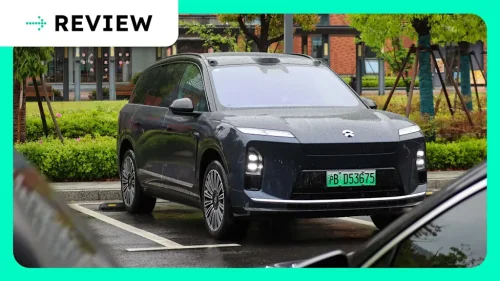
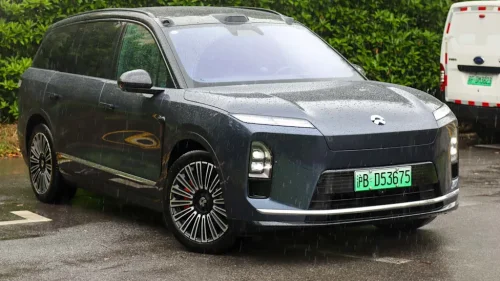
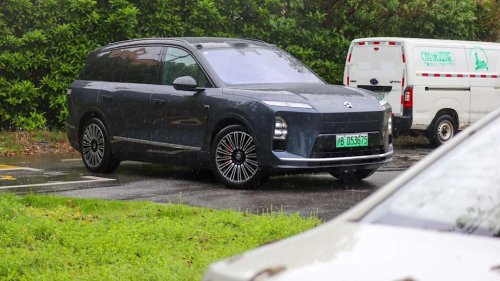
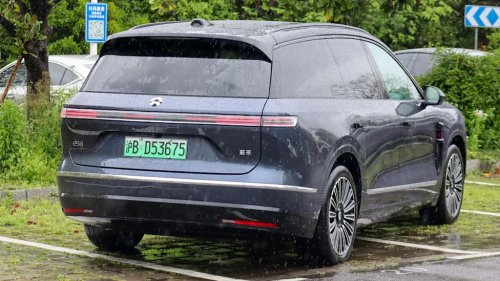
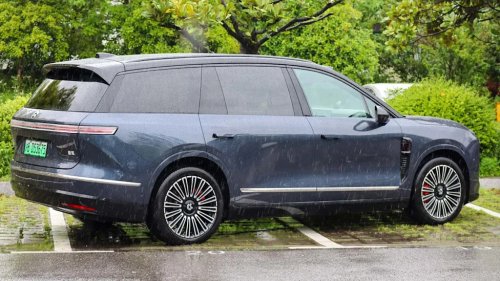
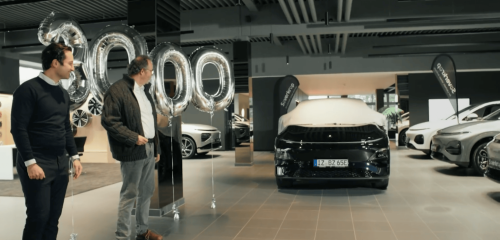
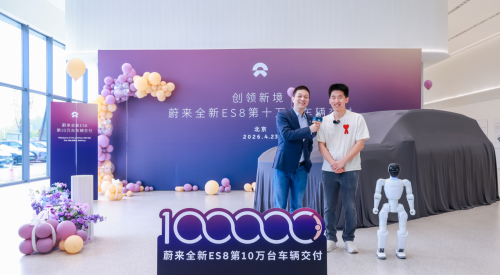
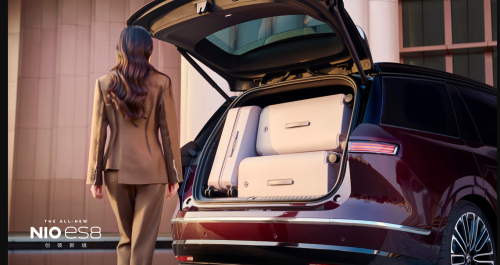
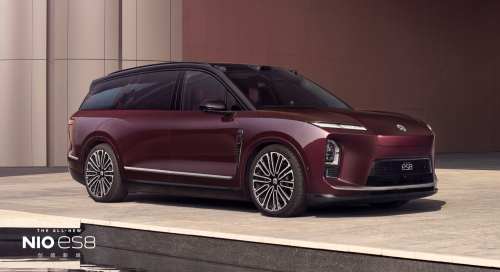
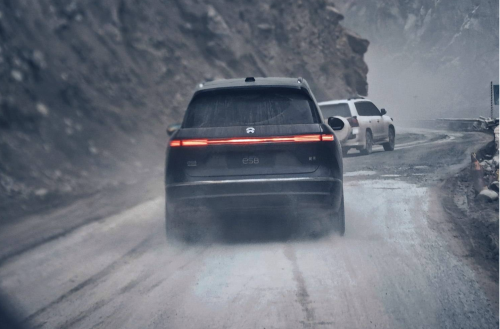
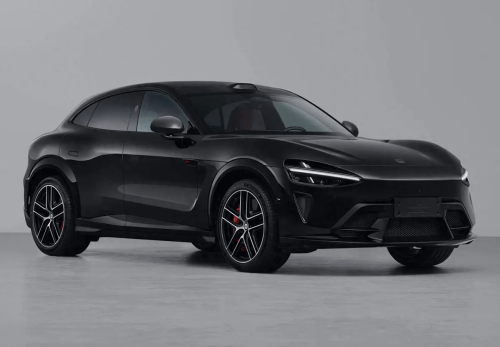
Gasgoo Munich- For years, the domestic premium market above 400,000 yuan was the fortress of traditional luxury internal combustion engine vehicles. Domestic brands faced steep barriers—brand awareness, market acceptance, product competitiveness—in their bid to scale up. Yet in recent years, the delivery and sales performance of these homegrown brands has shattered that old order.Take the all-new NIO ES8: it moved 100,000 units in just 215 days. On April 23, NIO founder, Chairman, and CEO William Li handed over the keys to the 100,000th owner at the NIO House in Beijing's Future Science City.Image source: NIO (same below)Product strength is the foundation, but it's not the whole storyThe 100,000th delivery signals that the all-new ES8 has entered a mature phase of mass production. As NIO's flagship large premium electric SUV, the model has kept a steady rhythm since mass deliveries began in September 2025, avoiding major production swings or sales gaps.Data shows the all-new ES8 set a new record for delivery speed and sales ramp-up in China's passenger vehicle market for premium models priced above 400,000 yuan, going from launch to 100,000 units faster than any predecessor.Retail performance paints a picture of stability. In March, the all-new ES8 recorded 16,255 retail sales, marking its fourth consecutive month ranking among the top sellers in both the large SUV segment and the 400,000 yuan-plus passenger vehicle market.Regionally, the all-new ES8 is making a particular splash in Beijing. The capital is a core battleground where competition for large SUVs is fierce and traditional luxury brands have a dense presence. Yet data shows that for every two large SUVs sold in Beijing, one is an all-new ES8. That market dominance has broken the long-standing hold of internal combustion engines in this segment.This surge is backed by a significant leap in product capability. Built on NIO's NT3.0 platform, the all-new ES8 measures 5,280 mm long, 2,010 mm wide, and 1,800 mm high, with a 3,130 mm wheelbase—181 mm longer and 60 mm more wheelbase than the previous generation. It offers six- and seven-seat layouts, with third-row legroom reaching 950 mm, complete with 130-degree recline and electric heating.For large SUVs, third-row practicality is a make-or-break factor for buyers. The improvements in the all-new ES8 directly address a pain point frequently cited by owners of the previous model.The powertrain features a full 900V high-voltage architecture and a standard 102 kWh battery, with dual motors delivering a combined output of 520 kW and peak torque of 700 N·m. CLTC range hits 635 km. The chassis employs front and rear five-link independent suspension, standard dual-chamber air suspension, and ZF CDC continuous variable damping. For charging, the vehicle supports both battery swapping and 4C ultra-fast charging.On paper, the all-new ES8 matches or exceeds mainstream benchmarks in its class across dimensions, power, safety, and intelligent features.The Market Shift Behind 100,000 SalesThe 400,000 yuan-plus market has long been dominated by models like the BMW X5 and Audi Q7. Chinese brands struggled to gain share or achieve scale at this price point. But the arrival of high-end domestic models like the AITO M9 and the all-new ES8 is reshaping the landscape.Data indicates a portion of all-new ES8 buyers are trading in vehicles from traditional luxury brands like BBA. This suggests that for purchases above 400,000 yuan, a significant number of consumers no longer equate luxury exclusively with German marques.To be sure, the all-new ES8 didn't drive this shift alone. The AITO M9, priced from 469,800 yuan, has surpassed 280,000 cumulative deliveries and long held the title of best-selling luxury SUV in the 500,000 yuan class. Meanwhile, models like the Zeekr 9X and Luxeed V9 are joining the fray.The 400,000 to 600,000 yuan price band—once a BBA stronghold—is being collectively infiltrated by domestic new energy vehicles. Yet the all-new ES8 distinguishes itself from competitors with NIO's proprietary battery swapping system and BaaS (Battery as a Service) separation model.The BaaS option cuts the purchase price by 70,000 to 128,000 yuan, bringing the all-new ES8's effective starting price down into the 300,000 yuan range and lowering the barrier to entry.NIO has deployed over 3,700 swapping stations nationwide, with plans to exceed 4,600 by the end of 2026. Swapping addresses the pain points of long charging times and holiday congestion for large SUVs, completing a swap in just three minutes. This "charge, swap, and upgrade" approach creates a competitive edge distinct from traditional charging.Still, the sustainability of this model bears watching. Construction and maintenance costs per station are significant, and with NIO adding roughly 1,000 stations annually, the financial pressure is undeniable. Chairman William Li has repeatedly stated that the swapping network is a long-term investment that is unlikely to break even in the short term.The significance of the all-new ES8's 100,000th delivery lies not in the success of a single model, but in the validation of a broader fact: Chinese brands have the capacity to build scale in the 400,000 yuan-plus market. The technological gap in electrification and intelligence is replacing traditional brand premium as the decisive factor for buyers.Yet the competition is far from over. BBA's electric offerings are accelerating to market, and the rivalry among domestic high-end models continues to heat up.



















 +76 others
![Gasgoo, NIO, [Gasgoo Express] NIO's William Li Discusses ES9 Design, Saying Originality is Difficult but Must Be Done; March Passenger Vehicle Exports Reach 695,000 Units](https://cdn.topcarnews.net/media/id/aHR0cHM6Ly9pbWFnZWNuLmdhc2dvby5j-b20vbW9ibG9nby9OZXdzL1VFZGl0b3Iv-aW1hZ2UvMjAyNTA2MTAvNjM4ODUxNzAw-MTkzODM1OTU2NTQxNDEzNi5qcGc/c06991c2ffe2e05fe81c97062ebd8cf3.jpg?t=20261004&post_id=14615)